Event Report
Vidhi Jakhmola
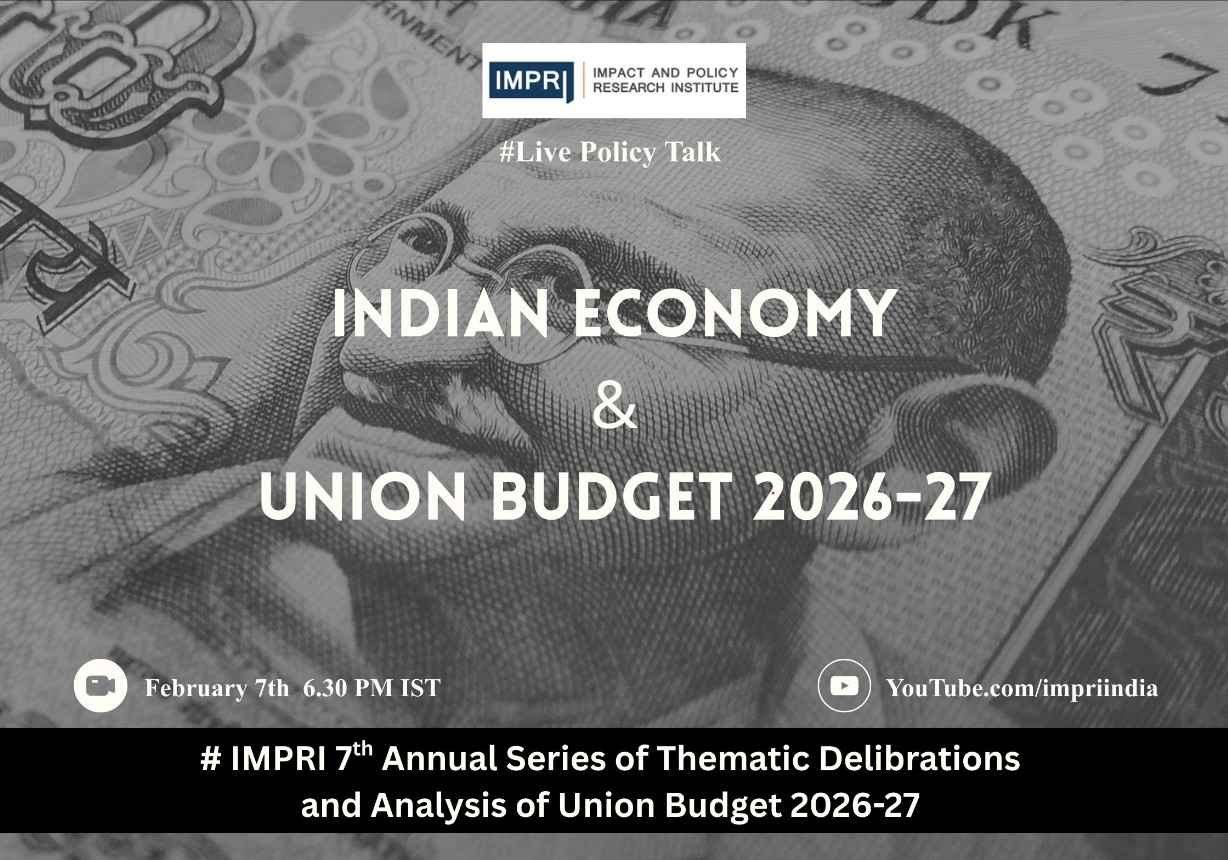
The IMPRI Center for the Study of Finance and Economics (CSFE) at the IMPRI Impact and Policy Research Institute, New Delhi, organized a thematic discussion on Indian Economy and Union Budget 2026-27 as a part of the 7th Annual Series of Thematic Deliberations and Analysis of Union Budget 2026-27 which was held on 7th February 2026.
The discussion commenced with Bhanvi, a researcher at IMPRI, who introduced the chair and moderator for the session, Prof Subhomoy Bhattacharjee, Consulting Editor at The Business Standard and professor at O.P Jindal Global University.
The distinguished panel of experts included
- Ms Yuvika Singhal, Co-founder and Economist, QuantEco Research, India
- Dr Rajeswari Sengupta, Associate Professor of Economics, Indira Gandhi Institute of Development Research, Mumbai
- Prof Pooja Misra, Professor, Economics & Area Chair – Economics & IB, Birla Institute of Management Technology (BIMTECH)
- Dr Sanjay Kathuria, Visiting Senior Fellow, Growth, Finance and Development vertical, Centre for Social and Economic Progress (CSEP)
- Mr T K Arun, Independent Journalist (TBC)
Opening remarks by Dr Rajeswari Sengupta: Backdrop and Implementation gaps
Dr Rajeshwari Sengupta began the discussion by providing the domestic macroeconomic backdrop against which the budget was presented. As of February 1, official data suggested that India’s economy was growing at around 7 per cent; however, she noted that this measurement remains debatable given persistent structural problems. She highlighted severe employment challenges: according to CMIE’s CPHS data, only 456 million people out of a total workforce of 1.11 billion constitute the labour force, while the global average labour force participation rate is 60-65 per cent, compared with India’s 41 per cent. ILO reports indicate graduate unemployment at nearly 30 per cent.
She argued that India is not undergoing an ideal process of structural transformation. Productivity remains low, manufacturing employs only about 25 per cent of workers and has not expanded sufficiently over recent decades, and nearly 85 per cent of workers remain in the informal sector. Services employ only 31 per cent of skilled labour, contributing to a continuing job crisis and the scarcity of formal employment.
Further Dr Sengupta highlighted the external macroeconomic backdrop, over the past year, she noted unprecedented economic uncertainty arising from tariff wars and declining investor confidence. Capital inflows have weakened: foreign portfolio investors withdrew roughly USD 20 billion net from Indian equity markets—the highest such withdrawal recorded. Between January 2024 and October 2025, India reportedly received close to zero net FDI per month, while gross FDI inflows have stagnated at around 1.7 per cent of GDP for the last four to five years. The rupee depreciated by over 5 per cent in 2025 against the US dollar.
Turning to the Union Budget, she described it as reflecting a broader doctrine or ideological blueprint for the country, with industrial policy as a central focus, an approach she viewed as problematic. She pointed to the 2024–25 employment-linked incentive scheme with an outlay of ₹2 lakh crore, which aimed to generate 4.1 crore jobs and became operational in August 2025, but for which there was no evidence yet of job creation.
Further Dr Sengupta mentioned the Budget 2021-22 Production-linked incentive scheme, out of which only about 12 per cent of the outlay had been disbursed. A skilling scheme launched in 2023–24 was also criticised, as 95 per cent of beneficiary records reportedly contained invalid or missing details, including bank account information, and some training centres were found to be fraudulent. She argued that several recent Budgets had announced ambitious schemes without producing favourable outcomes or desired performance.
Dr. Sengupta stressed that the government should create a broadly favourable environment for the private sector to operate in by removing regulatory bottlenecks rather than selectively favouring particular industries. She flagged weak state capacity and questioned whether the current capital-expenditure push is sustainable. Fiscal consolidation, she said, has been the slowest since the pandemic; the primary deficit remains high, gross borrowing has increased—leading to what she termed financial repression—and disinvestment targets have repeatedly been missed in previous Budgets.
Overall, she felt that allocations were inadequate to address the magnitude of the challenges. While structural reforms such as trade liberalisation and tax simplification were repeatedly referenced, she found the announcements piecemeal and noted the absence of a coherent strategy for growth and job creation, concluding that the Budget was “neither too good nor too bad.”
On demographics, she observed that India has roughly 20-25 years to maximise its demographic dividend, with about 10 million people entering the workforce annually. To sustain a “Viksit Bharat” trajectory, she argued that India would need about 8-9 per cent GDP growth, yet the service sector employs very few of these new entrants. Global Capability Centres employ nearly 80 per cent of India’s technology workforce but fewer than two million workers overall, despite services contributing about 60 per cent of GDP—illustrating the mismatch between output and employment, creating a “jobless growth”.
She warned that the consumption demand may already be slowing down. The government’s role, she emphasised, is to create an environment for private-sector jobs to be created, but this has not occurred for several years. She questioned why firms are not investing, why FDI has not materialised, and why the China+1 strategy has not benefited India as expected, suggesting flaws in the broader policy framework.
She advocated greater openness of the economy beyond bilateral trade deals, a level playing field for all firms, including lowering QCOs and lowering non-tariff barriers rather than preferential treatment for select multinational corporations, and improvements in ease of doing business, which she argued has worsened. According to her, schemes introduced over the past nine years have largely failed to deliver results, indicating that the government is losing valuable time while not addressing the current employment crisis.
On artificial intelligence, she suggested that while AI could create new low-skill jobs, it also risks displacing skilled workers, raising questions about where such workers will be absorbed. India, she warned, may be hit harder given its backlog of under-skilled labour and the prevalence of gig work. She described the situation as a “mild crisis” that has not yet been formally acknowledged.
She also commented on Centre–State fiscal dynamics, mentioning that the 16th Finance Commission’s hands are slightly “tied” because the government’s projected fiscal deficit is 3.5% of the GDP in the next 3-4 years. She further noted the growing use of cesses and surcharges, states’ bond-borrowing limits, and the fact that much of the capital-expenditure push is being channelled to states through interest-free loans amounting to 15 per cent. However, she argued that much of the capital-expenditure push is going to the states and many states, particularly in the eastern part of the country, lack the capacity to undertake large infrastructure projects, having not done so effectively for a decade.
Budget Continuity and Structural Constraints
Dr. Sanjay Kathuria, Visiting Senior Fellow at CSEP and Oxford alumnus, characterised the Budget as one with continuity but tempered with caution. He argued that the theme of employment remains inadequately addressed, even as the Budget seeks stability and predictability in a volatile global environment. He further highlighted the importance of macro credibility and fiscal discipline, noting that capital expenditure has reached its highest level in a decade at 4.4 per cent of GDP. However, he cautioned that the quality of execution matters as much as the size of public borrowing, particularly amid complex customs procedures and rising public debt.
He expressed skepticism about the proliferation of sector-specific schemes, such as those in textiles, including schemes like PM MITRA, New National Fibre Scheme, SAMARTH, etc., arguing that their impact is uncertain and past experience warrants caution. He warned that an excessive focus on monitoring select export segments risks diluting administrative attention, especially since deep structural problems cannot be resolved merely through schemes and policy announcements but require hard policy decisions to be made.
Dr. Kathuria observed that India’s recent export growth has been skewed toward capital-intensive sectors such as engineering goods, electronics, pharmaceuticals, and services, while textile exports have remained stuck at around USD 35 to 38 billion for the past five years. This pattern, he argued, is not accidental but reflects policy choices, particularly production-linked incentives, tariff protection for specific goods, and regulatory support. Labour-intensive sectors, by contrast, face higher costs and weaker policy backing.
He questioned why input costs remain a binding constraint for Indian manufacturing and why regulatory barriers persist. He noted that although 14 quality control orders (QCOs) were removed, more than 700 remain in place, functioning as non-tariff barriers that particularly hurt small firms. India continues to rely heavily on China for intermediate inputs, and while an EU trade agreement was welcomed, it does little to improve input-cost competitiveness. He also criticised what he termed an “anti-export bias,” whereby high domestic tariffs protect the home market and incentivise firms in automobiles, steel, consumer goods, and apparel to focus inward rather than export aggressively—despite India being a major automobile producer with limited export penetration.
On labour markets, he pointed out that 8–10 million people enter the workforce annually, while labour codes still contain threshold-based regulations that penalise scale and create uncertainty in implementation. Difficulties in accessing land and markets persist. He recalled that during the 2017 US–China trade war, India failed to capture significant export opportunities, arguing that resilience and streamlining alone are insufficient unless input costs, scale disincentives, and anti-export bias are tackled. Robust growth may continue, he said, but job creation remains inadequate; competitiveness must therefore be questioned—summarised in his “three Cs”: continuity, caution, but a big question mark on competitiveness.
He added that SEZs increasingly resemble domestic tariff area enclaves and reiterated that “growth without jobs” is India’s biggest challenge. When other Asian economies were growing rapidly, external demand played a crucial role. He further explored the possibility of how external demand can potentially add 1.5 percentage points to growth, but India remains constrained by domestic-demand limitations. He argued that India’s comparative advantage lies in labour-intensive manufacturing and that poverty lines remain extremely low, with upper-middle-class thresholds implying that more than half the economy would still fall below such levels in a “Viksit Bharat” scenario.
Dr. Kathuria stressed the need to correct incentive structures, improve health and education systems for sustainable and inclusive growth, and substantially raise female labour force participation, which remains far below that of other Asian economies. He highlighted our ability to really take advantage of the external market as one of India’s biggest underlying gaps. He also noted that while technological development is essential, it is currently concentrated in only a few sectors, posing another problem for the Indian economy.
He concluded by emphasising the importance of economic geography and industrial clustering, arguing that state-level initiatives aligned with inherent regional strengths are more likely to succeed than dispersed national schemes. Referring to the 16th Finance Commission, he noted that four to five states contribute more to GDP than they receive in transfers and argued for incentivising state participation, greater devolution to local bodies, and increased autonomy—steps he welcomed in the Budget, subject to faithful implementation.
Urban Economic Density, Infrastructure, and Productivity Challenges
Dr. Pooja Misra framed the “Viksit Bharat@2047” vision as one primarily focused on capacity-building and infrastructure-led development, particularly in urban areas making India an urban-led economy. She described a shift from basic mobility infrastructure toward infrastructure that supports economic density. The Budget’s ₹12.2 lakh crore allocation for government capital expenditure, along with its emphasis on crowding in private investment and promoting sectors such as semiconductors, biopharma, rare earths, and 7 high-speed rail corridors, was presented as laying building blocks essential for India to emerge as a long-term player.
She noted that the real GDP is expected to expand by 7.4%, inflation numbers are 2%, while acknowledging that these numbers might vary due to changes in CPI and GDP measurement methodologies, and suggested that India may be at a critical inflection point in its reform trajectory, while reiterating that execution remains the key. Cities, which account for roughly 60 per cent of GDP, must be reimagined as well-planned, productive growth hubs, supported by empowered municipal bodies capable of realising agglomeration economies while avoiding urban diseconomies and the middle-income trap.
She questioned the progress of the Urban Challenge Fund of ₹1 lakh crore, asking whether implementation had actually begun. She highlighted the importance of investments in urban transit systems and logistics to reduce pollution and raise productivity, and questioned the monitoring of programmes such as Smart Cities. Further, Dr Misra highlighted the need for greater alignment between Union and State Budgets, the ability to enable city-specific ecosystems that align with the local industrial clusters, workforce mobility across metropolitan regions, and strengthened municipal finances which have been incentivised in the budget 2026-27, and can currently raise municipal bonds of up to ₹1,000 crore, were also emphasized.
Prof. Misra described the proliferation of schemes as confusing and argued for building enabling ecosystems by expanding local governments’ borrowing capacity, improving management, and rationalising property taxes. Climate adaptation, low-carbon urban development, and integrated economic systems were also flagged as priorities. She further mentioned the allocation of 5000 crores made for the city’s economic region. She recommended that productivity per worker, which was highlighted in the Economic Survey, must become the anchor of growth, supported by deeper human capital, innovation, and financial development. She warned against the per capita income convergence slowing down and leading the country to fall into a middle-income trap.
She questioned the destination of rising private investment, noting that USD 29 billion had reportedly exited the economy, and argued that more capital should be deployed domestically. On female labour force participation, she asked what kinds of jobs women are entering, stressing the need for higher-paying, skill-intensive roles rather than care-economy to overcome the gap with developed economies. Echoing Dr. Kathuria, she questioned whether student employment actually utilises their skill emphasizing that the industries and academia need to work more closely. She underlined that productivity depends fundamentally on health and education spending, including in villages, where returns to such investment can be substantial.
She also referred to the “VB G RamG” scheme, noting that states in need would receive funds, and stressed that mayors must assume greater responsibility as states compete for resources and are encouraged to improve domestic investment and financial management.
Fiscal Credibility, Consolidation, and Long-Term Stability
Ms. Yuvika Singhal said the most important takeaway from the Budget was its long-term orientation and continuity rather than its focus on a single year. With the global trade order undergoing dramatic shifts, she argued against policy adventurism and urged adherence to fiscal fundamentals so as not to unsettle any of the economic stakeholders.
She focused on fiscal arithmetic and the consolidation path, noting the government’s stated aim to reduce the debt-to-GDP ratio to around 50 per cent by FY31—a decline of roughly 50 basis points from 56.1 to 55.6. While the stance was conservative, she suggested the government could have pursued a slightly more aggressive approach. She pointed to a fiscal deficit ratio of around 4.2 per cent and warned of looming revenue pressures from the 2028 Pay Commission, which could create financing needs of ₹2–2.5 trillion in FY28 and 29.
Ms. Singhal discussed tensions between fiscal consolidation and supporting growth, highlighting risks in bond markets stemming from rising State Development Loans and PSU borrowing—potentially pushing annual bond supply beyond ₹30-31 trillion. With demand from bond investors stagnant, the RBI had intervened the previous year through open market operations. She called for “out-of-the-box” thinking to restore balance, including clearer market communication, possible operation twists, and regulatory nudges to institutional investors such as banks and provident funds. She highlighted the lack of monetary transmission through the instance of RBI cutting by 125 basis points in the last fiscal year; its impact on the 10 year g-sec is negligible. Further, monetary transmission, she said, must be approached pragmatically.
She also highlighted the rising importance of the new-age services particularly in areas such as AI, global capability centres, and data centers, emerging as potential engines of future job creation. In December 2025, she noted that services exports exceeded merchandise exports at more than $40 billion, signalling a structural shift with potentially strong multiplier effects. Measures such as a 20-year tax holiday for GCCs, expanded FDI opportunities, and the role of high-powered committees in announcing reforms, such as the high-power committee to build service-sector capacity, were seen as supportive of the “Viksit Bharat” agenda, even though many reforms lie outside the Budget document itself. She concluded that stability is the “cheapest subsidy,” and credibility in fiscal arithmetic is paramount.
She added that the RBI’s monetary policy had undershot the government’s nominal GDP growth projections of 10 per cent. CPI inflation for 2026–27 had been revised upward by 10 basis points to 3.9 per cent, while WPI inflation stood at 3.5 per cent. Food inflation was expected to rebound, and commodity prices, including gold and silver, being the classic case, and even base metals have seen a rise. A new services-weighted CPI with a revised base had been introduced, but the NSO had not released back-series data for CPI, making comparisons difficult with the dramatic difference between the old and new series.
She assessed real GDP growth at close to 7 per cent, with possible upside due to India US trade deal. She further projected a 3.5 to 4% average for CPI and WPI, put together with a nominal GDP growth of 10–11 per cent, seeing no major red flags. The rupee was expected to depreciate by around 5–6 per cent, raising import costs, though she characterised inflation near 4 per cent as manageable. She stressed the compulsion to reduce the debt-to-GDP ratio amid fiscal profligacy elsewhere globally, rising state borrowing, revenue expenditures, and the prospective impact of the 8th Pay Commission, raising questions about individual states’ fiscal arithmetic positions.
Ms. Singhal also underscored the need for an industrial policy that generates employment while capitalising on the demographic dividend. Manufacturing and services, she argued, must advance together in a protectionist global environment. Given India’s English-speaking workforce, higher-education orientation, and rising aspirations, she saw opportunities in the creator economy and high-tech manufacturing, though she emphasised that declared intent in Budget documents must be followed by concrete reforms outside the Budget framework.
Conclusion
Prof. Bhattacharjee drew attention to specific Budget outcomes, noting that student apprenticeships in 2026–27 were expected to reach six lakh, with industry-specific skills targeted. The government also aims for 42 per cent of students to be enrolled in vocational courses, although currently such courses account for less than 12 per cent of total enrolment.
He highlighted a major missing link between training and productive employment. Referring to RBI projections, he warned that rising inflation could erode rural incomes and that sharp swings in price levels unseen in previous years pose risks amid global uncertainties. He also referenced the 16th Finance Commission’s role in determining Centre–State devolution, a 16 per cent “basket,” and the prospect of GST restructuring.
Acknowledgment: This Event Report is written by Vidhi Jakhmola, Research and Editorial Intern at IMPRI.
.