Tarushi Parihar
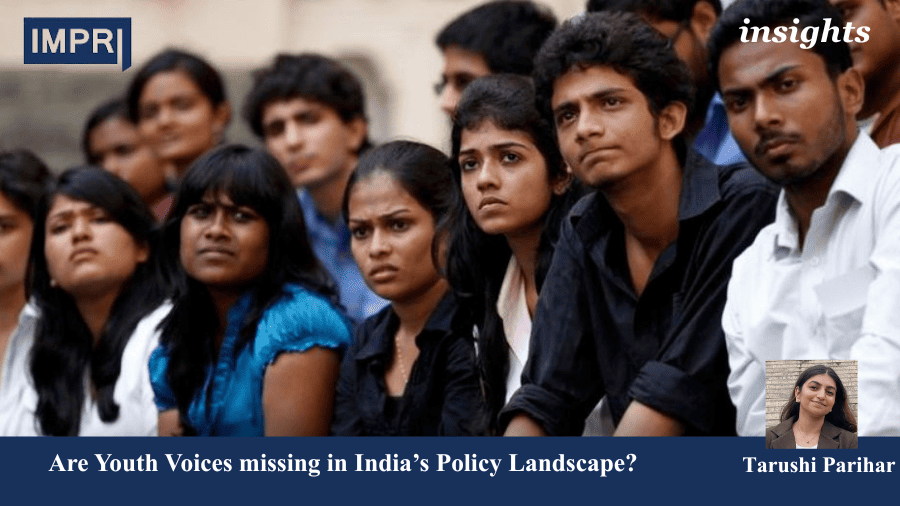
India is home to the world’s largest youth population, with over 350 million people aged between 15 and 29. India’s “demographic dividend” has often been celebrated as the driving force behind the nation’s rapid economic growth and social transformation. The potential of India’s youth is consistently highlighted by policymakers, economists, and educators, who look at this vast demography as a source of new ideas, relentless energy, and adaptability in a rapidly changing global environment. Young people are at the forefront of technological advancements, cultural shifts, and entrepreneurial ventures, making their perspectives invaluable to the country’s future endeavours.
Yet, as the country makes policies that will shape its future, a crucial question arises: is the voice of India’s youth truly being heard in the corridors of power? Despite their large population, young people often find themselves on the periphery of policy discussions, their perspectives overlooked or underrepresented in decision-making processes. While youth has been recognised as “the future of the nation,” this acknowledgment rarely translates into meaningful involvement in the development and implementation of policies that directly affect them. Instead, youth engagement in policymaking is often limited to tokenistic consultations or symbolic gestures, leaving the substantive aspects of governance in the hands of older generations.
India’s youth is not only a significant portion of the population but they also bring fresh perspectives, innovative ideas, and unique experiences to the policy table. Their involvement is critical for creating inclusive and forward-looking policies that address the realities of a rapidly changing world. Involving youth in policymaking would result in dynamic discussions that take into account grassroots realities, the challenges of a digital-first world, and the ambitions of a generation that is both globally connected and locally rooted.
For instance, youth-led approaches towards educational reform tend to prioritize digital literacy, creative problem-solving, and inclusivity, different from the traditional models that may not address present-day needs. In terms of employment, young people are uniquely positioned to push for new forms of work, such as gig economy opportunities, start-up ecosystems, and flexible working arrangements. When it comes to climate action, it is often the youth who are most vocal, mobilizing communities and leveraging technology for awareness and advocacy. In all these areas, youth participation becomes critical to ensure that policy decisions are not only responsive to contemporary challenges but also anticipate future trends.
Furthermore, meaningful youth participation can help bridge the gap between policy intent and implementation. Youth is often the first to experience the successes and shortcomings of government initiatives, making their feedback critical for effective governance. Their enthusiasm, creativity, and ability to adapt quickly can turn well-intentioned policies into impactful programs on the ground.
Despite this potential, actual youth representation in India’s formal policy spaces remains limited. A glance at the composition of Parliament and state assemblies reveals that only a small fraction of elected representatives is below the age of 35. This under-representation is even starker at higher levels of decision-making, where established political hierarchies and seniority-based systems prevail. Advisory bodies and think tanks, while sometimes including young professionals, are still largely dominated by senior experts and established voices.
Even in the youth wings of political parties, real decision-making power is often held by older leaders, with younger members relegated to organizational tasks or public outreach. In urban local bodies and panchayats, youth participation varies, and where it is present, it is frequently shaped by family ties or local dynamics rather than open opportunity. This lack of representation is not just a matter of age, it reflects deeper issues of access, privilege, and the persistence of traditional power structures.
However, outside formal institutions, Indian youth have demonstrated significant agency. The past decade has seen the rise of youth-led movements on various issues such as climate change, gender rights, mental health awareness, education reforms, and more. Social media and digital platforms have amplified the visibility of these voices, enabling them to organize, mobilize, and advocate for change at unprecedented speed. Social media hashtags, online petitions, and virtual campaigns have brought attention to issues that may otherwise have gone unnoticed. Through these tools, youth have contributed to shaping public discourse, generating momentum around critical concerns such as environmental degradation, gender-based violence, and access to quality education.
Despite their online influence, the translation of these movements into tangible policy outcomes has been slow or limited, pointing to a persistent gap between activism and formal policy influence. While public protests and digital campaigns can raise awareness and sometimes trigger government responses, they rarely lead to systematic, institutionalized changes unless there is sustained engagement with policymakers. This gap underscores the need for mechanisms that can convert youthful energy and advocacy into lasting policy reforms.
Several impediments hinder the meaningful participation of youth in policy making processes, making it difficult for even the most enthusiastic and capable young citizens to make their voices heard where it matters most. These obstacles are both structural and cultural, and often intersect in ways that reinforce each other, resulting in marginalization of youth in governance.
Structural barriers include age limits for contesting elections, the high cost of political participation, and lack of access to influential networks. It is challenging for the youth to navigate the complex bureaucracy or to compete in an environment where experience and seniority are given priority over fresh ideas. Cultural barriers persist as well. In many settings, youth are considered as inexperienced or lacking the gravitas required for policy deliberation. This perception often sidelines their contributions, regardless of the substance they can offer.
Lack of platforms is another fundamental issue. The formal opportunities for youth engagement in legislative and policy frameworks are limited. Youth parliaments and consultative forums exist but are often symbolic or limited in reach. In many cases, these platforms do not have the authority to make binding recommendations or are convened on an ad hoc basis, reducing their effectiveness. Without regular, structured opportunities for engagement and follow-up, the participation of young people remains superficial and unsustainable.
Recognizing the value and significance of youth involvement, in recent years we have seen the rise of new initiatives aimed at bridging this gap between young citizens and policymakers. Government institutions at the national and state levels are beginning to experiment with more participatory forms of governance, while the non-profit sector and international agencies are also launching programs to empower youth as policy advocates and change-makers. However, these developments, while promising, are still in their initial stages and require greater institutional support to reach their full potential.
The Government of India and state governments have launched youth-focused consultative forums and innovation challenges. Several NGOs and international organizations are working together to develop youth leadership in policy advocacy, offering training and networking opportunities. Digital platforms are lowering the barriers for youth to engage with policymakers and share their perspectives widely.
To further strengthen youth participation, a multi-pronged approach is necessary. It is not just enough to create opportunities for youth involvement, but also to ensure that these spaces must be meaningful, accessible, and influential. Policymakers, civil society leaders, and educational institutions should work collaboratively to remove barriers and foster an environment where young people can engage and become equal stakeholders in shaping the nation’s future. Key steps include:
- Institutionalizing youth representation by creating permanent youth advisory councils at both national and state levels with real influence over policy design and implementation;
- Establishing mentorship programs where young leaders are paired with experienced policymakers to build skills and networks
- Ensuring that youth inputs are visibly reflected in policy documents, with clear communication on how their contributions shaped outcomes
- Simplifying the process for young people to participate in consultations, especially for those from marginalized communities.
India stands at a crossroads where the energy, ideas, and aspirations of its youth can be harnessed to address complex development challenges. The journey of transforming from a developing to a developed nation will be shaped, in large part, by how effectively it leverages its youth population.
While their voices are increasingly being felt in public discourse, much remains to be done to integrate youth perspectives into the heart of policymaking. Failing to include youth in governance not only wastes potential but risks alienating a generation that is pivotal to the nation’s future. It is only through actively listening to and empowering young people that India can truly realize the promise of its demographic dividend, ensuring that growth is both inclusive and sustainable for generations to come.
About the Contributor: Tarushi Parihar is a Policy Researcher with keen interest in Public Policy. She is a fellow of the Public Policy Youth Fellowship.
Disclaimer: All views expressed in the article belong solely to the author and not necessarily to the organisation.
Read more at IMPRI:
Rethinking Government Support for Data Centre
External Partnerships vs. Internal Divisions: A Sovereignty Paradox
Acknowledgement: This article was posted by Anish Pujapanda, a Research and Editorial Intern at IMPRI.