Anil Trigunayat
In recent years several countries in the Middle East, especially from the GCC (Gulf Cooperation Council), have weaponised their foreign policies to achieve their perceived geopolitical objectives. It had become evident during and post-Arab Spring in the policies adopted by Saudi Arabia, the UAE, Qatar, Turkey, Egypt and Iran in their respective areas of interest.
While the Iran-Israel rivalry continues unabated, driven by Mutually Assured Destruction (MAD) syndrome, the Shia-Sunni divide between Riyadh and Tehran has been bridged to a great extent. Saudi Arabia is an acknowledged leader in the region and the Islamic world, being the biggest regional economy and power, accentuated by the King being the Custodian of the Two Holy Mosques.
Riyadh has not taken kindly to efforts by some of its brotherly neighbours when they tried to step out of the line or challenge its leadership or authority. The Qatar blockade of 2017 was one such example, but eventually it was Crown Prince Mohammed bin Salman who sorted the issues out. But the UAE was not very happy about this rapprochement and differed with Riyadh. Today Riyadh and Doha, both strong US allies, are working together, while Riyadh and Abu Dhabi are facing a stress in their relationship in the Afro-Arab geopolitical landscape.
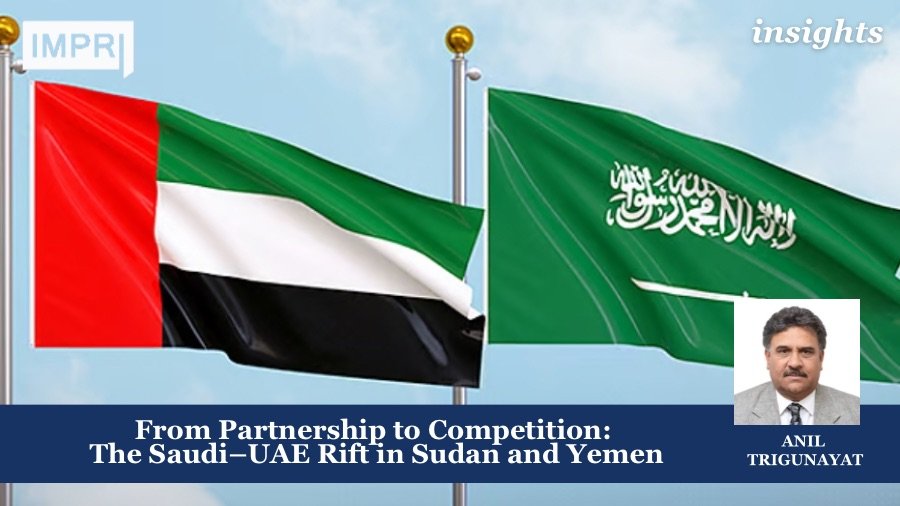
In recent years Sudan and Yemen have emerged as the two major contesting grounds where Saudi Arabia and the UAE are backing the opposing sides; thus, the tango of middle powers ensues with twists and turns. In Sudan, where the militancy and dangerous civil war continue to escalate, with untold miseries and humanitarian catastrophes, Riyadh supports the government forces (Sudanese Armed Forces) led by General Abdel Fattah al-Burhan, while the UAE backs the rebel Rapid Support Forces (RSF) of General Hamdan Dagalo, aka Hemedti.
Incidentally, the US, the UAE, Egypt and Saudi Arabia, while trying to also broker peace, had supported the ouster of Omar al-Bashir in 2019. But exactly like in Libya, currently divided into two rival camps controlling East and West, the Gulf and powers in West Asia, along with their respective western benefactors, chose opposing sides, thereby prolonging instability.
Sudan on the Red Sea is a strategic asset and a partner, and whoever controls it and has a friendlier government in charge will have a strategic advantage in the Horn of Africa and sub-Saharan Africa, huge natural resources and access to Nile waters. The UAE has officially denied any involvement with the RSF, but most observers and the US do not buy it.
Yemen is a classic case in this matrix. In 2015, a Saudi-led coalition of regional forces, including the UAE, fought against the Houthis and salvaged an internationally recognised government, but the war did not go according to plan. Houthis, supported by Iran in the regional power competition, held their ground and even attacked Saudi oil installations as well as drone and missile attacks in Abu Dhabi. They attacked Israel and the US shipping targets in the Red Sea, disrupting the maritime commercial shipping at will.
These have not been overcome or abated. However, some sort of an uneasy quiet has been secured with the Saudis and Americans cutting a deal with them as rapprochement between Riyadh and Tehran has continued to hold. In 2019, seeing that the objectives of the war were leading nowhere, the UAE took a pragmatic decision and decided to pull out while retaining its strategic stakes in southern Yemen, which has some of the most strategic ports.
Since then, the UAE has been working closely with and supporting the Southern Transitional Council (STC), led by its president, Aidarus al-Zubaidi, which fell out with the internationally recognised government supported by Saudi Arabia. In recent days STC forces embarked on a campaign and controlled large territories hitherto held by the government forces, bringing the conflict directly between their benefactors.
An embarrassed Saudi Arabia considered it a direct national security threat and accused the brotherly state of the UAE of complicity with STC, which Abu Dhabi denied. Riyadh wants the STC to leave the Al Mahara governorate in Yemen, on the border of Oman, and the large Hadramout governorate, which is on the border of Saudi Arabia juxtaposed to the Gulf of Aden.
The coalition forces even struck two ships in the port of Makalla, which were said to contain weapons and equipment for the STC sailing from Fujairah port. The UAE clarified that these were meant for their own counterterrorism forces and not for STC, which did not convince the Saudis or the Yemenis. The harshest verbal exchanges have taken place between the two brotherly countries.
The Saudi Arabian foreign ministry stated that the UAE’s actions in Yemen are “considered a threat to the Kingdom’s national security, and the security and stability of the Republic of Yemen and the region. The steps taken by the UAE are considered highly dangerous, inconsistent with the principles upon which the Coalition to Restore Legitimacy in Yemen was established, and do not serve the coalition’s purpose of achieving security and stability for Yemen”.
The Yemeni government, supported by Saudi Arabia, gave 24 hours for all UAE forces to leave the country and halt any military or financial support to any party within Yemen. They also rescinded the mutual defence agreement. The UAE expressed its disappointment over the Saudi stance. However, in a statement, the UAE Defence Ministry claimed that after a comprehensive assessment, it has voluntarily ended its counterterrorism mission in Yemen and decided to call back its forces.
For the time being the escalation ladder may have been averted, but this would not be the end of the geopolitical game, since both have often diverged on several geopolitical and geo-economic issues, from oil quotas to stances on various Afro-Arab issues and conflicts, including the Israel-Hamas war and the Abraham Accords and increasing proximity to Israel.
US Secretary of State Marco Rubio spoke to both his counterparts, urging for immediate de-escalation so as not to complicate regional security. Other Gulf countries like Oman, Kuwait and Bahrain expressed support for dialogue and peaceful resolution. Qatar mentioned that the security of Saudi Arabia and other Gulf countries “constitutes an inseparable part” of its own security.
The Chinese statement carried a more nuanced and pointed reference to maintaining the sovereignty and territorial integrity of Yemen. This could be seen as a reference to Israel’s recent recognition of Somaliland, which was equally strategic for regional middle powers, and the same could be applicable for South Yemen in case any country chose to follow the same path, which would complicate the matter even further.
Meanwhile, Riyadh maintains that Southern Yemen does have genuine and legitimate concerns, but these should be resolved through dialogue and diplomacy through a comprehensive political solution rather than military support to rebel factions. It is in the interest of regional security and stability that both brotherly countries, Saudi Arabia and the UAE, find a meeting ground in their external strategic interests so that the quest for a regional security architecture does not remain stillborn. India also has stakes in the stability of the region since both are its important strategic partners as well as critical for the India-Middle East-Europe Economic Corridor.
Anil Trigunayat, is a former Indian Ambassador to Jordan, Libya and Malta, and currently heads the West Asia Experts Group at Vivekananda International Foundation.
The article was first published in First Post as Brotherhood under strain: How Saudi-UAE power play in Sudan, Yemen deepens regional instability on January 3rd, 2026.
Disclaimer: All views expressed in the article belong solely to the author and not necessarily to the organisation.
Read more at IMPRI:
Reviving India-Canada Ties: The Moment for a Fresh Start and Renewed Strategy (2025)
Acknowledgment: This article was posted by Madhur Thapar, a visiting intern at IMPRI.