Omkar Shelar
Introduction
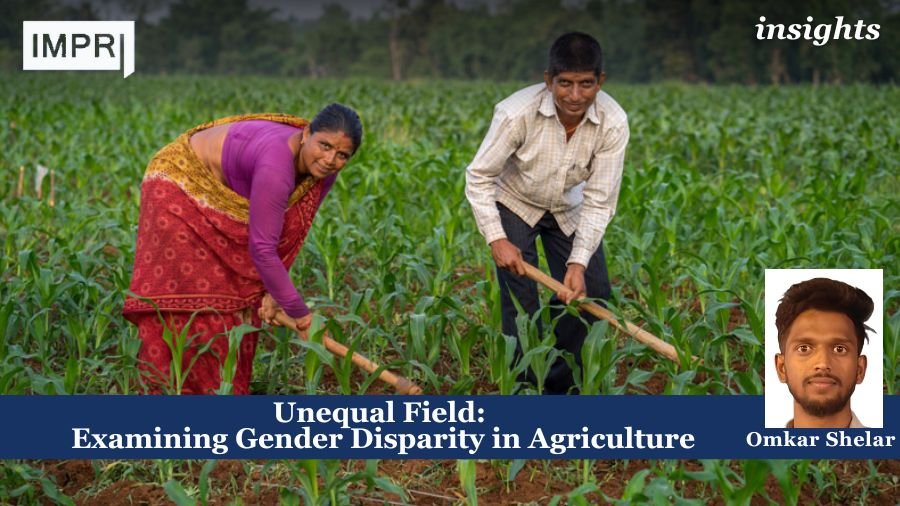
Agriculture plays a crucial role in economic growth especially in poor countries where rural people maintain their survival by farming. Economic development in rural areas is driven by agricultural progress. Although farmers are traditionally depicted as men, women act as major stakeholders in agriculture. Women perform major work as members of household farming and as workers who receive formal wages in agricultural employment. As per traditional data, women contribute 60-80% of agricultural labour in Africa and Asia, alongside 40% in Latin America (Michael P.Todaro, 2015). In India, women contribute over 63% of Indian agricultural workers and represent 75% of those employed full-time on Indian farms where they generate 60-80% of total food output (Vikas Meshram – Save Indian Farmers Foundation, 2024). The conventional belief in developmental policies that farms are operated by men has produced major gaps when addressing unique challenges experienced by women across development policies.
Findings and Analysis
The various studies reveal a complex landscape of gender inequality in agriculture, marked by the increasing participation of women coupled with persistent systemic barriers.
The Phenomenon of ‘Feminization of Agriculture’
Studies demonstrated that agricultural work is experiencing a significant process of feminization. This term refers to the increasing participation of women in agriculture and related fields, largely a consequence of rural-to-urban migration by men in search of higher incomes and better jobs (Ayush Mishra, 2022). The exodus of men from farms has forced women to take charge of both housework and farm responsibilities and labor tasks. The Economic Survey 2017-18 documented this development within the Indian population.
The study reveals that feminization fails to create empowerment even though more women participate in the workforce. The work tasks of women remain hidden in comparison to their lack of authority to make decisions. The feminization trend has boosted women’s work contributions in agriculture yet failed to modify the fundamental power dynamics and recognition patterns related to women in this domain (Vikas Meshram – Save Indian Farmers Foundation, 2024).
Key Disparities and Challenges
Gender inequality in agriculture manifests across numerous dimensions, creating significant challenges for women farmers and hindering their potential contributions.
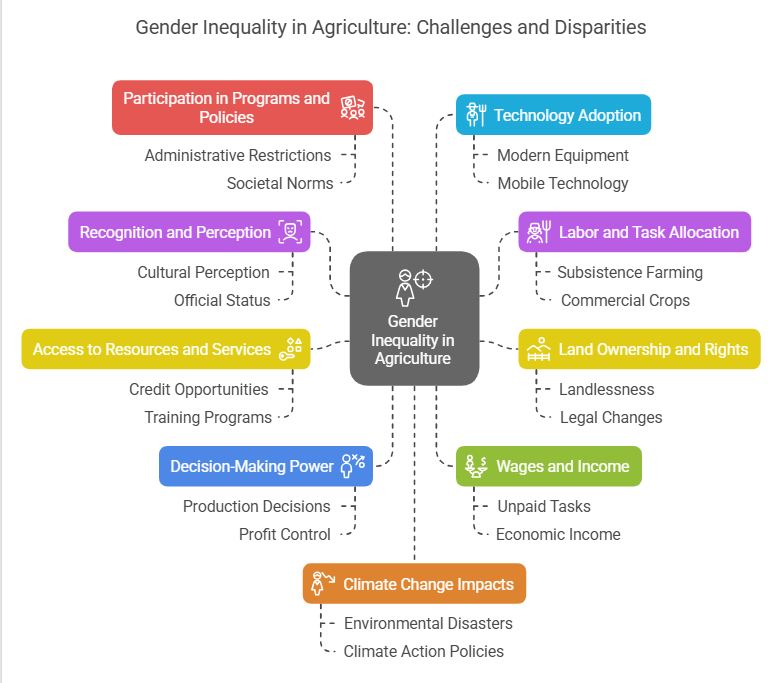
Source: Prepared by the author.
- Recognition and Perception: A fundamental equality issue exists because women working in farms often remain unrecognized when it comes to perceived femininity in the field. Popular cultural perception of farmers involves only male persons. In India’s agriculture sector, women comprise more than sixty per cent of the workforce, but government records show fewer than 3.6 crore women have official farmer status. Officially, they receive assignments as cultivators, whereas government agencies recognize only male landholders as farmers (Vikas Meshram – Save Indian Farmers Foundation, 2024).
- Labor and Task Allocation: Farming labor is mostly conducted by women throughout subsistence farming operations across Africa and across multiple farming tasks in India. Indian women contribute 60-75% of their labour to seedling nurseries, sowing, weeding and grain processing across the country, while almost all women participate in grain cutting, picking, cleaning and drying activities. Research indicates that women spend approximately 70% and almost 80% of their time performing agricultural work operations.
- Working Hours and Time Poverty: Women spend longer hours working each day since they undertake agricultural production alongside their daily tasks and unpaid service duties. Findings from research studies demonstrate that rural women experience time poverty by performing 15–16 hours of work each day. The excessive workload women handle according to social beliefs governs their availability for agricultural work tasks (Michael P.Todaro, 2015).
- Land Ownership and Rights: An estimated 12% or possibly as low as 2% of women farmers possess farmland although as per nationwide estimates, more than 60% of rural women actively work in agriculture. Official statistics from the agricultural census of 2015-16 demonstrate that women control 13.9% of all landholdings. Female domination persists due to the widespread problem of landlessness which affects many communities. Women who own land develop better negotiation power within the household to make important decisions. The legal changes have not led women to achieve equal secure land ownership compared to men. Women who gain land ownership receive less profitable agricultural land assignments which they cannot properly secure (Vikas Meshram – Save Indian Farmers Foundation, 2024).
- Decision-Making Power: Women who dedicate major efforts to agricultural tasks have minimal control over essential farm choices (Ayush Mishra, 2022). Decision-making authority covers all aspects regarding production, profits, and land use decisions. Research indicates that agricultural feminisation has not resulted in decision-making authority for women because most female workers stay in the labour category.
- Wages and Income: Studies identify numerous unpaid woman-performed tasks which statistics fail to recognize. Women earn less money than men for doing the same work. Women receive wages between 50 and 75 percent of male earnings and trail behind men by approximately 22 percent (Kaushik, 2024). Women lack sufficient pay to escape poverty because of their unequal compensation. The shortage of productive assets makes it hard for women to claim economic income and negotiate for increased wages.
- Technology Adoption: Women experience difficulties in obtaining and using suitable agricultural technological equipment. The deficiency of modern equipment, along with technology, leads to various perils that farm women experience on their farms. Access to mobile phone technology, which supports different agricultural operations, remains limited for women (Ayush Mishra, 2022).
Policy recommendations to overcome the challenges faced by women in agriculture
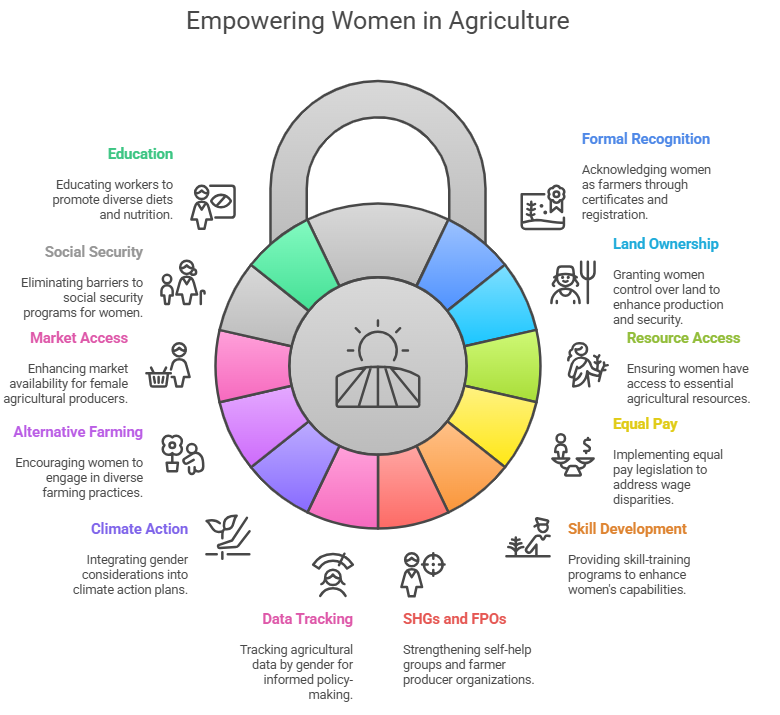
Source: Prepared by author
- The government should acknowledge women farm workers before distributing schemes such as crop insurance, together with crop loans, debt waiver programs, and additional support resources. Formal identification of women farmers requires issuing certificates that seal their status as farmers through the “woman farmer certificate” (Kaushik, 2024). To grant farm women formal farmer status, the concept of registration and certification should take place through the gram panchayats.
- There is a need to address the issue where women do not possess land titles and cannot guarantee land security. Granting women control over their land property and ownership leads directly to bigger agricultural production and reduced famine. Female subordination relies heavily on women being landless; thus, property ownership provides women with stronger voices and authority within their domestic sphere. A woman-centred asset-building strategy should become the focus since women constitute the biggest component of the agricultural sector yet possess minimal control over their farmland (Vikas Meshram – Save Indian Farmers Foundation, 2024).
- Women should gain better access to essential agricultural resources that include seeds and fertilisers, together with labour and credit, with extension services in addition to gaining access to agricultural technologies. The main obstacle to institutionalized credit access prevents women farmers from obtaining resources while requiring them to take loans from private moneylenders at high interest rates. Hence, there is a need for better access to credit facilities.
- The program should provide essential agricultural inputs together with training opportunities to female applicants. The allocation of land titles only to male household heads should be reformed because it harms women’s economic and income security during land distribution policies. Women-specific agricultural services, along with climate change adaptation tools, need to be made available through specially designed technologies (Kaushik, 2024).
- Workers must have access to equal pay legislation through careful checks at all organisational levels. Platform equality under the Equal Remuneration Act of 1976 failed in stopping ongoing unfair wage practices. Hence, there is a need for major reform in the Equal Remuneration Act of 1976 (Ayush Mishra, 2022).
- Several skill-training programs should be implemented to achieve skill development and capacity-building objectives. Agricultural programs should promote skilled and mechanized activities for women farmers because they decrease their workloads and provide time savings. Aggregated gender-sensitive agricultural practices should be documented to support future expansion (Nibedita Mishra, 2024).
- SHGS and FPOS must be strengthened as they give farmers empowerment through market connections and negotiating power, as well as collective authority and lowered trading expenses. The leadership of SHGS should direct them toward additional economic ventures (Satyabrata Mohanty, 2022).
- There is a need to educate and train women to participate in animal husbandry alongside poultry and floriculture farming, as they can increase their personal income through alternative farming and develop defence mechanisms against natural disasters, along with disease threats.
Conclusion
Women play an essential role in agriculture worldwide and throughout India because they complete numerous work activities, particularly in subsistence farming and food cultivation. Women farmers encounter critical obstacles because they have restricted land rights, minimal access to financial resources and agricultural products, as well as restricted services. Attaining progress requires society to acknowledge women farmers while securing their land rights and granting them access to resources, and adopting inclusive policies, followed by women’s empowerment using skills training, modern technology, and teamwork. Sustainable development goals depend on the complete elimination of agricultural inequalities to enhance farm productivity and reinforce food distribution networks (SDG-5).
References
- Ayush Mishra, A. (2022). Women in Agriculture : Status, Scope and Opportunities. . ResearchGate.
- Kaushik, S. (2024). Addressing Gender Inequality in Agriculture. AVIAN WE.
- Michael P.Todaro, S. (2015). Economic Development.
- Nibedita Mishra, C. (2024). Gender Dynamics and Economic Impacts: The Feminization of Indian Agriculture. Asian Journal of Agriculture Extension, Economics, 8.
- Satyabrata Mohanty, V. (2022). Evidence Based Gender Inequality in Agriculture and Food Systems in India. National Institute of Agriculture Extension Management (MANAGE).
- Vikas Meshram – Save Indian Farmers Foundation, I. (2024). Save Indian Farmers. From Save Indian Farmers: https://www.saveindianfarmers.org/the-plight-of-women-farmers-in-india/
About the Contributor: Omkar Shelar is a postgraduate student of Public Policy and Governance at the Tata Institute of Social Sciences, Hyderabad with a keen interest in Data driven policy making and analysis.
Disclaimer: All views expressed in the article belong solely to the author and not necessarily to the organisation.
Read more at IMPRI:
Losing Ground to the Sun: How Solar Expansion is Displacing Rain-fed Farming in Karnataka
Invisible Citizens: Why Hyderabad’s Skilled Migrants are Economic Drivers but Policy Outsiders
Acknowledgment: This article was posted by Bhaktiba Jadeja, visiting researcher and assistant editor at IMPRI.