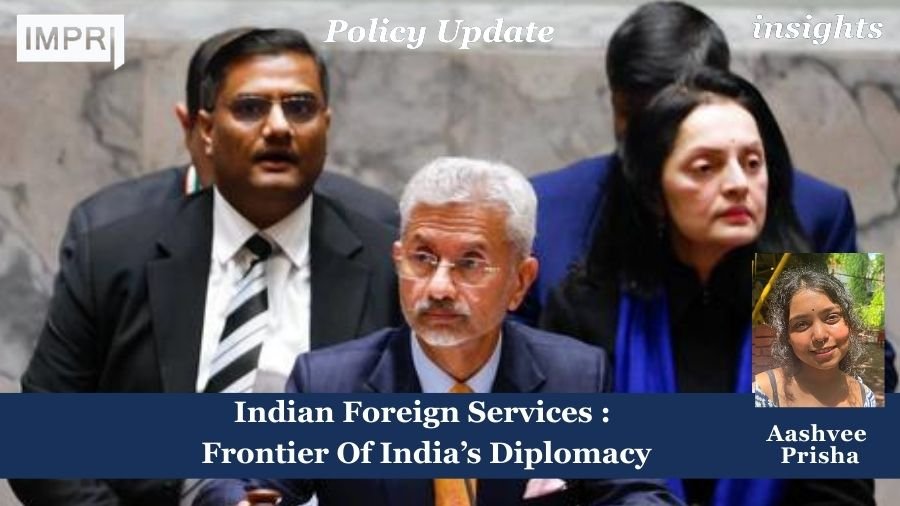
Policy Update
Aashvee Prisha
Background
The Indian Foreign Services(IFS) is India’s premier diplomatic corps, responsible for projecting the nation’s interests abroad. Recruited through the Union Public Service Commissions and managed by the Ministry of Personnel (DoPT), IFS officers form the core of the Ministry of External Affairs (MEA) and India’s missions overseas. According to the MEA, an IFS officer’s job is to “protect India’s interests… on a wide variety of issues,” including bilateral political and economic cooperation, trade and investment promotion, cultural interaction, press/media liaison and multilateral diplomacy. In practice , this means IFS diplomats represent India at embassies and UN missions, protect national interests, negotiate agreements, and provide consular support to citizens abroad. By conveying ground realities to New Delhi and negotiating with foreign governments, the IFS helps shape India’s foreign policy – translating national goals into on-the-ground outcomes.
Expanding Global Presence and Partnerships
In recent years India has actively expanded its diplomatic footprint. New embassies and consulates have opened across Africa, Latin America, the Caribbean, the Pacific Islands and Europe. Official figures (March 2023) cite roughly about 193 missions worldwide. Still, analyses note that India’s network remains thin relative to its global role, for example, the Lowy Institute ranks India 11th in total diplomatic posts with no presence in over 50 countries. A 2024 Stimson Centre report warns this gap affects India’s ability to influence countries and restrict its strategic space to secure interest abroad.
IFS officers are increasingly focused on economic and development diplomacy. About 18 million Indian expatriates and $111 billion in remittances, the mission must address migrant labour issues, visas, and worker exploitation. An expanded IFS presence could improve response to such crises and also better promote trade, investment and soft power.
India has also asserted itself in multilateral and regional forums. The MEA’s 2024 annual report highlights New Delhi’s proactive initiatives and leadership in plurilateral and multilateral platforms, including active participation in the UN, G20, G7, QUAD, SCO and BRICS. In August 2024, India hosted the Voice of the Global South Summit, convening 20+ heads of state representatives from over 120 countries on issues of trade, climate and inclusive growth. Such events underscore India’s diplomatic focus on Global South leadership and UN reforms, consistent with its policy of strategic autonomy and championing more equitable world orders.
Strategic partnerships have also deepened. India’s multi aligned, foreign policy manages ties with major powers and neighbours. Key bilateral ties with the United States, Russia, Japan, Australia and others, now include institutionalised 2+2 foreign ministerial dialogues, high-tech collaborations and defence agreements. For example, India and the United Arab Emirates have moved to bolster ties across defence, space, and energy and even signed a letter of intent on a formal strategic defence partnership. India is also part of the I2U2 grouping with the US, Israel, UAE, focusing on joint technology and economic projects and has promoted regional initiatives like India-Middle East- Europe economic corridor. Through the QUAD, IFS diplomats coordinate with the US, Japan and Australia on Indo Pacific security. Meanwhile, India maintains historic ties with Russia, and is pursuing new markets. In sum, IFS officers are at the forefront of forging India’s global strategic partnerships, even as world events reshape foreign policy priorities.
Emerging Challenges and Capacity Constraints
Despite its growing global role, the IFS faces severe institutional challenges. Chronic understaffing is widely acknowledged, a 2023 Parliamentary committee report bluntly noted that India’s diplomatic service is perhaps the most short staff among comparable countries with only 1000 diplomats actually in services, India fields about the same number of officers, New Zealand or Singapore. At this level, even routine tasks are stretched thin, diplomats report skipping UN meetings from lack of personnel, and foreign governments sometimes note incomplete briefings from Indian missions.
Budgetary constraints compound staffing shortages. The MEA’s entire budget was just USD 2.5 billion for 2024–25 – a tiny fraction (~0.4%) of national spending. This limited funding throttles many needs: one analysis notes it hobbles “diplomatic training programs” and severely limits India’s ability to fund strategic foreign aid or new missions . In contrast, China’s Ministry of Foreign Affairs budget is several times larger. Insufficient training funds have long been highlighted: even after selection, IFS officers receive very little formal preparation beyond their initial induction . As a result, mid-career training and language refreshers are under-resourced, leaving many diplomats ill-equipped for evolving challenges.
Organizational culture and career structure also pose issues. The IFS follows a traditional “pyramid” hierarchy: officers rise from Third Secretary through Counsellor to Ambassador, but promotions can stagnate. Former diplomats describe the civil service as a “cylindrical structure” with few senior slots, meaning many officers spend years at the same rank . This, along with a rising average age of diplomats , shortens officers’ active tenure abroad.
Moreover, the selection process (academic civil-services exam) produces generalists; critics argue it fails to attract or develop the specialized skillsets needed today. A U.S. study in 2009 warned that India’s diplomatic service was “small, hobbled by its selection process and inadequate midcareer training,” and urged reforms to expand and diversify the cadre . Many of these concerns persist.
Other challenges include adapting to modern technology and issues. Diplomatic work now demands expertise in AI, cybersecurity, climate change and emerging technologies – areas not traditionally covered by IFS training. Some experts suggest leveraging outside talent to bridge gaps. One former diplomat recommends outsourcing analytic tasks to think tanks or consultants when the MEA’s own manpower is insufficient. There are also demographic and welfare issues: historical surveys note low rates of field experience and demands for clearer family and gender policies. Notably, women now constitute about 37.8% of the IFS cadre reflecting gradual diversification, but questions remain about promotion and retention. Finally, IFS must navigate an increasingly polarised world without compromising India’s strategic autonomy, a delicate diplomatic tightrope that strains any service.
Reforming the IFS: Efforts and Proposals
Recognising these constraints, policymakers have begun to reform the IFS. The MEA has sought to increase recruitment. In early 2025 it reported raising its UPSC indent to 110 officer slots and tapping hundreds of additional positions through the staff selection commissions. While only 30-50 entrants join the IFS each year, these steps aim to reverse decades of minimal hiring. Some measures of lateral entry have also been experimented with: specialists from other government services or academia have been recruited into MEA posts.
Structural recommendations have come from various quarters. A 2022 parliamentary review suggested doubling the MEA budget to at least 1% of the union budget. It also urged a larger annual intake of diplomats. Experts advocate creating alternate entry streams for mid- career professionals. Diversifying expertise is widely seen as vital: one commentary argues that India must bring in officers with backgrounds in law, business and public outreach to handle trade negotiations and technology policy, rather than relying solely on generalist career diplomats.
Correspondingly, training is being revamped: the Sushma Swaraj Institute of Foreign Service now runs extensive simulations courses and domain-specific modules during both induction and mid career programs. However, many analysts say that training funding itself must rise, with only a few million dollars spent on all diplomatic training annually, the pipeline remains constrained.
Other reforms touch on organization and culture. Recommendations include streamlining the promotion hierarchy to allow upward mobility and creating special fast-track tracks for high-performing officers. Coordination with India’s vibrant think-tank community has been proposed to supplement MEA analysis. Some former officials suggest publicly recruiting experts (e.g. for climate negotiations or cybersecurity) and pairing them with IFS mentors on the job . Finally, a new emphasis on “whole-of-government” diplomacy is emerging: for instance, India’s Commerce and Technology ministries now routinely involve IFS officers in trade and digital partnerships, and joint diplomatic teams are deployed on major economic summits. These changes reflect an understanding that 21st-century diplomacy is cross-cutting and requires both stronger diplomatic capacity and better integration of specialized knowledge.
Way-forward
Recent global developments have tested and reshaped India’s diplomacy. The Russia-Ukraine war and the Israel-Gaza conflict illustrate the challenges of India’s multi-alignment. IFS officers have had to articulate India’s nuanced positions while arranging evacuations and aid. Similarly, India’s chairing of G20 and initiatives like the Global South Summit highlight how the IFS is leveraging multilateral platforms to advance issues like vaccine equity, climate finance and development. The ongoing competition with China from trade to security has also made it imperative for India to boost its diplomatic engagement including through bolstered personnel and new missions
On the technology front, India has joined or launched new dialogues that demand tech- savvy diplomacy. Climate change has become a key diplomatic agenda, India has led initiatives like the International Solar Alliance and Champions climate justice at UN fora. These fields require officers with economy and technical fluency. In response, the MEA has begun recruiting more economists and technologists and organizing climate focused training for diplomats.
Domestically,the IFS is also adjusting to new governance priorities. Initiatives like Vasudhaiva Kutumbaka and Atmanirbhar Bharat are influencing diplomatic messaging. The PM’s vision of India as a “Viswaguru” or global teacher adds cultural and educational diplomacy to the portfolio. Meanwhile, the rapid rise of social media and digital communication has transformed public diplomacy, Indian missions now engage foreign publics online, requiring new skill sets.
India’s ambition to be a leading global power hinges in large part on the strength of its diplomacy. As experts emphasise, having a “well staffed, and adequately trained foreign service” is essential to that vision. This means sustained reforms, expanding the cadre, investing in training and technology,diversifying expertise. It also means greater institutional support, for example, implementing the parliamentary recommendation to substantially increase the MEA budget so that diplomats are not hamstrung by resource constraints.
References
Bajpai, K. (2019). India’s foreign policy capacity. India Review, 18(3), 251–275. https://doi.org/10.1080/25741292.2019.1615164
Lowy Institute. (2023). Global diplomacy index 2023. https://www.lowyinstitute.org
Ministry of External Affairs. (2023). Indian Foreign Service. Government of India. https://www.mea.gov.in/indian-foreign-service.htm
Ministry of External Affairs. (2024). Annual report 2023–24. Government of India. https://www.mea.gov.in/annual-reports.htm
Ministry of External Affairs. (2024, August 14). Voice of Global South Summit 2024. Government of India. https://www.mea.gov.in
Ministry of Personnel, Public Grievances and Pensions. (2023). Civil services examination and service allocation framework. Government of India. https://dopt.gov.in
Stimson Center. (2024). From ambition to action: India’s quest for global diplomatic influence. https://www.stimson.org
Sushma Swaraj Institute of Foreign Service. (2023). Training and capacity building of Indian diplomats. https://www.ssiifs.mea.gov.in
About the Author
Aashvee Prisha is a Research Intern at IMPRI. She is currently pursuing her undergraduate degree in Political Science, with a deep interest in international relations, gender diplomacy, and digital storytelling.
Acknowledgement
The author sincerely thanks Ms. Aasthaba Jadeja for her invaluable mentorship and guidance during the development of this article. Special thanks are also extended to her fellow IMPRI interns for their thoughtful inputs, support, and camaraderie throughout the process.
Disclaimer: All views expressed in the article belong solely to the author and not necessarily to the organisation.
Read more at IMPRI:
National Food Security Act(NFSA), 2013
India–Sri Lanka: Shared Ramayana Heritage