Event Report
Mahalakshmi Gururaj
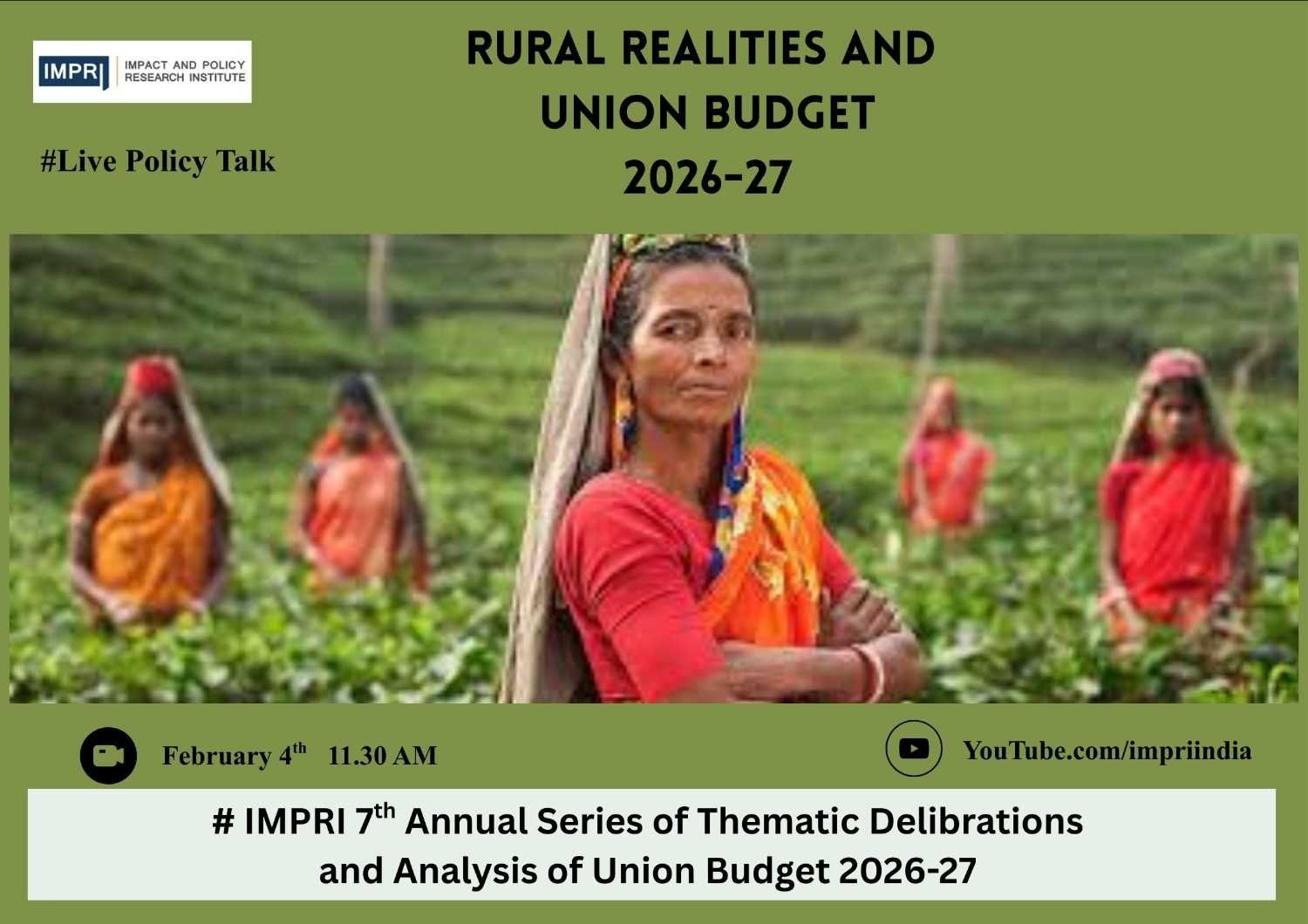
The IMPRI Center for Habitat, Urban and Regional Studies (CHURS) at the IMPRI Impact and Policy Research Institute, New Delhi, hosted an interactive panel discussion on “Rural Realities and Union Budget 2026-27” on February 4, 2026 (Wednesday) at 11:30 a.m. IST under IMPRI’s 7th Annual Series of Thematic Deliberations and Analysis of Union Budget 2026-27, as part of IMPRI, bringing together leading economists and policy researchers to assess how the latest Budget addresses rural livelihoods, agriculture, gender equity and employment generation.
The session commenced with Sana Ansari, Researcher at IMPRI, who welcomed the speakers and participants and outlined the objective of the discussion. She then introduced the chair and moderator for the session, Dr J. Dennis Rajakumar, Director, Economic and Political Weekly Research Foundation and Visiting Senior Fellow at IMPRI.
The distinguished panel of speakers included:
- Prof Ranjit Singh Ghuman, Professor of Eminence, Punjab School of Economics.
- Prof C.S.C. Sekhar, Professor and Head, Institute of Economic Growth, Former Honorary Director, AERC, University of Delhi, India.
- Prof Gummadi Sridevi, Professor, School of Economics, University of Hyderabad.
- Dr Jawed Alam Khan, Executive Director, Institute of Policy Studies and Advocacy, New Delhi
- Dr A. Amarendra Reddy, Joint Director, Policy Support Research, ICAR-National Institute of Biotic Stress Management (ICAR-NIBSM).
- Ms Purvi Thangaraj, Researcher and Consultant, Indian Council for Research on International Economic Relations.
Opening Remarks and Contextual Framework
The session was contextualised against the backdrop of a slowing agricultural growth rate, persistent rural distress, and heightened expectations from the Union Budget, particularly given that nearly two-thirds of India’s population continues to reside in rural areas and close to half of the workforce remains dependent on agriculture and allied activities for livelihood. While headline GDP growth projections for India remain relatively robust, panellists repeatedly underlined that macroeconomic growth has not translated into commensurate improvements in rural incomes, employment quality, or agrarian resilience. The discussion thus sought to interrogate whether the Union Budget 2026–27 meaningfully addressed these structural challenges or merely continued incremental policy adjustments.
In his opening remarks, Dr Dennis Rajakumar situated the discussion within a longer trajectory of IMPRI’s engagement with budgetary analysis, noting that similar concerns had been raised in previous years with limited evidence of substantive course correction. He highlighted two critical trends framing the current debate: first, the apparent decline in rural unemployment rates as reported by the Periodic Labour Force Survey (PLFS), and second, the restructuring of the rural employment guarantee framework through the introduction of a new scheme alongside the existing MGNREGA architecture.
While headline unemployment indicators suggest improvement, he cautioned that these figures mask deeper issues of underemployment, low-quality work, and stagnant real wages, particularly in agriculture. He also pointed to data gaps, especially the absence of recent agricultural census figures, which constrain evidence-based policymaking.
Specifically, he pointed out that the PLFS annual report of up to 2023-24 states that the unemployment rate between the age group of 15 to 59 years seems to have dropped t0 3.5% from 6.5% since the 2017-18 report. While the decline in the quarterly report is noticeable, the magnitude has varied according to him. The April-June unemployment rate stood at 4.8%, which dropped to 4.4% in the succeeding quarter.
The second trend that Dr Rajakumar identifies is how the output measured is not differentiated between the urban and rural sectors. This leads to inaccurately estimating the output of rural areas through sectoral performance, which has a larger proportionate share originating from the rural sector. The sector, on average, during the last five years, has reported a growth rate of 4.4,% which is slightly less compared to the overall GDP growth rate. However, one could still note an upward tendency in the last one to two years with respect to the growth of the agriculture sector.
In focusing on the budget allocation for the year 2025-26, Dr Rajakumar identified two major ministries that have an enormous influence on rural livelihood. One being the Ministry of Rural Development and the other, the Ministry of Agriculture and Farmers’ Welfare. The former is allocated 1.63 lakh crores rupees or 1.6 trillion rupees, while the latter is allocated 2.73 lakh crore rupees under the 2026-27 budget. All in all, the combined budget allocation stands at 4.36 lakh crore rupees, which he considers is quite substantial considering fertiliser subsidy stands at 1.7 crores and food subsidy stands at 2.2 crores.
46% of employment in India is dependent on the rural sector. The budget, in line with the economic survey, has taken cognisance of some of the recent developments taking place in technology and how agriculture can benefit from it. Dr Rajakumar also appreciated the integration of IoT (Internet of Things) into rural development, benefitting farmers in understanding soil health, detecting diseases, and optimising the use of water as well as pesticides. Hence, such AI-powered platforms prove to be beneficial as agriculture integrates with allied activities.
The budget has also acknowledged the importance of cash crops like coconut, sandalwood, cashew, and cocoa for the coastal regions, as well as dry fruits like walnuts and almonds for hilly regions, undoubtedly improving agricultural livelihood.
Dr Rajakumar took cognisance of the revamping of the rural employment guarantee scheme in the place of MGNREGA, with centre-state participation being redefined. Now named Viksit Bharat- Guarantee for Rozgar and Ajeevika Mission (Gramin) or VB-G RAM G Act 2025, will receive about 95,000 crores and the NREGA scheme will receive about 30,000 crores, adding to 1.25 lakh crore rupees. With this, Dr Rajakumar posed a question to the panel that asked whether it is appropriate to move to this new employment guaranteed scheme under which there will be a lot more burden on the state, as well as it’s going to be a target-based one.
What impact will it have on the rural sector? Whether the mandated 125 days and the number of job card holders, which in the year 2-25-26 seem to have come down by about 38 lakhs. So, what is going to be the scenario to envisage, so far as the rural employment guarantee scheme is concerned with.
Investments in the Cooperative Sector
Prof C.S.C. Sekhar’s intervention focused on the rural economy in its entirety, emphasising the need to examine budgetary allocations not only in absolute terms but also in relation to past expenditures and outcomes. He argued that the Union Budget 2026–27 remained largely conservative, reflecting limited ambition in terms of public investment. According to him, the Centre appeared increasingly inclined to shift responsibility onto states, particularly in sectors such as rural employment and agricultural development.
Prof Sekhar expressed concern that allocations for research, education, and extension services in agriculture remained inadequate, with a persistent bias towards production-oriented technological development rather than dissemination and adoption. He stressed that weak extension systems severely limit the effectiveness of even well-designed schemes, as awareness and uptake among rural households remain low.
A significant portion of Prof Sekhar’s remarks was devoted to the cooperative sector, which he identified as one of the few areas receiving tangible policy support in the current budget. He noted several positive measures, including tax exemptions on dividends distributed to cooperative members, extended tax benefits for national cooperative federations, and grants to strengthen cooperative exports. While welcoming these steps, he cautioned that they amounted largely to incremental extensions of existing initiatives rather than transformative interventions.
Under the Animal Husbandry Ministry, there are a few initiatives that have been announced, which include credit link subsidies for beneficiaries and beneficiary farmers. And loan link capital subsidies for investment. This is another important thing in animal hospitalisation and livestock farmer-producer organisations. While previously India has been focusing mostly on the crop sector, FPOS, more emphasis has been placed on livestock as well. Fishing has been made duty-free; the exclusive economic zone fishing has been made duty-free, and that’s good development for fisheries, and 500 reservoirs are sought to be developed in the future.
In his assessment, the budget lacked a coherent strategy to address the growing feminisation of agriculture, despite substantial increases in female workforce participation in rural areas. He underscored that millions of women engaged as unpaid family workers contribute significantly to household income, yet remain largely invisible in policy design.
There is a three-year tax exemption on dividend income from investments made by the National Cooperative Federation. That is, if a national cooperative federation makes any investment and whatever dividend they earn on that, and if they distribute that dividend income among their members, then that is made tax-free; that’s a three-year tax exemption. 450 crore rupees in aid have been provided to National Cooperative Exports Limited. This is sort of a public cooperative export entity, and the grant is mainly to make it competitive with a very large private exporter.
Disparities between Rural and Urban India
Prof R.S. Guman provided a broader structural critique of the budgetary framework, characterising the Union Budget as an annual ritual necessitated by constitutional requirements rather than a genuine instrument of developmental transformation. He traced a long-term decline in public investment in agriculture, accompanied by a growing reliance on private participation. According to him, this shift has weakened the state’s capacity to address agrarian distress and rural inequality. Prof Guman was particularly critical of the reconfiguration of the rural employment guarantee from a rights-based framework to a demand-driven, target-oriented model, arguing that such changes undermine the scheme’s original intent as a social safety net.
Drawing on macroeconomic data, Prof Guman highlighted stark disparities between rural and urban India. He noted that agriculture now contributes a relatively small share to GDP while absorbing a disproportionate share of the workforce, resulting in extremely low per capita incomes for agricultural households. Marginal and small farmers, who constitute the vast majority of landholders, remain trapped in low-income equilibria, necessitating diversification into non-farm activities. However, he argued that the budget failed to provide sufficient impetus for rural non-farm sector development, despite its critical role in absorbing surplus labour and generating sustainable livelihoods.
Given the fact that agriculture is still the backbone of the rural economy, and a large majority of the Indian population still lives in villages and agriculture continues to be their mainstay of employment, income, and livelihood.
As per 2011 population census nearly 69% of India’s population lived in rural area and certainly it is not going to fall below 63% even in the new census and by 2050 it is India is still going to be estimates are like this that India is still going to have more than 50% of its population in the rural areas in the Back backdrop of this it needs to be acknowledged that besides providing direct employment to 46% of the workforce agriculture provides indirect employment which often is ignored while talking of the role of agriculture and that is indirect employment is uh very sizable number of workers engaged in industries and activities using agriculture produce as input.
Agriculture is also providing much-needed food security. Higher income in the foreign sector and rural economy would have a higher multipolar effect on the overall growth rate of the economy. Evidently, there are strong backward and forward linkages between the farm and non-farm sectors, which are visible from the input-output tables.
Now, ironically, a very high proportion of the agricultural workforce is either underemployed or disguisedly unemployed, and agriculture is pushing them out. However, the system and the policymakers have no mechanism to address this challenge. The problem gets worse as the non-foreign sector is not capable of generating enough employment for the surplus workforce in agriculture, mainly because of jobless growth.
Consequently, agriculture and the rural economy are lagging behind the non-farm sectors in terms of per-worker productivity and per capita income. Share of agriculture in the GDP of India is merely 50%, resulting in 46% of the agriculture workforce sharing 15% of GDP. The average per capita annual income of agriculture households in 2023-24 is estimated at around 34, 940 rupees.
This necessitates supplementation of farm income with non-farm income, which is possible only by occupational diversification in the agricultural as well as rural economy. Nearly 2/3rd of the total workers of India are employed in the rural economy, but they share a much lower share in the country’s GDP. Rural area in general is lagging behind the urban areas in terms of social and physical infrastructure.
The literacy rate in the rural population is far below that of the urban population. Clearly, the budgetary allocation to agriculture since 1991 has been oscillating between 2 to 4%, and that of rural development between 3 to 6%. Along with non-farm employment, the development of agriculture and the rural economy is equally essential for India’s navigation to a developed economy. The government would have to give high priority to agriculture and the rural economy, both in terms of budget allocation and gross capital formation.
Gendered Lens of Rural Union Budget
Prof Gummadi Sridevi‘s intervention foregrounded gender as a central analytical lens for evaluating the Union Budget. She acknowledged certain positive measures, such as increased allocations for women-centric programmes, support for self-help groups under the National Rural Livelihoods Mission, and expanded housing provisions under the Pradhan Mantri Awas Yojana. However, she questioned whether these initiatives translated into substantive empowerment for women, particularly in terms of control over resources and decision-making within households. Ownership of assets, she argued, does not automatically confer agency, especially in deeply patriarchal rural contexts.
Prof Gummadi Sridevi also emphasised the heterogeneity of women as a social category, cautioning against homogenised policy approaches. Drawing on NFHS and employment data, she highlighted persistent nutritional deficits and higher rates of anaemia among women from Scheduled Caste and Scheduled Tribe households. Despite repeated budgetary assurances, these groups continue to experience exclusion from education, healthcare, and quality employment. She raised critical questions about whether rising female labour force participation in agriculture reflects genuine opportunity or distress-driven compulsion, especially in the absence of alternative employment options.
Within the new VB-G RAM G budget allocation, most hold the consensus that 95,000 crores is not at all sufficient income because they require at least 2.3 lakh crores. She questions if it is able to create employment for women at the minimum wage for females because on an average day, pay for women comes to rupees 355. Without addressing the question of gender discrimination in the labour market and gender justice in terms of equity and equality, with the rise in allocation to certain programs, she asks whether it actually leads to the empowerment of women.
Women-centric programs on paper will exist, but what is the status of the implementation, or what is the status of the implementation towards the various special programs mentioned to the social groups, is another question. Her larger question is what about the unpaid female labour and in intersectionality, scheduled caste and scheduled tribe women under the gender responsive budgeting. India is not practicing gender responsive budget in its substantive sense in terms of providing empowerment or providing greater wages or access to the labour market to women.
Subsidies vs Agricultural Research and Development
Ms Purvi Thangaraj offered a macro-fiscal assessment of the budget’s rural and agrarian components. She noted that while the aggregate allocation to agriculture and rural development appeared substantial at first glance, its composition was heavily skewed towards subsidies, particularly food and fertiliser. While such subsidies provide short-term relief and input cost support, she argued that they do little to address structural constraints or enhance long-term growth. Investments in infrastructure, markets, and value chains, she maintained, are essential for inclusive rural development but remain insufficient.
Ms Thangaraj also reflected on the revamped employment guarantee framework, noting that reduced person-days under MGNREGA may signal declining dependence but could also reflect unmet demand or administrative constraints. The effectiveness of the new scheme, she argued, would depend on implementation, state capacity, and the adequacy of funding relative to statutory commitments.
Agricultural R&D is one of the four most important drivers of economic growth through its contribution to total factor productivity. India’s R&D expenditure as a percentage of GDP is less than 0.5 per cent, and this has been the trend for quite some time. The budget allocation for R&D has declined this year, which has significant long-term consequences for yields, resilience, technological progress, and climate-resilient agriculture.
In his book Supporting Indian Farms the Smart Way, Prof Ashok Gulati estimates the marginal returns on investments and subsidies, noting that for every million rupees spent on fertiliser subsidies, only 26 people are lifted out of poverty. In contrast, if the same amount is invested in agricultural R&D and extension, 328 people are lifted out of poverty. The returns in terms of GDP growth are also significantly higher for agricultural R&D compared to subsidies.
However, year after year, the budget continues to prioritise subsidies rather than direct income transfers or productive investments that could benefit farmers more effectively. Greater investment in R&D and extension could also help reduce the negative consequences of excessive fertiliser use, such as declining soil organic carbon, groundwater contamination, and increased nitrous oxide emissions. In the context of climate change, these environmental challenges are intensifying. Although farmers may not be the primary contributors to these broader environmental issues, they are often the first to experience their adverse effects.
Fiscal Federalism and Social Justice
Dr Jawed Alam Khan approached the budget from the perspective of fiscal federalism and social justice. He drew attention to declining allocations for key ministries and the weakening of institutions tasked with rural development and poverty alleviation. In particular, he underscored the implications of unchanged devolution shares under the Finance Commission, coupled with the exclusion of certain cesses and surcharges from the divisible pool. These fiscal arrangements, he argued, constrain states’ ability to meet their obligations under centrally sponsored schemes, especially in poorer and backward regions.
Dr Khan expressed concern that the redesigned rural employment guarantee scheme, with its altered cost-sharing formula, would disproportionately burden states with limited fiscal capacity. Drawing on his work with marginalised communities, he noted that Dalits and Adivasis continue to face barriers in accessing benefits under flagship programmes, including land purchase schemes and employment guarantees. He argued that without a conscious focus on equity and inclusion, budgetary allocations risk reinforcing existing hierarchies rather than alleviating them.
Dr Jawed Alam Khan focused on allocations to the Ministry of Rural Development and the Ministry of Panchayati Raj, situating his critique within the changing fund-sharing mechanism between the Centre and states. He observed that allocations for rural development have largely remained stagnant, with no meaningful increase even after accounting for inflation. This, he argued, weakens the capacity of flagship programmes to meet their stated objectives.
He expressed concern over the redesigned rural employment framework, noting that while the number of guaranteed workdays has increased on paper, funding levels remain inadequate. Persistent issues such as delayed wage payments, low wage rates, and implementation bottlenecks continue to undermine the effectiveness of employment programmes. He also pointed out that self-employment initiatives have received insufficient attention compared to wage employment schemes.
Dr Khan highlighted the neglect of rural infrastructure, particularly the lack of emphasis on rural roads and connectivity, which play a crucial role in economic mobility and income generation. He also criticised the low allocations for social assistance schemes supporting the elderly, widows, and persons with disabilities, describing the amounts as inconsistent with the government’s long-term development ambitions. Centralisation through Direct Benefit Transfers, he cautioned, further curtails the role of local governments in development planning.
Bridging Agricultural Research and Allocation
Dr A. Amarendra’s contribution focused on agriculture, allied sectors, and research and development. He observed that the Union Budget 2026–27 largely continued earlier policy trajectories, including missions related to pulses, oilseeds, millets, and livestock. While acknowledging the articulation of intent, he noted that actual financial allocations remained modest, raising questions about implementation capacity. Dr Amarendra stressed the importance of strengthening linkages between laboratory research and field-level application, arguing that underinvestment in social science research and extension could undermine long-term productivity gains.
He highlighted targeted support for high-value crops such as coconut, cocoa, and cashew, describing these allocations as more symbolic than transformative given their limited scale. In contrast, he noted continuity in the government’s focus on oilseeds, pulses, and millets, which occupy a larger share of cultivated area and have received sustained attention over successive budgets.
A key concern raised by Dr Reddy was the decline in funding for agricultural research and education. He warned that reduced investment in research, extension, and field-level dissemination weakens the link between technological innovation and farm-level adoption. Reflecting on changes over time, he noted that traditional extension systems—once characterised by regular field visits and close farmer engagement—have been eroded, raising doubts about whether digital platforms alone can bridge this gap.
He also pointed to mismatches between policy intent and budgetary support, particularly in areas such as organic farming and soil health. While official records suggest saturation of schemes like Soil Health Cards, he argued that implementation quality remains poor due to weak verification and reimbursement mechanisms. This, he suggested, reflects a broader issue where programme success is measured through targets rather than actual outcomes.
The discussion also featured an engaged question-and-answer session, during which panellists debated the interpretation of rising female participation in agriculture. Prof Sekhar referred to recent empirical research suggesting that women entering agriculture are not necessarily less productive than their counterparts in other sectors, challenging assumptions that feminisation reflects declining sectoral productivity. This exchange highlighted the need for nuanced analysis grounded in robust data.
Conclusion
In his concluding observations, Dr Dennis Raj Kumar synthesised the key themes emerging from the discussion. He identified a recurring gap between budgetary promises and realised outcomes, pointing to consistent shortfalls between budget estimates and actual expenditures. He also underscored the gradual erosion of institutional capacity resulting from constrained allocations to education, research, and rural governance structures. A major unresolved challenge, he noted, lies in financing expanded welfare commitments within a fiscal framework that places increasing responsibility on states without commensurate resource transfers.
The session concluded with a consensus that while the Union Budget 2026–27 contains several positive intentions, it falls short of addressing the structural roots of rural distress. Panellists collectively emphasised the need for higher public investment, stronger institutions, inclusive programme design, and a renewed commitment to agriculture and the rural economy as central pillars of India’s development trajectory. The deliberations reaffirmed IMPRI’s role as a platform for critical, evidence-based engagement with public policy and underscored the importance of sustained dialogue on rural realities in the context of national budgeting.
Acknowledgment: This Event Report is written by Mahalakshmi Gururaj, Research and Editorial Intern at IMPRI.