Sonam Chosdon
The two giant powers of Asia, India and China, have a long standing contentious relations. Both countries are attempting to balance the status quo through negotiations and bilateral talks. Given the history of frequent military stand-offs, the undemarcated frontier creates a constant fear and suspicion, fueling mutual distrust which is mirrored in the evolution of Line of Actual Control (LAC). China administer approximately 38,000 sq. km of Aksai Chin.
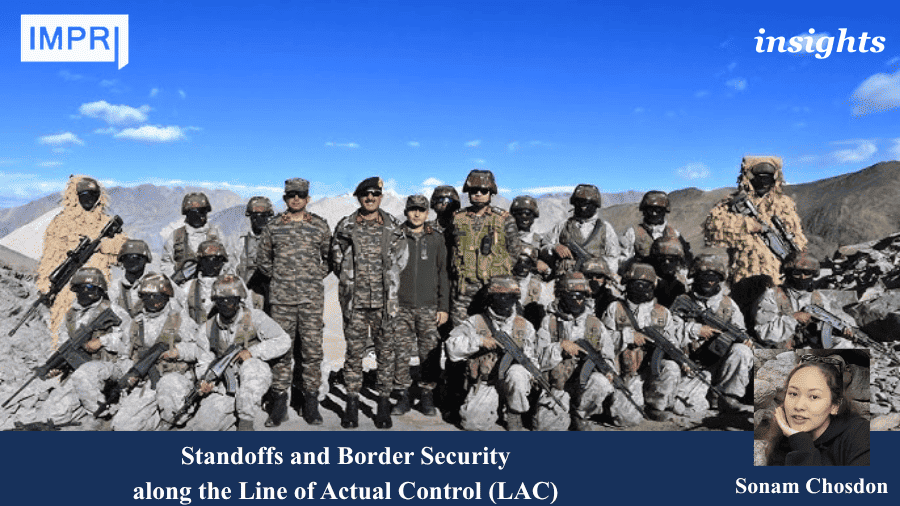
It ambitious move of incrementally capturing territories and asserting claims over parts of India makes it difficult to resolve the underlying questions of border security. In the aftermath of Galwan Valley clash in eastern Ladakh, tensions along the LAC have remained cautiously persistent, particularly for India. The frosty bilateral talks between the two sides have often ended in a stalemate.
Political strategies and Economic Implications
Both countries have engaged in multiple skirmishes along the borders since 1960s. Military troops deployment and infrastructure development have increased rapidly on both sides. India and China have been pursuing strategic autonomy and maintaining their regional ambitions, thereby increasing the risk of potential rivalry. New Delhi’s vision of Viksit Bharat by 2047 entails robust border surveillance through cutting edge technologies, integrating Border Surveillance System (BOSS), an advanced satellite-based monitoring system that enables motion detection and imaging, as well as Unmanned Aerial Vehicles (UAVs) and others to counter threats in high altitude regions of Aksai Chin where traditional patrolling methods proves inadequate due harsh climatic condition.
Beijing’s revisionist policy aim to realize its ‘China Dream’ by asserting its claim and engaging in grey-zone tactics to alter the status quo along its de facto border. Its strategy of ‘salami-slicing’ poses considerable challenge to India. The People’s Liberation Army (PLA) is expanding its influence across both land and maritime through Belt and Road Initiative (BRI). In response, India’s Border Roads Organisation (BRO) is investing significantly in development of roads and highways projects.
Both the parties have strengthened their forward bases and increased troop deployments. New Delhi have adopted a strategy of multi-alignment to counter threat posed by China. Strengthening partnerships with regional countries and engagement with forums such as QUAD and ASEAN is expected leverage India’s political and economic security. Meanwhile, China’s growing influence in South Asia and beyond necessitates greater trilateral and multilateral engagement among countries to counterbalance its strategic reach.
The prevailing power asymmetry ratio remains tilted against India, with economic pressure comparatively higher on its side. To mitigate this problem, the ‘China Plus One’ strategy has been adopted to diversify the supply chain. India’s Production Linked Incentives (PLI) initiative aims to boost domestic manufacturing and attract global investment covering numerous sectors. By banning over 200 Chinese applications, India has also signalled its intend to become more self-reliant and reduce dependence on China. Furthermore, India’s increasing focus on Indo-Pacific and participation in regional coalition seeks to enhance maritime security and monitor Beijing’s activities in the South China Sea.
Conclusion
The India-China border dispute requires balanced engagement through open dialogue and sustained diplomacy. Both India and China should strive to build mutual trust and foster collaborative engagement. The two countries must create space for cooperation and confidence-building measures. The rivalry have profound implication on both the nations and its effects are felt across the global arena. Military standoffs and competition for power and control have triggered repeated confrontations along the border. It is therefore necessary to institutionalise sustainable bilateral talks and pursue meaningful reconciliation.
Reference:
Joshi, M. (2025, November). Diplomacy, sanctions, and military might: India’s post-Galwan strategies in managing China (ORF Occasional Paper No. 508). https://www.orfonline.org/research/diplomacy-sanctions-and-military-might-india-s-post-galwan-strategies-in-managing-china
Sagar, P. R. (2024, June 13). Four years since Galwan Valley clash: How new manoeuvres deepen India–China border logjam. India Today. https://www.indiatoday.in/india-today-insight/story/four-years-since-galwan-valley-clash-how-new-manoeuvres-deepen-india-china-border-logjam-2552774-2024-06-13
Ramachandran, S. (2024, October 22). India and China reach breakthrough agreement on border tensions. The Diplomat. https://thediplomat.com/2024/10/india-and-china-reach-breakthrough-agreement-on-border-tensions/
Banerjee, M. (2022, June 26). Sino-Indian border dispute: A brief introduction. E-International Relations. https://www.e-ir.info/2022/06/26/sino-indian-border-dispute-a-brief-introduction/
US Institute of Peace. (2020). China-India Relations. In China’s Influence on Conflict Dynamics in South Asia (pp. 32–38). US Institute of Peace. http://www.jstor.org/stable/resrep27534.8
Jahan, R., & Shahwaiz, M. (2025). Border disputes between India and China: Causes, geopolitical analysis, and consequences. International Journal of Creative Research Thoughts (IJCRT), 13(12). https://www.ijcrt.org/papers/IJCRT2512056.pdf
Umarkar, A. V. (2025, May). India–China border disputes: Political, strategic, and economic implications. International Journal of Scientific Development and Research (IJSDR), 10(5). https://ijsdr.org/papers/IJSDR2505341.pdf
Rahul G Gangaraj, Malka Biddappa. Securing Borders, Enabling Progress – Leveraging Technology for India’s Border Surveillance and Developmental Vision 2047. J. Contemp. Politics 2025;4(2):79–86. https://doi.org/10.53989/jcp.v4i2.25.29
Sitaraman, S. (2020). ARE INDIA AND CHINA DESTINED FOR WAR?: THREE FUTURE SCENARIOS. In A. L. Vuving (Ed.), HINDSIGHT, INSIGHT, FORESIGHT: Thinking About Security in the Indo-Pacific (pp. 283–306). Daniel K. Inouye Asia-Pacific Center for Security Studies. http://www.jstor.org/stable/resrep26667.24
About the Contributor: Sonam Chosdon is an alumnus of Lady Shri Ram College of Women. She is a fellow of the Diplomacy, Foreign Policy and Geopolitics Youth Fellowship
Disclaimer: All views expressed in the article belong solely to the author and not necessarily to the organisation.
Read more at IMPRI:
COP30 and the Missing Voice of Children
Rebuilding Industrial Depth: India’s Strategy in a China-Centric Manufacturing Order
Acknowledgement: This article was posted by Anish Pujapanda, a Research and Editorial Intern at IMPRI.