Policy Update
Madhur Thapar
Introduction
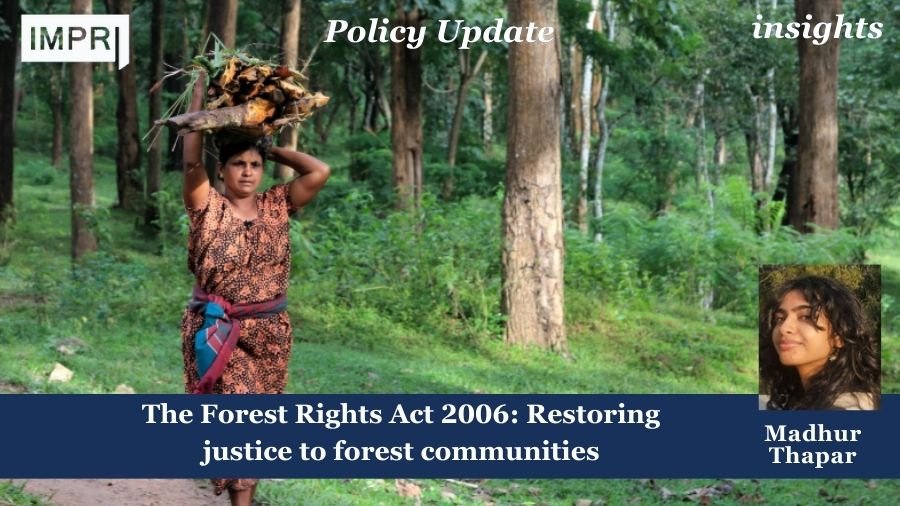
The relationship between India’s tribal communities and forest stretches back millennia, it is characterised by a delicate balance where indigenous populations lived off forest resources but protected the ecosystem at the same time. Over time, colonial forest policies came up and dispossessed these communities of their traditional rights, transforming the forest from a community resource to a state controlled commercial asset. The Schedule tribes and other traditional forest dwellers (recognition of forest rights) act 2006, commonly known as the Forest Ò7rights act represents a landmark legislative attempt to reform this historical injustice by recognising and investing Forest rights in communities who have been residing in forests for generations.

Historical background and context
The colonial administration introduced a series of Indian Forest Acts in 1865, 1894, and 1927 that fundamentally altered forest governance in India. These laws curtailed centuries old customary-use rights of local communities, prioritising commercial extraction and agricultural expansion over subsistence needs. The focus shifted from forests as sustenance bases for local populations to state resources serving commercial interests and development agendas.
Post-independence India largely continued these policies until much later. The marginalisation of forest-dwelling communities became a critical governance failure, contributing to social unrest and even fuelling Naxalite movements in states like Chhattisgarh, Odisha, and Jharkhand. This situation demanded a comprehensive legal framework that could address both conservation objectives and the livelihood security of forest-dependent populations.
Key features and dimensions of the act
The forest rights act includes several important dimensions that differentiate it from previous such legislations. The act recognises forest dwelling scheduled tribes (FDST) and other traditional forest dwellers (OTFD) who have been residing in forest for generations. It establishes both the rights and responsibilities of these communities for sustainable forest use, biodiversity, conservation, and maintaining ecological balance.
The legislation identifies four different types of rights that can be claimed-
Title rights grant FDST and OTFD ownership to land they have been farming, subject to a maximum of 4 hectares. Ownership applies only to land actually under cultivation, with no provision for new land grants.
Use rights extend to various forest resources, including the extraction of minor forest produce, access to grazing areas, and recognition of pastoralist routes. These rights acknowledge the diverse ways communities interact with forest ecosystems.
Relief and Development Rights provide for rehabilitation in cases of illegal eviction or forced displacement, along with access to basic amenities, subject to forest protection restrictions.
Forest management rights is one of the most significant dimension, it grants communities, the authority to protect, regenerate, conserve or manage community forest resources they have traditionally protected for sustainable use.
Eligibility and Procedure
Members of Scheduled Tribes who live mainly in forests and rely on them for their basic livelihood needs qualify under the Act. Any member or community that has lived mostly in forests for at least three generations (75 years) before December 13, 2005, for legitimate livelihood needs can also claim their rights.
The process focuses on the Gram Sabha, which is the full village assembly. The Gram Sabha starts the proceedings to determine Individual Forest Rights (IFR) or Community Forest Rights (CFR). Its recommendations are reviewed by committees at the taluka and district levels. Each committee includes three government officers and three elected representatives. The district-level committee makes the final decisions, and there are options for appeals at both taluka and district levels. Notably, any recognized land cannot be sold or transferred, which protects against speculation.
Importance and Potential Impact
The Forest Rights Act is very important for several reasons. It seeks to address historical injustices faced by forest-dwelling communities since the colonial period, when their claims to resources were regularly denied. By expanding the protections in the Fifth and Sixth Schedules of the Constitution for indigenous communities, the Act offers a stronger legal foundation for tribal rights.
This law has great potential to democratize forest governance. It recognizes community forest resource rights over about 85.6 million acres, empowering over 200 million forest dwellers in more than 170,000 villages across India. This marks a significant change from centralized, bureaucratic forest management to community-based conservation models that combine traditional knowledge with livelihood security.
The Act also addresses an underlying issue related to Naxalite movements by including and recognizing marginalized tribal populations. When communities have legitimate control over their traditional resources, it lessens their alienation and creates stakeholders in peaceful governance.
Implications for Conservation and Development
The Forest Rights Act challenges the usual divide between conservation and development. It shows that forest-dwelling communities have maintained forest ecosystems for generations using traditional practices. The legislation suggests a joined approach where conservation and livelihood security support each other instead of opposing.
The Act’s implementation greatly affects wildlife conservation strategies in India. While there were initial worries about conflicts between habitat protection and community rights, experience shows that communities with secure rights can become strong partners in conservation efforts. Combining traditional knowledge about forest ecosystems with modern conservation science can lead to better results.
For broader development policy, the Act serves as an example of rights-based approaches that value human dignity and self-determination over paternalistic welfare programs. It views communities as decision-makers instead of passive recipients, changing power dynamics in resource governance.
Critical Challenges in Implementation
Despite its positive goals, the Forest Rights Act has encountered serious challenges in implementation that have limited its potential impact.
- Administrative Apathy and Political Neglect
The primary challenge is a lack of motivation among officials at various levels. Many state governments see tribal communities as a small vote bank and choose to ignore the Act or undermine it in favor of short-term financial gains through commercial exploitation of forests. Forest departments, used to centralized control, often resist the shift toward community rights recognition.
- Lack of Awareness and Capacity
Widespread ignorance among both forest officials responsible for processing claims and beneficiaries has hampered implementation. The forest bureaucracy often misunderstands the FRA as just a tool for legitimizing encroachment, rather than a welfare measure that acknowledges existing rights.
At the grassroots level, Gram Sabhas often do not have the technical skills needed to create accurate maps and documents for individual and community claims. The extensive documentation process is particularly tough for illiterate tribal populations who are not familiar with bureaucratic procedures.
- Institutional and Structural Obstacles
The lack of clear timelines for settling claims causes uncertainty and leads to delays. The Act does not set time limits, allowing officials to extend processes without accountability.
Environmental groups have expressed concern that the Act focuses too much on individual rights at the expense of community rights. Since Community Forest Rights transfer significant control over forest resources from state revenue systems to Gram Sabhas, many states are hesitant to fully recognize these rights.
- Bureaucratic Resistance
Both central and state forest bureaucracies have, in many cases, intentionally sabotaged implementation. This resistance arises from fears of losing the considerable power over land and people that the current system provides. Large corporations that rely on cheap access to natural resources have also fought against effective implementation.
Way forward
Effective implementation of the forest rights act requires comprehensive reforms across multiple fronts.
Large scale awareness campaigns at local levels are required, targeting both tribal communities and implementing officials. Detailed training strategies must be developed for panchayats, Gram Sabhas, and village level forest rights committees.
The centre must adopt a more productive role in pushing states to honour the law and monitor implementation rigorously. Establishing clear timelines for claim resolution would create accountability and prevent delays. Simplifying documentation requirements, while maintaining rigger can make the process more accessible to illiterate populations.
Acknowledging Community Forest Rights is a significant step in the direction of a community conservation system that places equal emphasis on environmental preservation and food security and livelihood. According to this paradigm, communities who have a long-term interest in the health of forests are frequently the best conservationists. A growing body of research shows that community-managed forests may provide livelihood stability while achieving conservation results that are on par with or better than state-managed forests.
In the end, political commitment at the highest levels is critical to the Act’s success. State governments must see forest rights as fulfilling their constitutional duties to marginalized populations rather than as compromises. Accountability in execution can be guaranteed by independent monitoring systems that include tribal leaders and civil society organizations.
References
Ministry of Tribal Affairs, Government of India. (2006). The Scheduled Tribes and Other Traditional Forest Dwellers (Recognition of Forest Rights) Act, 2006 (Act No. 2 of 2007). Government of India. https://www.indiacode.nic.in/bitstream/123456789/8311/1/a2007-02.pdf
Ministry of Tribal Affairs, Government of India. (n.d.). Forest Rights Act (Scheduled Tribes and Other Traditional Forest Dwellers (Recognition of Forest Rights) Act, 2006). https://tribal.nic.in/FRA.aspx
Forest Rights Act (FRA). (n.d.). FRA.org.in.https://www.fra.org.in/
Ministry of Tribal Affairs, Government of India. (n.d.). Forest Rights Act, 2006: Act, Rules and Guidelines. https://tribal.nic.in/FRA/data/FRARulesBook.pdf
Tribal Research and Training Institute, Government of Maharashtra. (n.d.). About Forest Rights Act. https://trti.maharashtra.gov.in/page/about-fra
Government of India, Ministry of Tribal Affairs. (2025, December 19). National consultative workshop on the Forest Rights Act, 2006 [Press release]. Press Information Bureau. https://www.pib.gov.in/PressReleasePage.aspx?PRID=2206601®=3&lang=1
Sahoo, P. S., Bang, S., & Sahil, G. (2024). Forest conservation and development in India: An analysis of the Forest Rights Act 2006 and its impact on the forest system. ResearchGate. https://www.researchgate.net/publication/385637456_Forest_Conservation_and_Development_in_India-_An_Analysis_of_the_Forest_Rights_Act_2006_and_Its_Impact_on_the_Forest_System
About the contributor: Madhur Thapar is a Research Intern at IMPRI. She is currently pursuing her undergraduate degree in Political Science from Kamala Nehru college, Delhi university. Her research interest include public policy, international relations and psychology
Acknowledgement: The author sincerely thanks IMPRI and other IMPRI fellows for their valuable contribution.
Disclaimer: All views expressed in the article belong solely to the author and not necessarily to the organisation.
Read More on IMPRI
National Food Security Act(NFSA), 2013
India–Sri Lanka: Shared Ramayana Heritage