
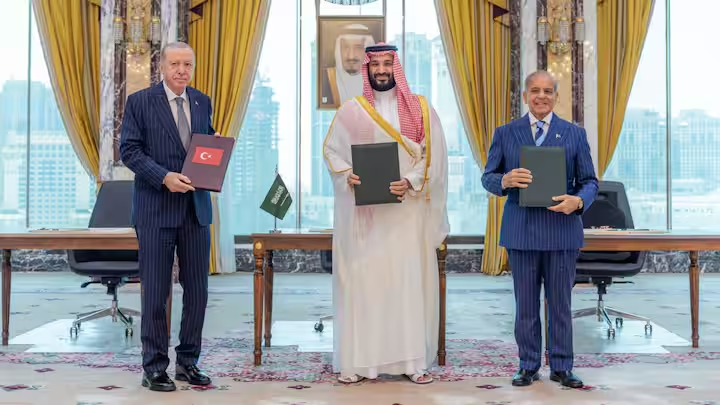
Mecca Agreement complicates India’s strategic calculus at a time when its key partners are caught in competing conflicts and alliances
Insights
Anil Trigunayat
It is ironic that all of India’s strategic partners are engaged in devastating warfare, adversely impacting her well-being, directly or indirectly, while narrowing the strategic space for manoeuvring without resorting to some radical approaches in the regional security matrix. The US-Iran-Israel war has precipitated, while the Russia-Ukraine-NATO war has generated its own dynamics, placing extraneous constraints on strategic choices.
Last year, one of our strategic partners (Israel) attacked another strategic partner (Qatar), and our Comprehensive Strategic Partner (Saudi Arabia) went on to sign a Strategic Mutual Defence Agreement (SMDA) on September 17, 2025, with India’s eight-decades-old adversary, Pakistan. This has been further expanded to include Turkiye through the ‘Mecca Agreement’, which itself has been another adversary due to its blind pursuit of and support for Islamabad’s agenda, including during Operation Sindoor, which has effectively downgraded ties.
Rawalpindi is happy projecting it as an ‘Islamic NATO’, backed by its ‘Islamic Bomb’. Its efficacy might be questionable, but the optics may not be, as the signatories underscore: ‘Three brotherly nations, united by faith, friendship and a shared resolve for peace and security’ — with the aim of building a layered deterrence that taps Turkish drones and Pakistan’s nuclear shadow. NATO and non-NATO allies and partners are trying to band together to project collective deterrence.
This was clearly evident in Defence Minister Khawaja Asif’s ambitious rant a day after Pakistan signed the Mecca Joint Defence Agreement with Saudi Arabia and Turkey. He stepped up calls for a broader ‘Islamic NATO’, urging Muslim nations to unite against what he described as security challenges posed by India and Israel, conveniently ignoring the US and, especially, Trump’s strategic shield for Israel.
Noted commentator Husain Haqqani argued that Pakistan is capitalising on its military ties with Saudi Arabia and Turkiye to gain strategic influence amid West Asian rivalries and economic trade-offs, but rightly observes that its success in carving out a significant regional role will depend on its ability to navigate complex rivalries and on whether West Asian nations are willing to risk their growing economic ties with India for security partnerships with Pakistan.
No doubt, the Houthi problem and strategic rivalry with Iran are real for Riyadh. However, reduced faith in the US security umbrella and its ability to defeat Iran, despite combined US-Israeli firepower, as well as the Sino-Pakistani axis, with implicit support from the US, might have added some sweeteners to the Mecca Agreement.
India called for dialogue and diplomacy through de-hyphenation while maintaining strategic autonomy, as PM Modi spoke to all the concerned leaders, urging de-escalation from the very beginning while calling for respect for sovereignty and territorial integrity. This fell on deaf ears as they remained blinded by the MAD syndrome.
However, the US-Iran war ironically involves regional and extra-regional combatants who are also India’s strategic partners, be it the US, Israel, Iran or, for that matter, the collateral Gulf countries. This complicates matters while accentuating supply-chain disruptions. Therefore, choices become strained and limited, and diversification becomes essential, including for energy security.
There again, India’s over forty per cent energy imports from Russia could come under 100 per cent tariff stress as the US Senate passes extraneous sanctions against several countries. It might as well be yet another pressure tactic driven by domestic politics. On the other hand, Vice President JD Vance called Prime Minister Narendra Modi a day later to reiterate the importance of the Indo-US relationship, trapped in the verbosity of the Global Comprehensive Strategic Partnership.
It was expected that this much-avoided direct conflict between the US and Israel on one side and Iran and its proxies on the other would eventually play out into newer equations and dynamics, even as superpowers are losing the credibility and capacity to assure and ensure the security of their clients and partners.
Pakistan, which is a master at encashing its nuisance and nuclear value as a rentier state, bit the bullet yet again. It has not been easy for it to calibrate and navigate the prevailing regional rivalries, but given its domestic socio-economic, political and financial malaise, it needs to keep the bogey of continued relevance intact.
But Iran, and more so the unbridled Houthis, will keep it under the tight leash of the Saudis, whatever its claimed mediatory postmanship role assigned by Comrade Trump. Yet it remains expendable in the superpower chess game. No doubt, short-term benefits will accrue, and more countries like Qatar (having US and Turkish bases and being in the Saudi camp), Kuwait (having already shown its inclination towards an agreement with Pakistan) and possibly Egypt could be the next to join the trilateral alliance, since Egypt has already been part of the R-4 meetings with Turkiye, Saudi Arabia and Pakistan.
For the time being, the NATO-like clause that ‘an attack on one is an attack on all’ will be somewhat comforting, but then the proof of the pudding is in the eating, and one hopes it will not be made with curdled milk.
Amidst this grouping and these developments, the Saudi position could be critical and concerning for New Delhi because the direction of the long-term Pakistan-Turkiye alliance is very clear and manageable. I recall speaking to a retired Pakistani general about the SMDA, and he quipped, ‘Do you really think that the Saudis will come to our help in the event of an India-Pakistan war?’ Overtly, they may not be counting on it, but Rawalpindi, with strategic access, could in any case benefit from the availability and interoperability of advanced US and Western weapons, equipment and platforms, while already being trained and supported on Chinese ones.
This would need to be factored into India’s countermeasures. Many analysts surmise that these expanding developments and military embedding could lead to a closer partnership with Israel, the UAE and the larger Abraham Accords framework. It might not be that easy, but as the New York Lotto dictum goes, ‘Hey, you never know’. While India will have to prepare for all eventualities, permutations and combinations to defend her security and national interests, getting bogged down in binaries may not yield the desired results.
In the interim, everyone is keeping their fingers crossed, hoping that the war and madness do not ascend into another escalation trap. But hope is not strategy — gearing up is.
About the Author
Anil Trigunayat is a former Indian ambassador to Jordan, Libya and Malta and a distinguished fellow and head of the West Asia Experts Group at the prestigious Vivekananda International Foundation. He is also a Distinguished Fellow at the oldest Indian think tank, the United Services Institution of India.
Read more at IMPRI
Nagaland Department Wise Schemes Update 2026 – IMPRI INSIGHTS
Acknowledgement
This article was posted by Ashwani Dubey, Research and Editorial Intern at IMPRI


