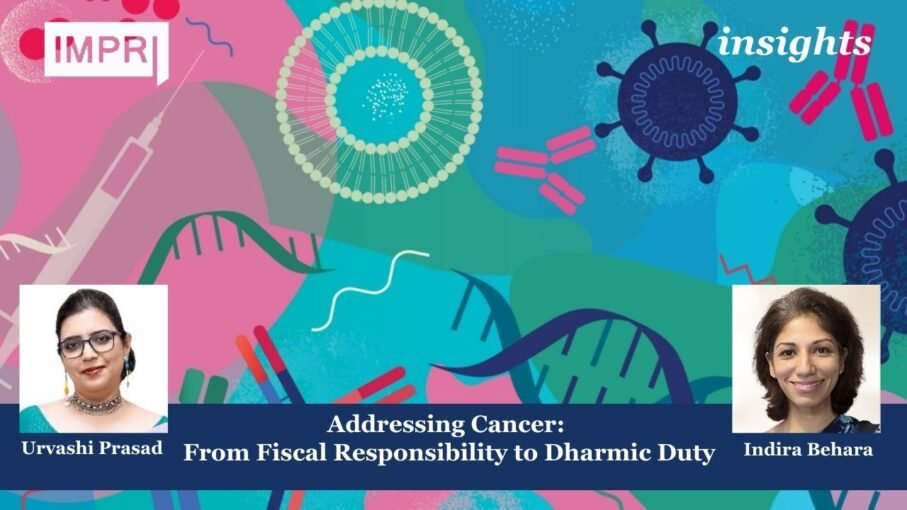
Indira Behara
Urvashi Prasad
The Union Budget 2026-27 has been unveiled with a philosophical framing around three kartavyas–duties not merely fiscal but karmic/dharmic: To accelerate economic growth and resilience by improving productivity and competitiveness; to fulfil the aspirations of people and build capacity; and to ensure Sabka Saath, Sabka Vikas. Lofty ideals, but as always, the test lies in translation to reality.
The Economic Survey had already set the tone, flagging malnutrition, lifestyle diseases, digital addiction, and environmental degradation as pressing concerns. The budget has responded in part, with some notable initiatives in health and research.
Among the highlights is the Biopharma Shakti initiative, with an annual investment of ₹2,000 crore until 2030. Regulatory bodies see modest increases in allocations, while the Department of Health Research and the Ministry of Health and Family Welfare receive a near-10% bump. The PM-Jan Aarogya Yojana (PM-JAY), India’s flagship health insurance scheme, also gets a boost.
Equally significant are the reductions in customs duties for 17 therapies targeting cancer and rare diseases, with exemptions for drugs imported through patient assistance programmes. Coupled with the potential benefits of the India-EU trade agreement, these measures could make treatments that were once prohibitively expensive a little more affordable.
These are welcome steps. And yet, as we approach World Cancer Day on February 4, we must confront the scale of the challenge ahead.
India recorded over 1.5 million new cancer cases last year. Projections suggest that by 2045, we could see an additional million cases annually. Particularly worrying is the rising incidence among younger populations.
India’s population is exposed to a toxic cocktail of risk factors, the convergence of which makes India uniquely vulnerable. Tobacco use remains among the highest globally, with 29% of adults consuming smoked or smokeless forms. Obesity rates are climbing, a known contributor to several cancers. Environmental pollution, including air pollution often dismissed as a respiratory issue, is now firmly linked to multiple cancers.
The government’s national cancer programme is a clear priority. PM-JAY provides some cover, day-care cancer centres are expanding, specialised institutes are being approved, and duty reductions on therapies are encouraging.
But challenges remain stark. Screening programmes are limited to oral, breast, and cervical cancers, leaving out others like colorectal, lung and prostate. The HPV vaccine, which can prevent up to 90% of cervical cancers, is still not part of the national immunisation schedule.
Awareness gaps delay screening and care-seeking. Primary care is patchy, diagnostics are uneven, and treatment in public hospitals faces long waitlists.
Insurance coverage is inadequate. Public schemes often exclude advanced therapies, while private insurance requires costly add-ons and still may not cover the latest treatments. Duty cuts and exemptions risk being swallowed by profiteering unless carefully monitored.
If India is serious about tackling cancer, the following priorities are non-negotiable:
* Improving data collection: The National Cancer Registry Programme (NCRP) is extensive, but reporting remains voluntary and inconsistent. Mandatory, user-friendly reporting of every diagnosed case is essential. Reliable data is the foundation of effective policy, research, and even AI-driven health models.
* Updating treatment standards and prices regularly: The National Cancer Grid must align guidelines with global best practices, while insurers, providers, and hospitals must collaborate to ensure reimbursement reflects updated standards. This is the only way to guarantee quality care at fair prices.
* Expanding insurance and regulating pricing: Insurance coverage must broaden, but equally important is setting non-predatory pricing for treatments. Public-private blended financing models would bring in larger and diverse sources of funds, spreading the load and the risk, and could therefore help balance affordability with sustainability.
* Upgrading R&D capabilities: India must stop playing catch-up. The announcement of new R&D hubs is positive, but they must be future-oriented, adequately funded, and designed to retain the brightest minds. If India aspires to be a biopharma superpower, it must invest not just in infrastructure but in innovation ecosystems.
No discussion of cancer in India can ignore pollution. Air quality in many Indian cities ranks among the worst globally, and studies increasingly link particulate matter and toxic emissions to cancers of the lung, bladder, and even breast. Tackling pollution is not just an environmental imperative–it is a public health necessity. Without aggressive action on clean air, clean water, and safe food, our cancer burden will only escalate.
The budget’s health allocations and policy shifts are steps in the right direction. But cancer is a formidable adversary, and incremental measures will not suffice. India needs a whole-of-society approach–government, private sector, civil society, and citizens–working together to reduce risks, expand access, and invest in innovation.
The three kartavyas outlined in the budget–growth, aspiration, inclusion–must translate into concrete action for cancer care. As India stands at the cusp of becoming a global economic powerhouse, it cannot afford to let cancer silently erode its demographic dividend.
The budget has lit a spark. Now, the challenge is to turn that spark into a sustained flame of action–so that when we mark World Cancer Day in the years ahead, we can speak not of rising burdens, but of lives saved and futures secured.
Indira Behara, public health expert and senior consultant, Indian Cancer Society (Delhi) and Urvashi Prasad, senior fellow, Pahle India Foundation and former director, NITI Aayog.
This article was first published in Hindustan Times as Addressing cancer: Going beyond fiscal duties to dharmic ones on February 02, 2026.
Disclaimer: All views expressed in the article belong solely to the author and not necessarily to the organisation.
Read more at IMPRI:
Beyond the Data Centre Boom:Rethinking India’s AI Strategy
Between Powers: Bangladesh’s Case for Strategic Pragmatism
Acknowledgement: This article was posted by Pallavi Lad, a Research and Editorial Intern at IMPRI.