Srikanth Kondapalli
Notwithstanding the rampant corruption in China’s military, including in its strategic rocket forces, as seen in the dismissal of commander Li Yuchao and deputies Liu Guangbin and Zhang Zhenzhong, the country continues to modernise its nuclear arsenal.
Earlier this month, Thomas DiNanno, the United States Under Secretary for Arms Control and International Security, made a startling remark that China had conducted, in 2020, nuclear tests at Lop Nur, “including preparing for tests with designated yields in the hundreds of tons”, and that its nuclear arsenal was expanding to 1,000 warheads by 2030.
This is a significant jump, from an estimated 190 weapons a decade ago to about 600 a couple of years ago, even though China has officially maintained that it only has a “handful” of such weapons. Although it has stated it would not enter a nuclear arms race, the expansion of fissile material production and delivery systems suggests an active contest is emerging.
Notwithstanding the rampant corruption in China’s military, including in its strategic rocket forces, as seen in the dismissal of commander Li Yuchao and deputies Liu Guangbin and Zhang Zhenzhong, the country continues to modernise its nuclear arsenal.
Miniaturisation and tactical nuclear weapon development are said to be the main focus of the recent test. It was reported that in the 1980s and 1990s, China’s fissile material production at its 14 nuclear sites – specifically at Lanzhou and Heping – was slow, but it has expanded phenomenally over the last decade.
Towards increasing the production of plutonium, China is building two new fast breeder reactors (CFR-600) at Changbiao Island in the Fujian province. It must be noted that the concealed test was done on June 22, 2020, a week after the Galwan clashes with India. Despite China’s denial of the test and its refusal to join the strategic arms reduction talks with the US and Russia, this has a significant bearing on the emerging nuclear order.
When India tested its nuclear weapon in 1998, China was at the forefront, along with the US, to pass the No. 1172 Resolution in the UN Security Council, which called to “cap, roll back and eliminate” India’s nuclear capability and impose debilitating sanctions in this connection. China has maintained this position in its strategic engagement with India. As it proliferated nuclear technologies and ballistic missiles to Pakistan, China has refused to discuss any escalatory control measures with India in the nuclear domain
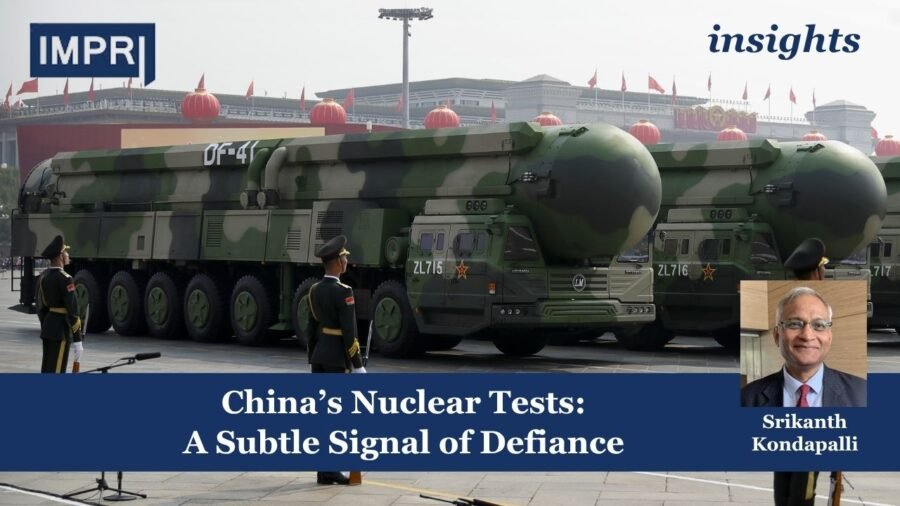
China’s growing nuclear arsenal was on display at the military parade in September last year in Beijing, where the country showcased its triad of nuclear-ready capabilities in land, air, and sea. The parade also featured advanced precision-strike vehicles and technological capabilities in automation, AI, and lasers. This display came against the backdrop of expansive efforts to build ballistic missile silos at Yumen and Hami in the western regions of China. These programmes underline what China’s White Papers have called “medium- and long-range precision strikes” that signify challenges to the regional and global orders.
In addition, despite the 1964 pledge of minimum nuclear deterrence, which suggests a strategy of delayed counter-strike, Chinese military officials underline a shift in approach – from “how to hide” to “how to fight” – apart from preparations for “launch under attack” and, more significantly, to the swift “launch on warning” operational doctrine.
After Taiwan’s President Tsai Ing-wen made a phone call to President-elect Donald Trump ahead of his first term in December 2016, China test-fired the DF-41 ICBM from Heilongjiang in what was perceived as a warning signal. However, as a conciliatory measure, China notified the US when it test-fired the DF-41 ICBM from Hainan into the Pacific Ocean on September 25, 2024.
China may be preparing for a power transition with the US by undertaking these decisive measures in the modernisation of nuclear forces. However, to realise such a goal, the country has to take the lead in the regional order in Asia. China provided diplomatic and other support to North Korea in the latter’s quest to nuclearise the Korean Peninsula. Pyongyang has also been involved in the proliferation to Pakistan, raising concerns for India.
While India and China have a “no first use” policy, and no N-word was spoken by either country in the recent stand-offs, both have been preparing to enhance their capabilities in nuclear deterrence, shifting gradually from dissuasion.
The rapid expansion of China’s nuclear arsenal may primarily indicate a posture of defiance directed at the US. The development, however, also poses significant challenges to India. A nuclear capability, once built, can be pitched against any adversary as a tool of coercion. In a regional order marked by competing global powers, this capability can also mean a formidable threat to stability.
About the Contributor
Srikanth Kondapalli is a Professor in Chinese Studies at Jawaharlal Nehru University, New Delhi, India. He was the former Dean of the School of International Studies, JNU. He is a frequent writer and commentator in the national and international media.
This article was first published in Deccan Herald as A quiet test of nuclear defiance on March 01, 2026.
Disclaimer: All views expressed in the article belong solely to the author and not necessarily to the organisation.
Read more at IMPRI:
Imprisoned Without Conviction: India’s Undertrial Crisis and the Urgency of Reform
National Mission on Monuments and Antiquities (NMMA) – 2025
Acknowledgement: This article was posted by Pallavi Lad, a Research and Editorial Intern at IMPRI.