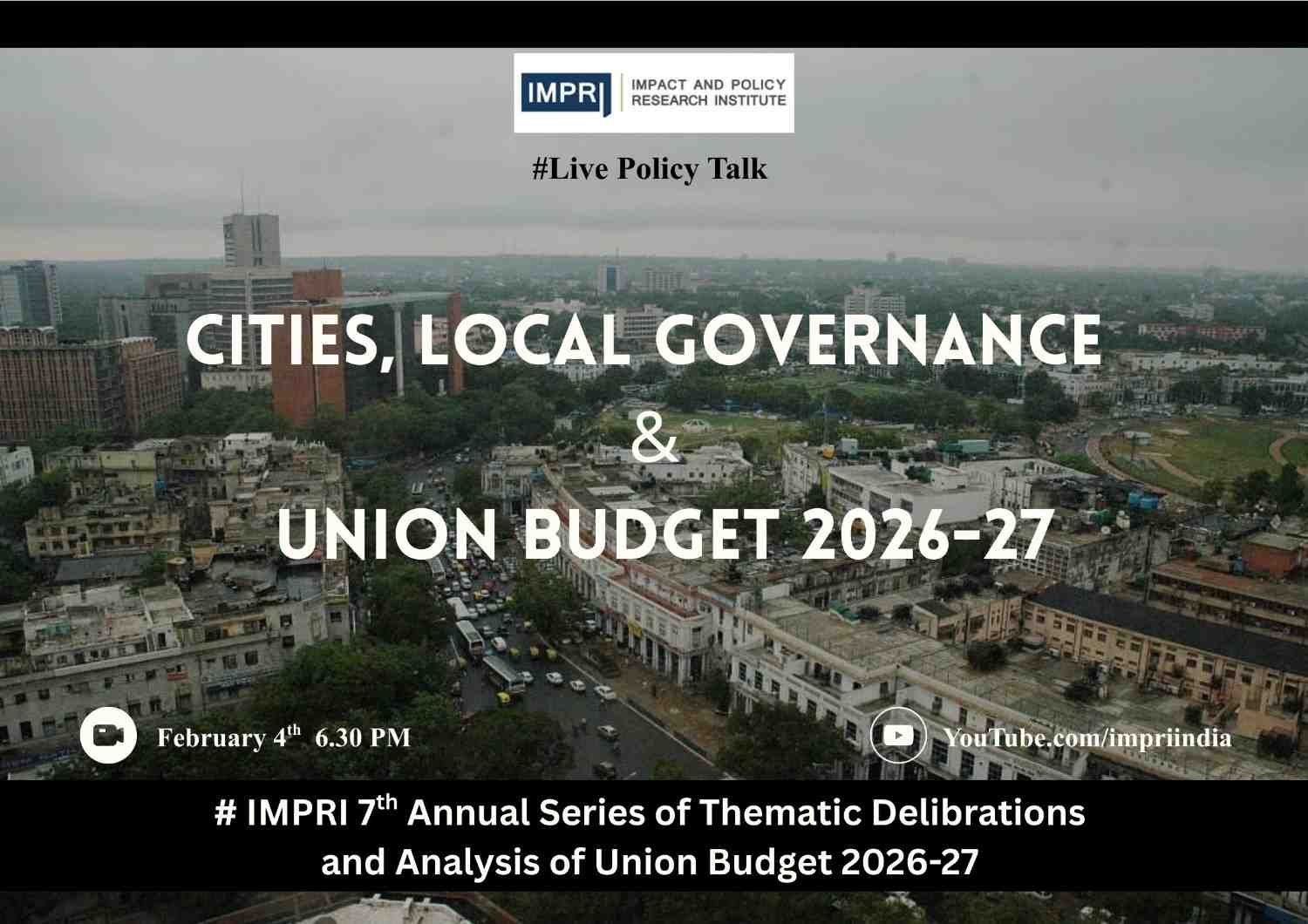
The IMPRI Centre for Habitat, Urban and Regional Studies (CHURS), IMPRI – Impact and Policy Research Institute, New Delhi, convened an online policy discussion on Cities, Local Governance and the Union Budget 2026–27 as part of IMPRI’s 7th Annual Series of Thematic Deliberations and Analysis of the Union Budget 2026–27, which was held on February 4 at 6:30 p.m. IST.
The session examined how the Economic Survey, the Union Budget 2026–27, and the 16th Finance Commission recommendations (with its Action Taken Report) collectively shape the direction of India’s urban governance and municipal finance ecosystem.
Opening and Welcome
The programme commenced with Priyanka Negi, a Researcher at IMPRI, who welcomed participants to IMPRI Web Policy Talk and introduced the session as part of the 7th annual series of thematic deliberations on the Union Budget 2026–27. She noted that the discussion was organised by the IMPRI Centre for Habitat, Urban and Regional Studies (CHURS).
Priyanka introduced the Chair and Moderator, Prof. Chetan Vaidya, Visiting Distinguished Professor, IMPRI; Independent Urban Advisor; Former Director, School of Planning and Architecture, New Delhi and National Institute of Urban Affairs, New Delhi; Independent Director, GIFT City, Gandhinagar.
She then introduced the expert panel for the session:
- Dr Soumyadip Chattopadhyay, Associate Professor, Economics, Visva-Bharati, Santiniketan; Visiting Senior Fellow, IMPRI.
- Prof Vishwa Nath Alok, Professor of Public Finance, Indian Institute of Public Administration (IIPA), New Delhi.
- Prof Mahalaya Chatterjee, Professor, Centre for Urban Economic Studies, Department of Economics, University of Calcutta; Visiting Professor, IMPRI.
- Mr Sameer Unhale, State Joint Commissioner of Municipal Administration, Government of Maharashtra; Urban Expert; Visiting Senior Fellow, IMPRI.
- Prof Tathagata Chatterji, Professor of Urban Management and Governance, Xavier University, Bhubaneswar.
The conveners of the programme were Dr Simi Mehta and Dr Arjun Kumar.
Chair’s Framing: Reading the Economic Survey, Union Budget, and 16th Finance Commission together
Prof. Vaidya opened the session by emphasising that the urban sector benefits from very few collective deliberative spaces in a year, and that this forum is crucial precisely because it enables a combined reading of the Economic Survey, the Union Budget 2026–27, and the 16th Finance Commission through a single urban governance lens.
He stressed that the Survey’s core message is not just a number but the underlying claim that India’s urban share is likely much higher than census figures reflect. He highlighted how urbanisation is expanding into semi-urban and peri-urban areas. Still, governance remains fragmented: urban local bodies (ULBs) and urban development authorities do not yet function as economic agencies and largely remain oriented toward physical infrastructure and implementation. He argued that the “economic” role of urban governance remains underdeveloped.
He flagged the scale of the fiscal constraint: municipal fiscal autonomy is around 0.6% of GDP, which he characterised as extremely low. He raised the policy question of restrictive Floor Space Index (FSI). He linked it to the Survey’s framing of land as dead capital, asking whether a national policy reflection is needed on the costs of restrictive FSI versus the opportunities and risks of relaxing it.
On city functioning, he noted that the Survey pushes for reducing dependence on private vehicles, strengthening public transport, and improving waste management: while collection has improved, segregation remains missing. He also stressed the importance of addressing informality and calling for improved civic behaviour. He observed that the Survey mentions municipal bonds and frames time as a resource, encourages creative density, and advocates for more workable cities.
On the budget, Prof. Vaidya read the urban direction as a sustained capex push with stated focus on Tier-2 and Tier-3 cities, while noting the definitional vagueness: the budget indicates cities of “more than 5 lakh population,” yet it does not clarify the upper bracket (whether say 40 lakh or otherwise).
He highlighted the major shift toward City Economic Regions, an idea associated with NITI Aayog, already explored in Mumbai, Surat, and Visakhapatnam, with a proposal to scale across seven regions through state participation. However, he stressed that the necessary institutional infrastructure is not yet in place, making the execution of a city-regional investment vehicle a primary concern.
He also pointed to proposed seven high-speed rail corridors, 50 global/all-season tourist destinations, new waterways, regional centres of excellence, e-buses, seaplanes, and emerging thinking on urban finance, including a risk guarantee fund. He mentioned the possibility of leveraging central PSUs as resources. He also read the emphasis on construction and infrastructure equipment manufacturing as positive, noting that if FSI increases, building heights may rise, and the infrastructure equipment ecosystem becomes more central.
Prof. Vaidya described the 16th Finance Commission’s urban recommendation as the most positive development in the tri-document frame: 45% of total local government funding to urban areas, amounting to ₹3.56 lakh crore over the award period. He noted a 60–40 split between performance and basic grants.
He flagged entry-level conditions: elections, duly constituted bodies, accounting transparency, and the requirement that State Finance Commissions be regularly set up with ensured Action Taken Reports. He also highlighted that performance is linked to a 5% increase in own-source revenues, and drew attention to a major condition: states must contribute 20%, which he suggested could be difficult for many states. He explicitly invited panellists, especially Prof. Alok, to examine whether this 20% condition is feasible.
He explained that grants would be partly tied and partly flexible: 50% with untied flexibility, and 50% for sanitation, solid waste management, and water management, with a prohibition on use for salaries and establishment costs.
Finally, he highlighted an innovation: an “urbanisation premium”—a one-time grant for peri-urban or rural areas that join urban areas. He noted that such a measure would require an overarching urban policy framework and called for comprehensive support for wastewater management.
IMPRI’s Budget Snippet Presentation:-
Following Prof. Vaidya’s framing, Priyanka introduced a short budget snippet prepared by team IMPRI and invited Anish, an intern at IMPRI, to present it. Anish then provided a structured overview of the budget’s urban-relevant highlights.
He described the Union Budget 2026–27 as having an urbanisation focus, noting the Finance Minister’s framing of cities as engines of growth. He outlined the shift from the Smart Cities Mission to City Economic Regions, with an allocation of close to ₹5,000 crore over five years. He noted that local government grants, aligned with the 16th Finance Commission, are now being delivered on a performance basis to improve service delivery, finance discipline, and revenue mobilisation for local institutions.
He highlighted the renewed emphasis on municipal bonds as instruments for financial independence, noting that climate change has pushed a budgetary focus on installing carbon technologies in urban centres, with close to ₹20,000 crore proposed.
He explained that planning now emphasises integrated development for areas in transition. Specifically, City Economic Regions will target Tier-2 and Tier-3 settlements moving from rural to urban status. He also highlighted seven new high-speed rail corridors designed to improve regional trade and connectivity.
On governance, he pointed to digital transformation, including simplified tax compliance, intended to ease citizen-facing procedures. He also referenced budget estimate changes in housing and urban affairs and broader increases across certain rural schemes such as MNREGA, PM Awas Yojana, and National Rural Livelihood Mission, while concluding with a key interpretive point: the budget reflects a shift from entitlement-based schemes to compliance/performance-based allocations, alongside the move from Smart Cities to City Economic Regions.
Expert Reflections and Speaker Interventions:-
Constitutional Mandate, Fiscal Space, and the “State Subject” Constraint:
Prof. Vishwa Nath Alok began by noting that the Union Budget, presented in the Lok Sabha on 1 February, was awaiting approval at the time of discussion. He further stated that the 16th Finance Commission report was presented alongside its Action Taken Report, and that the Economic Survey—featuring a dedicated chapter on urbanisation—had been tabled on 29 January.
He then explained why the Finance Commission is constitutionally significant for municipalities. Following the 74th Constitutional Amendment (1993), a clause was added to Article 280 requiring the Union Finance Commission to recommend measures to augment the consolidated fund of states for municipalities, in accordance with State Finance Commission recommendations. He observed that several finance commissions have made recommendations, often without State Finance Commission recommendations being available for relevant periods. While the recommendations apply to both municipalities and panchayats, the present discussion was focused on municipalities.
He emphasised that cities and local governance are a state subject (Seventh Schedule), limiting what the Union government can do directly, and suggested IMPRI should also consider a dedicated discussion on state finances and the role of local governments after the RBI’s state finances report.
On the macro-fiscal context, he stated that growth was estimated at 7.4% in 2025–26 and expected at 7.2% in 2026–27. He then argued that fiscal space remains constrained: government spending rose from around 12.8% of GDP (2016–17) to about 13.6% (2026–27 budget estimates)—an increase of only 0.8%. He suggested this expansion is largely borrowing-driven, with limited growth in regular tax incomes, and noted reliance on RBI dividends (about ₹1 lakh crore), indicating limited “real money” for sectors like urban development and civic services.
Turning to the 16th Finance Commission, he noted that municipal grants have been doubled compared to the 15th Finance Commission, reaching about ₹3.5 lakh crore over five years (about ₹70,000 crore per year), but he characterised this scale as modest (“almost peanuts”) relative to needs. He argued that instead of lump-sum recommendations, finance commissions should consider giving municipalities a percentage share in the Union divisible pool, which would account for inflation and align with multi-order federalism.
He observed that both the Finance Commission and the budget are oriented toward “growth centres,” especially transitional areas governed by Nagar Panchayats, and that the Union’s direction is increasingly toward capex and debt routes rather than expanded vertical schemes.
In response, Prof. Vaidya noted that Prof. Alok’s suggestion about discussing state finances and State Finance Commissions should be taken seriously, and he also raised the broader question of reviewing centrally sponsored schemes, mentioning that a committee-based review has been suggested.
Peri-Urban Growth and Land-Based Revenues
Prof. Mahalaya Chatterjee began by recognising that the session deliberately combines three documents: the Economic Survey, the budget, and the 16th Finance Commission. She welcomed the fact that, perhaps for the first time, the Economic Survey contains a full chapter dedicated to urbanisation. However, she stressed that in the absence of updated census data, the chapter reconstructs urbanisation since 2011 using partial indicators such as nightlight data and other sources.
She agreed that peri-urban areas are growing fast and argued this is not abnormal: core city growth may slow while peripheral areas expand rapidly. However, she posed the central question: has the budget done justice to this reality? She noted the Finance Commission’s urbanisation premium for areas absorbed into urban jurisdictions, but emphasised that implementation depends entirely on state governments, which decide whether to municipalise such areas or leave them as peri-urban/panchayat/transitional spaces.
On municipal finance, she noted that the Economic Survey revives the municipal bond debate, but she expressed scepticism based on discussions with an NIPFP professor who argued the municipal bond issue is “almost dead” and has not been successful. While the Survey references own-source revenues and land as capital, she argued that there is insufficient seriousness about fiscal reform that would allow own-source revenue to increase sustainably.
Her strongest caution was on land. She argued that land monetisation is often one-time: once land is sold or leased, the revenue is largely exhausted, and it does not constitute a stable fiscal base. She also noted that municipalities often do not own much land (citing West Bengal), and there is fear of using land indiscriminately. She warned that when land is framed solely as revenue, ecological functions, green cover, and environmental balance are ignored.
Since revenue from land often depends on construction and built-up expansion, the ecological costs become irreversible; later lamentations about green loss cannot undo the change. She therefore cautioned that treating land as the primary municipal revenue source could create an environmental disaster. She argued that dependence on property tax should be reduced and municipalities should explore other tax and non-tax revenues, but she did not see serious budgetary emphasis on such reforms.
She also raised conceptual questions about City Economic Regions, recalling its Chinese lineage as a combined urban-rural unit intended to be self-sufficient, and asked what the economic basis and intended logic of India’s model is.
She questioned the budget’s reference to five university townships, noting the lack of detail. She asked whether these resemble IIT campuses (which can function like cities), and cited the Kanpur example where census categorisation distinguishes Kanpur Shahar, Kanpur Dehat, and IIT Kanpur. She asked what the morphological setup and impacts of such townships would be.
Finally, she flagged an “excessive stress” on transport-oriented development, including high-speed corridors, and referenced earlier research on the Golden Quadrilateral’s influence on urbanisation patterns along corridors. She asked whether high-speed corridors would have similar impacts along their routes.
She concluded by reiterating a key disconnect: what is highlighted in the Economic Survey—informality, migrants, urban amenities—does not appear adequately reflected in the budget, except perhaps in the allocation signal around Pradhan Mantri Awas Yojna PMAY-Urban.
Municipal Realities and Policy Gaps
Mr Tikender Singh Panwar opened by stating that while the Economic Survey is “pretty good” (including, for the first time, congestion fee discussion), the budget is a “dismal failure,” and the 16th Finance Commission is, in his view, a major disappointment.
He began with the Finance Commission, arguing that celebration of increased outlays ignores the reality that 30% of funds were not spent in the last budget cycle and across the last five years, pointing to a structural “disease” in implementation and governance capacity that needed treatment. He recalled meeting the Finance Commission chairperson in Shimla with former mayors and being encouraged by the chair’s patient hearing, but the Commission still fell into the same trap, especially by adding the 20% state contribution condition.
He argued that the real value of transfers must be assessed against GDP growth, inflation, and the scale of urban migration; in his reading, once these are accounted for, the increase becomes a reduction effectively. He also stressed that these funds’ real impact will depend on local revenues, aligning partly with Prof. Alok’s emphasis on the limited fiscal base of municipalities.
He strongly criticised “paranoia” about tied grants and conditions. He argued it is not the Finance Commission’s role to dictate property tax priorities. He emphasised the political economy after GST: he said that after GST, cities lost over 20% of own-source revenues in his state context, yet conditions were imposed in the 15th Finance Commission requiring property tax increases to be commensurate with state GDP, with penalties when this was not achieved. He described this as “obnoxious,” arguing that many who design these conditions have not served in cities and do not understand municipal constraints.
He illustrated the mismatch through the Smart Cities experience: in Dharamshala (annual budget roughly ₹50–100 crore), consultants prepared a Smart City plan worth around ₹2,000 crore. He quoted an official’s Hindi remark comparing this to not having money even for peanuts in one’s pocket, but attempting to deal in Rafale—underscoring the gap between municipal capacity and centrally designed ambition. He generalised this to India’s settlement system, stating that around 8,500 towns are small, and 90% cannot pay salaries and wages, making matching contributions unrealistic.
He also raised federalism concerns. Drawing from Kerala Urban Commission experience, he noted that some panchayats explicitly did not want to become urban because they were functioning well and would lose departmental advantages. He argued that the Finance Commission should have treated rural and urban areas as local self-government and enabled flexible amalgamation of funds. Instead, separation prevents integration, he cited a concrete example: Swachh Bharat Mission rural and urban could not be integrated, even for sewage management in Kerala. He added the Northeast complexity, noting that in places like Shillong, large parts are governed through village headmen due to Schedule 6, producing a “fourth tier” beyond panchayat/municipality categories.
Turning to the Union Budget, his critique centred on what he called the obsession with capital-intensive technologies, particularly the metro. He described observing metro corridors in Bhopal where metro services were not running and being told there were no passengers, sarcastically asking whether birthday parties would be held inside trains. He said about 33% of the budget goes to the metro and argued the trend continues despite questionable ridership.
He argued the urban budget should be at least ₹2 lakh crore, which would still be only around 0.25% of GDP at the Union level. He criticised the broader fiscal architecture where cess collection has increased to about 2% of GDP, implying roughly ₹8 lakh crore generated at the Centre outside the divisible pool—money he argued should have been available to states and cities.
On housing, he provided PMAY-Urban figures: previous year budgetary allocation around ₹19,794 crore (not revised estimates), now around ₹18,625 crore. He also challenged housing adequacy, noting poorer households often have larger families and therefore 25 sq metre units are not desirable. He flagged major reductions in Swachh Bharat Mission (Urban) (nearly 50% by his account) and questioned why. He also discussed AMRUT: earlier for 500 cities, now for all statutory towns excluding census towns, yet with around 20% reduction, raising questions of shrinking commitment.
He argued the budget fails to address skill migration, demographic churn, informalisation of employment, and climate shocks. He cautioned against higher FSI, particularly for Himalayan towns, and referenced learning in Shillong about a scheme that enables more central funding if cities have higher FSI—calling this ridiculous for fragile geographies.
He concluded by arguing that the future lies in Tier-2 and Tier-3 cities (though the definition remains unclear), where precarity in housing and civic amenities is significant, but where policy lacks the lens to meaningfully engage everyday insecurity.
Urban Definitions, Environment, and Infrastructure Priorities
Prof. Tathagata Chatterji argued that there is a major disconnect between what the Economic Survey articulates about urbanisation and what the budget funds. He stressed that India’s definition of urban remains among the most conservative globally and pointed to the Survey’s reference to the UN’s updated methodology using satellite imagery and census data, suggesting that India’s urbanisation is far higher than census figures show.
He argued that the long gap since the 2011 census creates a structural governance problem: even when the next census arrives (discussed in the session as expected around 2027), it may still use old administrative definitions, missing the opportunity to align administrative categories with economic/functional urban realities. Unless that alignment happens, he argued, governance remains trapped in a dichotomy where the state does not precisely know what “urban area” it is governing.
On the 16th Finance Commission, he acknowledged positives: the increase to 45% for ULGs, the pressure on states to form State Finance Commissions and submit reports in time (improving predictability), and transparency measures such as uploading annual reports to the CTFIN website.
However, on the budget, he argued it is “business as usual”: cities are called engines of growth, but fuel is not provided. He noted contractions across key programmes (AMRUT, SBM-U, PMAY-Urban). He observed increases in PM SVANidhi and NULM, noting that NULM had received no funds for some years and then suddenly received allocations (he referenced movement from around 200 crore in revised to around 500 crore now), interpreting this as implicit recognition of the precarity of the urban poor. Yet he argued that poverty is multidimensional and that sanitation, housing, and environmental dimensions remain underfunded.
He framed environmental dysfunction as an economic constraint: Delhi’s pollution, Mumbai’s flooding (despite being the financial capital), and Bengaluru’s congestion (despite being the innovation hub). He noted that environmental conditions can drive away investors, and argued that without fixing these metro-city dysfunctions, the 2047 developed economy vision is difficult to achieve.
He raised a pointed implementation question about the Urban Challenge Fund: last year’s budget announced an Urban Challenge Fund at ₹10,000 crore, but nothing was spent; this year it is again announced (with ₹5,000 crore noted for Tier-3 cities through it), but he did not see distinct earmarking within MoHUA allocations, raising the question of whether this is a reallocation of the same unspent fund.
He also questioned the rationale behind high-speed rail corridor choices: metro-to-metro links like Bombay–Pune–Hyderabad–Bangalore–Chennai appear understandable, and Delhi–Varanasi appears understandable, but he asked why the corridor goes from Varanasi to Siliguri, especially when industrial development discussions (Purvodaya) reference Durgapur. He suggested it might have made more sense to connect Durgapur, and linked this logic to the east–west freight corridor and industrial corridor planning, questioning the planning rationale behind the corridor endpoints.
Discussion and Q&A
After the first set of remarks from all the panellists, Prof. Chetan opened the floor to participants for questions.
A key audience question was: given that the last census was in 2011, how are allocations for urban development being madewithout an accurate picture of the urban population?
Prof. Tathagata Chatterji responded to this by stating that without updated data, governance “goes for a toss.” He noted that urban agglomeration rankings vary by methodology; for example, UN records may list Kolkata as the second-largest agglomeration after Delhi, with Mumbai extremely dense but not necessarily second by size, and Hyderabad not necessarily a 10-million megacity by certain counts. He also referenced global shifts in rankings, noting that Jakarta is identified as a very large agglomeration (he cited around 42 million), followed by Dhaka (around 39 million), with Tokyo and Delhi following—illustrating how methodology reshapes foundational assumptions.
A second audience question asked whether there is any mention of an urban MNREGA-like employment programme, particularly in the context of unemployment.
Mr Panwar responded that this is a long-standing argument and noted that a private member’s bill pending in Parliament has not been addressed. He argued that an urban employment guarantee could be powerfully articulated through green jobs and asset creation, and he strongly supported a “carbon employment” orientation.
Panel Reactions and Closing Interventions
In short reactions, Prof. Alok added three important points. First, he referenced the governance complexity in hill regions and the Northeast: the 125th Bill includes autonomous district councils, but it has not been discussed in Parliament. He stressed that these councils exist in hilly areas (around 10), and are neither panchayats nor municipalities, complicating standard governance frames.
Second, he stated that census operations would begin on 1 April 2026, and until then, administrative rules restrict boundary changes; he suggested that Finance Commission recommendations are therefore somewhat “interactive,” with the “real thing” beginning only around 2027–28. Third, he reiterated that because GST and other revenues are centralised, the structural solution is to allocate municipalities a share in the Union divisible pool so that Union, state, and local expenditures draw from the same shared- revenue logic.
Prof. Mahalaya added that the FSI debate must not be reduced to vertical growth. Higher FSI affects electricity loads (lifts and pumps), water supply, drainage, sewage, and solid waste management. She noted that even after the 2016 rules, 90% of gated communities lack their own solid waste management systems—meaning density policy without service capacity is dangerous.
Prof. Chatterji added a state-level caution: he referenced Odisha moving toward a uniform FAR 4 across all cities, calling blanket FAR dangerous because each city has its own distinct carrying capacity. He also cautioned against blind conversion of defence land into real estate, noting that defence land forms key urban green space in cities like Delhi and Kolkata; he suggested transfer of development rights might be explored toward Tier-2/3 contexts but not in a heavy-handed manner.
Mr Panwar added two closing points: he mentioned the impending release of his edited book “The City Limits” (Penguin) and, borrowing from it, iterated that climate must be a pivotal driver in future city policy, and suggested exploring instruments such as green fees, linking finance and governance as inseparable.
Prof. Vaidya returned to one unresolved point raised by Prof. Chatterji on the Urban Challenge Fund, stating there was limited clarity from the ministry, but based on communications (emails/WhatsApp), it appeared the Tier-2/Tier-3 framing may indeed be tied to the same Urban Challenge Fund logic.
Finally, Prof. Alok added a caution on the budget’s apparent reliance on debt routes: if municipal bodies do not have capacity, accounting systems, and expenditure discipline, they may not be able to spend borrowed resources efficiently, and interest burdens could rise. Prof. Vaidya acknowledged this as a key point.
Conclusion
In closing, Prof. Vaidya described the discussion as productive precisely because it included disagreement and competing interpretations. He synthesised the conversation into linked takeaways.
First, the session raised major issues around land as a resource and the debate on FSI—not only whether higher FSI should be pursued, but whether the full systems impact on cities (services, ecology, infrastructure loads) is being considered. Second, while Tier-2 and Tier-3 cities were repeatedly emphasised, the session noted that these categories remain vague, and it remains uncertain whether metro cities can be deprioritised, especially when their dysfunction, pollution, flooding, and immobility create national economic constraints.
Third, the panel strongly debated infrastructure priorities, especially the heavy allocation toward metro rail and whether that crowds out everyday urban needs. Fourth, speakers repeatedly noted that while the Economic Survey discusses informality and urban poverty, the budget does not sufficiently address the urban poor, except through limited signals such as NULM’s increased allocation (the chair referenced a 26% increase in the revised allocation as noted during the summary).
Fifth, City Economic Regions were identified as a major directional shift with significant funds indicated, but with unclear institutional arrangements, raising questions about implementation, governance, and coordination with state governments. Sixth, the rationale behind high-speed rail corridors—including questions about endpoint selection such as Varanasi–Siliguri—remained a live issue, suggesting the need for closer scrutiny of spatial planning logic.
Finally, the panel underscored that forthcoming census processes and evolving global methodologies, particularly the UN’s revised definitions and measurement approaches, may reshape India’s understanding of urbanisation and therefore should be integrated into fiscal and governance thinking. The closing remarks also emphasised the need to engage more seriously with climate frameworks and the long-term limits and values shaping the future of Indian urbanisation.
Priyanka Negi concluded the session with a vote of thanks to the chair, panellists, and participants, and invited the audience to join subsequent deliberations in the budget series (including sessions on Population Health and the Union Budget 2026–27, and Defence, Foreign Policy and the Union Budget 2026–27).
Acknowledgement: This Event Report is written by Pallavi Lad, Research and Editorial Intern at IMPRI.