Event Report
Jyoti Poonia
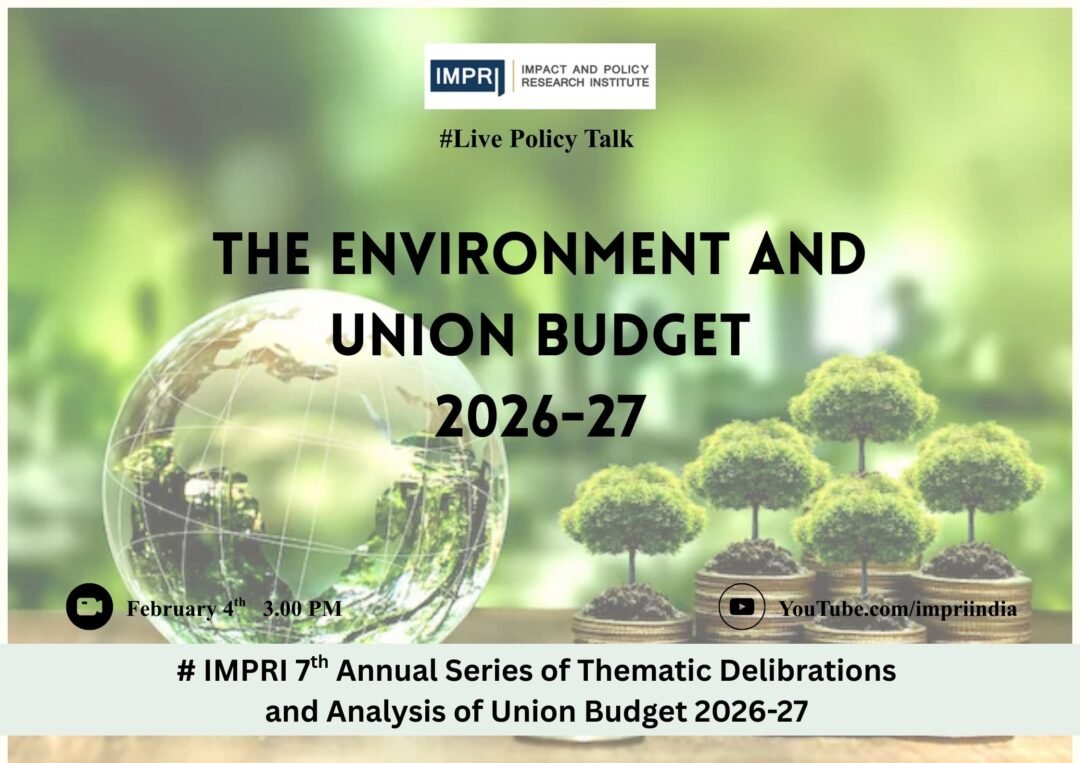
On the 4th of February, 2026, IMPRI (Impact and Policy Research Institute) Centre for Work and Welfare (CWW), New Delhi, convened a crucial online thematic discussion titled “The Environment and the Union Budget 2026-27.” This event was a significant component of IMPRI’s 7th Annual Series of Thematic Deliberations and Analysis of the Union Budget, an initiative designed to move beyond surface-level fiscal analysis and delve into the profound policy implications of India’s most important financial document.
The session was premised on a fundamental understanding: that the Union Budget is not merely an accounting exercise or a statement of government receipts and expenditures. Rather, it is a powerful, directive instrument of state policy, a reflection of national priorities, and a blueprint that actively shapes the country’s developmental trajectory. By choosing to scrutinise it through an environmental lens, the organisers sought to answer a pivotal and increasingly urgent question: Does India’s fiscal planning for the coming year genuinely internalise the imperatives of environmental sustainability and climate resilience, or does it continue to treat ecological concerns as peripheral add-ons to a fundamentally growth-at-all-costs economic model?
The discussion aimed to critically examine the budget’s fine print, to look past the headline announcements of “green initiatives” and analyse the actual allocations, policy signals, and implicit incentives that would determine the country’s environmental future. The full recording of this incisive dialogue serves as an invaluable public resource, capturing a nuanced debate on how fiscal choices made today will determine the ecological viability and social equity of India’s development tomorrow.
The distinguished panel of speakers included:
- Mr Ashish Kothari, Environmentalist, Academic, and Founder of Kalpavriksh.
- Prof. Krishna Raj, Professor and Head, Centre for Economic Studies and Policy (CESP).
- Mr Soumya Dutta, Co-Convener of South Asian People’s Action on Climate Crisis (SAPACC) in New Delhi, Visiting Senior Fellow, IMPRI.
- Mr Himanshu Shekhar, Senior Editor at NDTV India.
- Mr Debadityo Sinha, Senior Resident Fellow and Lead, Climate & Ecosystems team at Vidhi Centre for Legal Policy.
- Ms Prarthana Borah, Policy Researcher with Expertise in Sustainable Industrial Development.
Opening Remarks: Framing the Problem of Structural Invisibility
The session was authoritatively opened by Mr. Ashish Kothari. Mr. Kothari immediately cut to the core of the issue, introducing the concept of “structural invisibility.” He argued that ecology, biodiversity, and the foundational services provided by nature are systematically rendered invisible within the architecture of the Union Budget. This invisibility, he stressed, is not accidental but structural, a consequence of an economic paradigm that cannot adequately value or account for natural capital. Mr. Kothari then delineated a critical analytical framework for the ensuing discussion: the distinction between direct and indirect environmental finance.
Direct allocations, he explained, refer to the explicit budgets for institutions like the Ministry of Environment, Forest and Climate Change (MoEF&CC) and specific line items for wildlife conservation, pollution control boards, or afforestation drives. These figures are typically minimal, often stagnant, and glaringly insufficient given the scale of India’s ecological challenges. The real story, however, lies in the indirect expenditures, the massive financial flows towards sectors and projects that have severe, long-term environmental consequences but are never booked as “environmental costs.”
He pointed to the substantial allocations for large-scale river linking projects, new highways cutting through forests, subsidies for water-intensive agricultural inputs, and incentives for extractive industries. These expenditures, while not labelled as ‘environmental,’ have a far greater aggregate impact on India’s ecosystems than the meagre direct conservation budget.
Mr. Kothari lamented that sectors directly responsible for safeguarding the environment are treated as decorative, while sectors that actively degrade it are turbocharged as engines of growth. He cited the consistent underfunding of agencies responsible for environmental regulation and monitoring, leaving them toothless against powerful economic interests. This budgetary pattern, he concluded, is the fiscal manifestation of a deeper ideological stance: a development model where the environment is at best a constraint to be managed, and at worst, an externality to be ignored.
His opening remarks thus established the central thesis for the day, that a meaningful analysis of the budget’s environmental impact requires looking beyond the green window dressing and interrogating the entire fiscal edifice for its ecological logic, or lack thereof.
The Urban Conundrum: Growth, Sprawl, and Unaccounted Ecological Costs
Expanding on Mr. Kothari’s macro critique, Professor Krishna Raj focused his analytical lens on the dynamic and messy interface of economic growth, urbanisation, and environmental decay. He anchored his intervention in the government’s own Economic Survey, which, as he noted, unabashedly promotes urban expansion as the primary engine of India’s future growth. Professor Raj dissected this narrative, highlighting its fundamental flaw: the systematic externalisation of environmental costs. The model of urban growth being championed and funded, he argued, calculates benefits in terms of GDP contribution, real estate value, and formal job creation, but it leaves the immense ecological bills, pollution, waste, habitat destruction, water scarcity, and heat island effects off the balance sheet.
He painted a vivid and troubling portrait of the contemporary Indian city, a portrait drawn from stark data. Urban centres are suffocating under chronic and hazardous air pollution, with PM 2.5 levels consistently breaching safe limits by massive margins, leading to a public health catastrophe. Traffic congestion is not just an inconvenience but a massive drain on economic productivity and fuel. The demand for energy in cities is skyrocketing, placing unsustainable pressure on the grid and driving increased reliance on fossil fuels. Water tables are plummeting in urban and peri-urban areas, while natural drainage systems and water bodies are being paved over, exacerbating urban flooding during monsoons.
Professor Raj then connected this on-ground reality directly to the budgetary choices evident in the Union Budget 2026-27. He observed a persistent and concerning tilt towards non-renewable energy infrastructure even within urban development schemes. Funding for large, centralised thermal power plants or gas infrastructure often takes precedence over decentralised solar solutions, energy efficiency upgrades for buildings, or robust public transportation networks. He pointed out that allocations for comprehensive, multi-modal public transit systems are dwarfed by those for road widening and flyover projects that ultimately induce more private vehicle traffic.
The budget, in his assessment, was investing in the very model of urbanisation that was creating the problem, a car-centric, energy-intensive, and spatially expansive paradigm. He warned that by not using the fiscal lever to mandate green building codes, fund nature-based solutions for urban resilience, or prioritise compact, transit-oriented development, the budget was locking India into a path of urban growth that was ecologically unsustainable and would eventually impose crippling costs on public health and the exchequer itself.
The MSME Paradox: Promoted as Growth Engines, Absent from Green Transition
Ms. Prarthana Borah shifted the focus to the critical arena of industry and, specifically, the Micro, Small, and Medium Enterprise (MSME) sector, often hailed as the backbone of the Indian economy. Her analysis centred on the discursive and practical treatment of sustainability within the budget’s industrial policy framework.
She identified a subtle but significant shift in rhetoric: sustainability is increasingly framed not as an urgent ecological imperative for survival, nor as a matter of intergenerational justice, but predominantly as an economic opportunity or a niche “green market.” This reframing, she argued, is politically convenient but analytically shallow. It turns sustainability into a voluntary add-on for businesses seeking a competitive edge, rather than a non-negotiable baseline standard for all economic activity.
This flawed framing, Ms. Borah contended, becomes glaringly evident in the budget’s approach to the MSME sector. On one hand, MSMEs are celebrated as pivotal agents for job creation, innovation, and achieving self-reliance (‘Atmanirbhar Bharat’). They are offered various production-linked incentives (PLI) schemes and ease-of-doing-business promises. On the other hand, the budget exhibits a deafening silence on integrating environmental safeguards into this growth push for MSMEs.
There are no significant allocations or structured programmes to help these often “resource-constrained” units adopt cleaner production technologies, manage their waste and effluent responsibly, or improve their energy and material efficiency. The massive environmental footprint of decentralised, “small-scale” manufacturing, from dyeing units polluting rivers to metal workshops contributing to urban air pollution, remains unaddressed.
She highlighted specific gaps: there was no mention of creating a “Green MSME Fund” to provide concessional loans for environmental upgrades. There was no expansion of schemes that could help MSMEs in sectors like leather, textiles, or food processing to comply with environmental norms without facing existential threats. The critical issue of logistics and freight emissions linked to MSME supply chains, often relying on old, polluting diesel trucks, was also absent from the budget’s transportation discourse. For Borah, this represented a profound strategic failure.
The MSME sector, with its vast scale and deep penetration, presented a unique opportunity to embed sustainability into the industrial fabric of the nation. By not leveraging fiscal policy to guide MSMEs towards greener practices, the budget was not only missing a chance to mitigate a major source of pollution but also potentially exposing these enterprises to future trade barriers and market shifts demanding higher environmental standards. She concluded that true industrial resilience in the 21st century would require making sustainability intrinsic to the MSME story, not an optional chapter.
Energy Policy: The Chasm Between Green Rhetoric and Fossil Fuel Reality
Providing one of the session’s most trenchant critiques, Mr. Soumya Dutta trained his focus on the energy sector, the single largest source of India’s greenhouse gas emissions. His intervention was a masterclass in reading between the lines of budgetary announcements. He acknowledged that the budget document, like most contemporary policy statements, was peppered with references to renewable energy, energy transition, and green hydrogen. However, he urged the audience to follow the money, not just the words. A detailed analysis of allocations, tax breaks, and implicit subsidies, he argued, reveals a starkly different picture: the continued, and in some ways entrenched, financial and political support for the coal and fossil fuel-based economy.
Mr. Dutta provided evidence on significant capital allocations for railway corridors dedicated to coal transport; budgetary support for coal gasification projects (rebranded as“clean coal”) and the absence of a clear, accelerated timeline for phasing out fossil fuel subsidies. He argued that the renewable energy push, while real in terms of capacity addition, operates within a system still fundamentally wired for fossil fuels. His sharpest criticism was reserved for the growing prominence of Carbon Capture, Utilisation and Storage (CCUS) in India’s climate policy dialogue, a trend reflected in the budget’s support for related research and pilot projects.
Mr. Dutta derided CCUS as a “technological fantasy” and a dangerous“delay tactic” promoted by the fossil fuel industry. He described it as an unproven, exorbitantly expensive solution that serves a political purpose: to create the illusion that coal and gas can be burned “cleanly,” thereby justifying the continued expansion of fossil fuel infrastructure and postponing the urgent, wholesale shift to renewables and radical energy conservation.
This led to his core argument about “Climate hypocrisy.” He posited that environmental and climate vocabulary is being increasingly co-opted and weaponised. Terms like ‘sustainable,’ ‘green,’ and ‘low-carbon’ are used to legitimise and greenwash essentially business-as-usual projects, a new coal plant with a token solar installation, a mining project promising vague “ecological restoration,” or a highway framed as a “green corridor.” The budget, in this reading, becomes a document of this doublespeak: it uses the language of ecological crisis to secure social license for activities that perpetuate that very crisis.
Dutta warned that this approach not only jeopardises India’s ability to meet its climate commitments but also locks the nation into stranded assets and technological pathways that will be obsolete in a decarbonising global economy. True climate leadership, he asserted, would require a budget that clearly signals a phase down of fossil fuels, redirects all incentives and institutional support towards decentralised renewable energy, and prioritises energy sufficiency and justice over mere supply expansion.
The Silent Urban Health Emergency: Sanitation, Air, and Resilience
Bringing a “ground-level”, public health perspective to the fore, Ms. Shyamala Mani focused on the budget’s treatment of the immediate environmental issues that affect the daily lives and “well-being” of hundreds of millions of urban Indians. She expressed deep dismay at the persistent neglect of three interconnected urban environmental crises: air pollution, solid waste management, and climate resilience. Despite being among the top causes of premature death and disease in India, these issues received what she termed “ritualistic mention” in the budget, devoid of the scaled-up, mission-mode financing they desperately require.
Ms. Mani provided a forensic analysis of specific allocations. She pointed to the stagnant or reduced funding for flagship urban missions. The Atal Mission for Rejuvenation and Urban Transformation (AMRUT), aimed at water supply and sewerage, saw no meaningful increase to match the exploding demand in cities. More alarmingly, she highlighted how the Swachh Bharat Mission (Urban), after its initial phase, appeared to be losing fiscal momentum just as the challenge of managing the mountains of municipal solid waste, including complex plastic and electronic waste, was becoming more acute. The budget was silent on financing advanced waste processing facilities, formalising the informal sector of waste pickers, or creating systems for the circular economy in cities.
Her most powerful argument linked budgetary apathy directly to human suffering. Air pollution, she stated, is not an abstract environmental indicator but a direct cause of asthma, lung cancer, strokes, and low birth weight. By failing to fund robust air quality monitoring networks across all cities, back strong enforcement of pollution control norms for industries and vehicles, or support “large-scale” transitions to clean cooking and heating in urban poor households, the budget was indirectly contributing to a staggering burden of disease. Similarly, the lack of dedicated, substantial allocations for urban climate adaptation, such as heat action plans, restoration of urban wetlands for flood mitigation, or “green-blue” infrastructure, left cities dangerously exposed to climate shocks.
Mr. Mani concluded that this neglect was a form of fiscal myopia. The government was saving small amounts by underfunding environmental health today, but it would inevitably pay a far higher price tomorrow in the form of skyrocketing healthcare costs, lost labour productivity, and disaster relief expenditures. The budget, she argued, failed to recognise that investing in a clean, resilient urban environment is not a welfare expense but a fundamental driver of economic productivity and social stability.
Infrastructure as Ideology: Media Narratives and Hidden Costs
Mr. Himanshu Shekhar offered a meta perspective, analysing how the budget and the projects it funds are narrated in the public sphere, and how this narrative shapes political and social acceptance. He argued that large-scale infrastructure projects, be they expressways, industrial corridors, ports, or multimodal logistics parks, are consistently framed in media and political discourse through a singular, powerful lens: that of “development,” “national pride,” and “progress.” This framing, he noted, is actively cultivated and is overwhelmingly dominant. It portrays concrete, steel and “earth-moving” equipment as unambiguous symbols of a nation on the move, a government getting things done.
The problem, Mr. Shekhar elucidated, is that this triumphalist narrative systematically erases or marginalises the associated environmental and social costs. The destruction of forests, the diversion of rivers, the displacement of communities, the fragmentation of wildlife corridors, and the long-term pollution loads are relegated to footnotes, if they are mentioned at all. He connected this discursive practice directly to the budget’s expenditure patterns. He highlighted a telling contrast: while allocations for environmental governance and regulation (like the Central Pollution Control Board) remain anaemic and funding for sustainable alternatives (like integrated public bus systems or pedestrian infrastructure) is minuscule, there is a veritable flood of capital pouring into large, landscape-altering infrastructure projects.
He cited the example of reduced budgetary support for state-level agencies responsible for air quality management, even as new highway projects that will increase vehicular traffic receive lavish funding. He pointed to the emphasis on riverfront development projects that often morph into real estate ventures, compromising the river’s ecological function. For Mr. Shekhar, this was not just a budgetary imbalance but an ideological stance materialised in concrete and cash. He called for a fundamental shift in the criteria for evaluating infrastructure.
Instead of celebrating projects based solely on their length, cost, or speed of completion, he advocated for a new paradigm where mandatory, transparent, and participatory Environmental and Social Impact Assessments (ESIAs) become the non-negotiable starting point. The budget, he suggested, should explicitly link funding for infrastructure to the demonstrable integration of ecological safeguards and community consent, thereby using fiscal power to reshape the very meaning of “development” in the public imagination.
The Extractive Frontier: Mining, Rare Earths, and the Assault on Ecology
Taking the discussion into the heart of India’s resource frontier, Mr. Debadityo Sinha delivered a stark warning about the budget’s implications for mining, rare earth minerals, and the broader extractive economy. He observed a clear policy push, supported by budgetary allocations, for the aggressive exploration and extraction of minerals, including those critical for the so-called “green transition” like lithium, cobalt, and rare earth elements. The danger, Mr. Sinha emphasised, lies not in the extraction per se, but in the context and manner in which it is being promoted.
He raised a red flag regarding the expansion of mining leases into ecologically sensitive and legally protected areas, including biodiversity-rich forests, critical wildlife habitats, and the catchment areas of rivers. This expansion, he argued, is being fast-tracked through processes that dilute environmental safeguards, bypass meaningful public consultation, and rely on flawed cost-benefit analyses. The environmental costs, permanent loss of forests, contamination of soil and water with heavy metals, disruption of hydrological cycles, and destruction of carbon sinks, are either grossly underestimated or completely ignored in the financial calculus that approves these projects.
Mr. Sinha introduced the spectre of “green extractivism”, a paradox where minerals needed for renewable energy technologies (like solar panels and EV batteries) are extracted using methods that cause severe local ecological damage and social injustice. He warned of the risks of crony capitalism, where access to these valuable resources is granted to private entities without transparent auctions or robust environmental covenants, leading to private windfalls and public ecological liabilities. Furthermore, he extended his critique to the budget’s continued reliance on market-based mechanisms for environmental management, such as carbon trading or compensatory afforestation.
These approaches, Mr. Sinha contended, commodify nature and create a dangerous illusion that ecological destruction in one place can be “offset” by a financial transaction or tree planting elsewhere. This logic, he argued, privileges economic efficiency and corporate flexibility over the non-negotiable principles of ecological integrity, the rights of forest-dwelling communities (under the Forest Rights Act), and intergenerational equity. The budget’s support for this model, he concluded, signaled a commitment to a form of development that views nature merely as a warehouse of resources to be exploited for economic gain, rather than as the living, fragile foundation upon which all life and economy depend.
Interactive Question and Answer Session: From Critique to Demands
The presentations were followed by a vigorous and wide ranging Question and Answer session, where online participants, including students, researchers, activists, and concerned citizens, engaged directly with the panelists, sharpening the critique and probing for solutions. The discussion traversed several key themes:
On Carbon Capture (CCUS): Questions revisited Mr. Dutta’s critique, asking about the specific risks of investing in CCUS. Panelists elaborated that beyond being a delay tactic, it diverts crucial R&D funding and political attention away from proven, scalable solutions like renewables and efficiency. There was consensus that it could become a “moral hazard,” allowing polluters to avoid cutting emissions at source.
On Mining and Community Rights: In response to queries about mining impacts, Mr.Sinha and Mr.Kothari detailed the violation of community forest rights, the pollution of water sources essential for agriculture and drinking, and the weak enforcement of mine closure and remediation plans. They emphasized that the issue was not just environmental but one of democratic governance and justice.
On Climate Adaptation Financing: Several participants noted the glaring absence of a dedicated, scaled-up fund for climate adaptation in the budget. They questioned how farmers facing erratic monsoons, coastal communities confronting sea level rise and cyclones, or urban poor battling heatwaves were expected to cope without state support. The panel agreed that this was a major blind spot, reflecting a fixation on mitigation (reducing emissions) while ignoring the already locked-in impacts of climate change on vulnerable populations.
On Institutional Capacity: A recurring concern was the systematic weakening of the MoEF&CCand State Pollution Control Boards (SPCBs). Participants cited chronic understaffing, political interference in granting clearances, and lack of technical capacity for monitoring complex pollution as key failures. The panelists concurred that no amount of budgetary allocation for “green projects” would matter if the institutions mandated to regulate and protect the environment remained hollowed out and impotent.
On Biodiversity Conservation: Deep worry was expressed about consistent budget cuts for wildlife conservation, protected area management, and species recovery programs. Participants linked this to increasing human-wildlife conflict and the silent erosion of India’s natural heritage. The speakers connected this to the larger theme of invisibility, arguing that biodiversity’s intrinsic and ecological value finds no resonance in a budget obsessed with tangible, monetisable outputs.
In synthesising their responses, the panelists converged on a set of clear, actionable demands that a truly green budget would embody:
1. Strengthen Environmental Institutions: Provide adequate, untied funding to regulatory bodies, ensure their independence, and build technical capacity.
2. Mandate Ecological Fiscal Transfers: Develop a formula to reward states for conserving forests, protecting watersheds, and maintaining biodiversity, making conservation fiscally beneficial.
3. Enforce Full-Cost Accounting: Integrate environmental and social costs into the appraisal of all projects, and make these assessments public and subject to democratic scrutiny.
4. Prioritise Rights-Based Conservation: Align budgetary support for forestry and wildlife with the Forest Rights Act, recognising and funding community-led conservation efforts.
5. Launch a Just Transition Fund: Create a substantial fund to support workers and regions dependent on fossil fuels and extractive industries, facilitating their shift to sustainable livelihoods.
6. Mainstream Climate Resilience: Ensure that a significant percentage of all infrastructure, agriculture, and urban development budgets is earmarked for climate adaptation and resilience-building measures.
Conclusion: Beyond Greenwashing- The Imperative for an Ecological Fiscal Revolution
The thematic discussion on “The Environment and the Union Budget 2026-27” concluded with a powerful and sobering consensus. The expert analysis presented over the session compellingly demonstrated that the current Union Budget, much like its predecessors, continues to operate within a paradigm of ecological marginalisation. It pays lip service to sustainability and climate action in its narrative, but its financial architecture remains firmly wedded to a model of growth that is “resource-intensive”, fossil fuel dependent, and blind to externalities. The budget privileges concrete over canopy, extraction over restoration, and private speed over public health.
The session illuminated the multifaceted nature of this failure: from the invisibility of natural capital in accounting, to the hypocrisy in energy policy, the neglect of urban environmental health, the dangerous narratives around infrastructure, and the brutal calculus of extractivism. What emerged was not a picture of occasional oversight but of systemic design.
Therefore, the conclusion of the discussion was a call not for incremental tweaks but for a foundational transformation. The panelists and participants collectively argued for an ecological fiscal revolution. This would entail discarding the current “growth-centric” budgeting framework and adopting a new one that is “nature-centric”, “people-oriented”, and climate resilient. Such a framework would recognise that the economy is a wholly owned subsidiary of the environment, not the other way around. It would value ecosystem services, invest in natural infrastructure, uphold ecological limits as non-negotiable boundaries for economic activity, and centre the well-being of the most vulnerable communities and future generations in its calculations.
The Union Budget, in this vision, would become a tool not for accelerating ecological breakdown, but for steering the Indian economy towards a genuinely prosperous future because it is sustainable, resilient, and just. The discussion at IMPRI served as an urgent reminder that this recalibration is not a luxury for a distant future; it is an immediate necessity for India’s survival and dignity in the Anthropocene. The recording of this session stands as a detailed manifesto and a critical resource for all those engaged in the vital struggle to align India’s fiscal power with its ecological imperative.
Acknowledgement: The event report was written by Jyoti Poonia, Research and Editorial Intern at IMPRI.