ADITI NARAYANI PASWAN
While the language of reservation and victimhood still endures, the dominant narrative hails Dalits, OBCs, and women as aspirational stakeholders in a Bharatiya Civilisational project.
The Strauss-Howe generational theory suggests that every 80 years or so, civilisations undergo an archetypal generational shift. This theory aligns with the cyclical approach of Indic traditions, which are unlike the linear Western traditions.
As we enter the 80th year of Independence in 2026, our nation stands at the cusp of a new social, political, and economic climate. Caste, for most of independent India, remained a tool of exploitation. For eight decades, policy atrophy bred insecurity, blinding us to past follies, and the youth (yuva), especially women (nari) from marginal communities, were starved of opportunities. Farmers (annadatas) remained cost centres, and not engines of profit for the state, and the poor (gareeb) were seen as a mere vote bank and not contributors to growth.
Under Narendra Modi’s tenure as Prime Minister, we have witnessed a social and economic churn, evident in development indices, intellectual capital, and the surge in the economy. This reflects a dynamic shift from charity to parity.
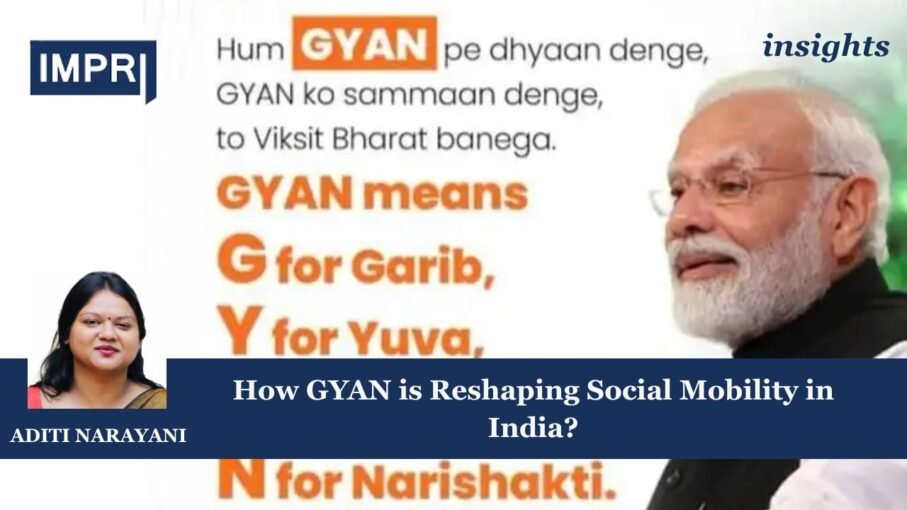
Now, the caste conversation is not around victimhood and marginalisation. It is about empowerment, embodied in the “Gareeb, Yuva, Annadata, Nari” (GYAN) quartet. Caste has been re-coded — from a politics of identity to a politics of development. Modi’s efforts resonate with Amartya Sen’s “capability approach” and seek to make the constituents of GYAN enablers and creators, not patronage seekers.
Dalit women are redefining empowerment, starting their own enterprises and creating an ecosystem to inspire and support others like them who are charting their own path to success. The Dalit youth do not merely see themselves as “quota kids” seeking upward mobility through a government job. They aspire to become job creators. The frame of our ambitions has expanded with the celebration of “Azadi ka Amrit Mahotsav”.
The transformation from farmer to annadata has also resulted in a change in perspective towards agriculture. It is now seen as a way of getting discernible returns for both the annadata and consumers.
Poverty and deprivation are serious concerns for any nation, and how it deals with them shows how it values its citizens. For much of its post-1947 history, India was run by some version of a self-proclaimed socialist government — an ideology premised on eliminating class divides. But the country barely moved in that direction.
Every election cycle had a new slogan for garibi hatao, but this proved to be a ploy to gain power. Nothing much changed for the poor except for the kind of dole, handed down like alms. Under the Narendra Modi government, the gareeb are treated with respect. Direct Benefit Transfer has proved to be a game-changer, providing direct access to funds without making a plea before local officials.
We will face challenging times going forward. For we are not just decolonising our minds but our history too, along with ideas of caste. This is not nostalgic revivalism but a radical negation of the historical marginalisation of communities who were written out of the promise of equality, inclusivity, and justice, even as these were celebrated as the defining ethos of Indic civilisation.
While the language of reservation and victimhood still endures, the dominant narrative hails Dalits, OBCs, and women as aspirational stakeholders in a Bharatiya civilisational project of Viksit Bharat. Through timely government interventions of digital inclusion and entrepreneurial opportunity, the caste spectrum is being rewritten, encapsulated in the GYAN framework that names them as the pillars of India’s 2047 vision, Viksit Bharat has started the discourse on dignity and conscious development that can challenge the structural exclusions of caste and not merely sublimate them under the umbrella of growth.
About the Author
Aditi Narayani is an assistant professor of sociology at Lakshmibai College, Delhi University
The article was first published in Indian Express as With GYAN, India is rewriting the script of caste, marginalisation, and empowerment on 7th January, 2026
Disclaimer
All views expressed in the article belong solely to the authors and not necessarily to the organisation.
Read More at IMPRI
Empowering India’s Youth: Rashtriya Yuva Sashaktikaran Karyakram (RYSK)
Sanchar Saathi Mobile App, 2023
Acknowledgment
The article was posted by Avni Singhai, a Research Intern at IMPRI.