Shakil Ahmed
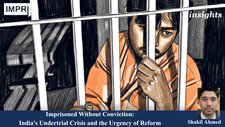
India’s criminal justice system confines 4,34,302 of its 5,73,220 prisoners without conviction the largest undertrial population in the world. This article examines the structural governance failures driving this crisis: an acute judicial capacity deficit, a bail framework that punishes poverty, a legal aid system that provides form without substance, and cooperative federalism that fragments prison reform.
Drawing on Prison Statistics India 2022 (NCRB), the National Judicial Data Grid (2024), and landmark Supreme Court judgments, and illustrated through the case of Jammu and Kashmir’s Kot Balwal Central Jail, the article argues that effective reform demands simultaneous intervention across four institutional nodes — police, courts, prisons, and legal aid — rather than the piecemeal approaches that have repeatedly failed. The Bharatiya Nagarik Suraksha Sanhita, 2023 provides a legislative opening; what is now required is the institutional investment and political will to make it operational.
The Scale of the Problem
Walk into any Indian prison today and you will find a deeply troubling reality. Of the 5,73,220 persons confined in Indian prisons as of the latest available data (Prison Statistics India 2022, NCRB), 4,34,302 have not been convicted of any crime. These are undertrial prisoners individuals detained pending investigation, charge-sheet, or trial — legally presumed innocent, yet confined, often for years, in facilities built for 4,25,609 persons. The gap between sanctioned capacity and actual population tells its own story: India’s prisons are not just overcrowded, they are overwhelmingly populated by the unconvicted.
This is not an anomaly. It is a structural governance failure one that implicates the police, the judiciary, prison administration, and the legal aid ecosystem simultaneously. It is also a constitutional crisis. Article 21 of the Constitution guarantees the right to life and personal liberty. The Supreme Court held, as far back as Hussainara Khatoon v. State of Bihar (1979), that prolonged detention without trial violates this guarantee. Nearly five decades later, the numbers have barely moved.
Why the System Fails
The judge shortage is critical. India has approximately 21 judges per million population against the Law Commission’s recommended 50. Subordinate courts carry vacancy rates of 20-25 percent of sanctioned strength. The National Judicial Data Grid (NJDG) recorded over 4.5 crore cases pending in district courts as of 2024, with approximately 30 percent of criminal matters pending for more than five years. For an undertrial, this arithmetic is devastating: the wait for trial can and routinely does exceed the sentence that conviction would have carried.
Bail law works on paper, not in practice. The Bharatiya Nagarik Suraksha Sanhita (BNSS), 2023 introduced Section 479, entitling first-time offenders who have served one-third of the maximum sentence to bail, improving on the previous one-half threshold under CrPC Section 436A. Yet District Legal Services Authorities lack the staff to proactively identify eligible undertrials, courts lack integrated prison data, and many of the 4,34,302 undertrials remain entirely unaware of their entitlement.
Legal aid, meanwhile, provides form without substance. NALSA panel lawyers are compensated at ₹500–₹2,000 per hearing in most states amounts that structurally preclude serious case preparation. The outcome is a two-tier justice system: those with financial resources retain counsel who invest in their defence; the rest receive formal representation without substantive advocacy.
The burden falls hardest on the most vulnerable. Undertrial incarceration is disproportionately borne by Scheduled Castes, Scheduled Tribes, religious minorities, and those living in poverty groups structurally disadvantaged in furnishing financial sureties, producing fixed addresses as bail conditions require, and accessing legal counsel (Singh & Verma, 2023).
A Case from Jammu and Kashmir
The undertrial problem acquires particular gravity in Jammu and Kashmir. Kot Balwal Central Jail in Jammu the UT’s principal detention facility with a sanctioned capacity of approximately 800 chronically houses populations exceeding its limits, with undertrials forming the dominant share.
What makes J&K structurally distinct is the Public Safety Act (PSA), 1978, a preventive detention law permitting detention for up to two years without trial or charge. PSA detainees do not appear in NCRB’s undertrial counts at all they fall outside conventional criminal procedure entirely. Following August 2019, civil society organisations documented hundreds of PSA detentions in Kot Balwal and Srinagar’s Central Jail, many involving individuals with no prior criminal record, held without legal counsel for weeks.
The case of a young daily-wage worker from Sopore detained in 2021 under a minor IPC offence, unable to furnish the financial surety attached to his bail order illustrates three compounding failures: a bail framework that penalises poverty, a legal aid system that is reactive rather than proactive, and an absent data mechanism that would have automatically flagged his Section 436A entitlement. He remained in Kot Balwal for over 14 months before a DLSA paralegal volunteer identified him during a routine prison camp visit.
What Reform Requires
Effective reform demands simultaneous intervention at four institutional nodes police, courts, prisons, and legal aid. Piecemeal approaches have consistently failed.
- At the police: Mandatory compliance with Arnesh Kumar (2014) arrest restraint directives, with disciplinary consequences for non-compliance; decriminalisation of petty offences under the Bharatiya Nyaya Sanhita
- At the courts: Full operationalisation of BNSS Section 479 through integrated NJDG-prison data, enabling automatic bail-eligibility alerts without requiring undertrials to apply
- In legal aid: Replace the panel lawyer model with district-level Public Defender Offices full-time, salaried, caseload-capped — benchmarked to public prosecutor remuneration
- In prison governance: Statutory conversion of Supreme Court-mandated Undertrial Review Committees (UTRCs) into enforceable obligations, with compliance linked to Central funding under the Modernisation of Prison Infrastructure scheme
The BNSS, 2023 has opened a legislative window. The e-Courts Phase III project (2023–2027) is building the digital infrastructure. The Model Prisons and Correctional Services Act, 2023 offers a modern governance template. The architecture for reform exists. What has been persistently absent is the institutional investment and political will to operationalise these instruments for the individual undertrial the daily-wage worker in Kot Balwal who does not know his rights, cannot afford a surety, and has no one to file his bail application.
India has 4,34,302 reasons to act. Each one has a name.
About the Contributor: Shakil Ahmed is a Policy Researcher with keen interest in Public Policy. he is a fellow of the Public Policy Youth Fellowship.
Disclaimer: All views expressed in the article belong solely to the author and not necessarily to the organisation.
Read more at IMPRI:
Rethinking Government Support for Data Centre
External Partnerships vs. Internal Divisions: A Sovereignty Paradox
Acknowledgement: This article was posted by Anish Pujapanda, a Research and Editorial Intern at IMPRI.