Soumyadip Chattopadhyay
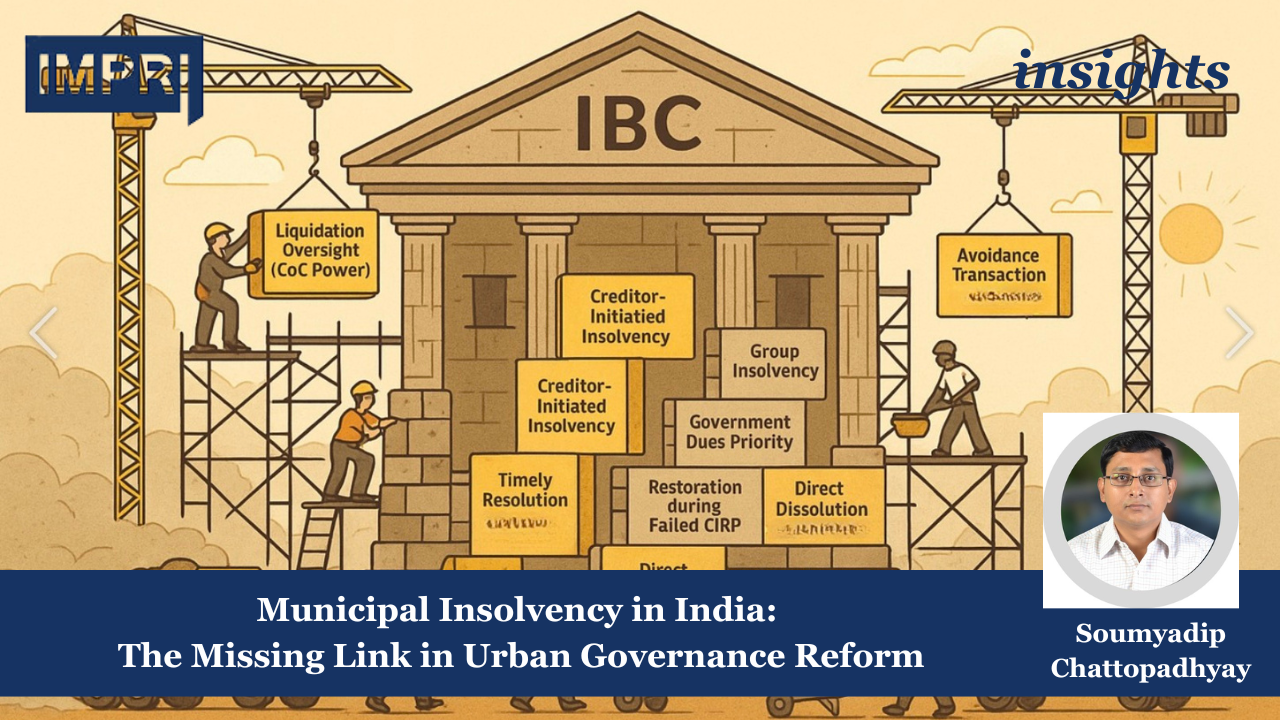
The proposed Municipal Solvency Act aims to address India’s lack of legal clarity on city bankruptcies, ensuring predictable debt resolution and boosting municipal creditworthiness.
The recent introduction of the Insolvency and Bankruptcy Code (Amendment) Bill 2025 in the Parliament have catalysed policy discussions on a dedicated Municipal Solvency Act—signalling that India may finally address its most glaring urban financial regulatory gap. Indian cities borrow from diverse sources—HUDCO, LIC, scheduled commercial banks, specialised infrastructure finance companies, and state financial intermediary funds.
Some cities have ventured into capital markets through municipal bonds. According to the RBI’s 2024 report, borrowings from financial institutions constitute about 5 per cent of total municipal receipts, with HUDCO loans—backed by state government guarantees—accounting for over 80 per cent of commercial debt.
While municipal bonds contribute only a small fraction to total debt, their recent resurgence is noteworthy. Between 2017 and 2023, two-fifths of all bond proceeds to date were raised, driven by new SEBI regulations that set clear eligibility criteria: positive net worth, clean debt repayment records, and an investment-grade credit rating (BBB- or above).
Since April 2019, foreign investors can participate in this market, albeit with a modest 2 per cent cap on State Development Loans. Given the persistent inadequacy of municipal revenue in financing urban infrastructure, this exploration of innovative financing instruments assumes critical importance. As Indian cities increasingly turn to capital markets to fund infrastructure, a troubling question looms: what happens when they cannot repay?
Legal Ambiguities and Real Consequences
State Municipal Acts determine borrowing powers, including authorisation, purpose, limits, tenure, and repayment mechanisms. Municipal bonds in India resemble general obligation bonds, with debt servicing secured through escrow accounts linked to specific tax sources like property tax or project revenues such as user charges and fees.
Some states have provisions for intercepting other revenues (e.g., Madhya Pradesh Municipal Corporation Act, 1956, Section 122 of Bihar Municipal Act applicable for all urban local bodies) or even mortgaging municipal property (e.g., Nagpur Municipal Corporation) to ensure liquidity. However, these ex-ante borrowing regulations remain predominantly ad hoc and discretionary.
More troublesome is the conspicuous absence of any ex-post arrangements for addressing municipal bankruptcy. When cities default on debt, creditors face complete uncertainty about their rights and claim-making procedures. SEBI has yet to issue clear guidelines on debt recovery for insolvent municipalities. It remains unclear whether the Insolvency and Bankruptcy Code or the Debt Recovery Tribunal Act, applicable to corporate debt, can be invoked in cases of municipal defaults. This regulatory vacuum severely undermines creditor confidence and limits the depth of India’s municipal bond market.
Lessons from Abroad
Only a handful of countries have established insolvency frameworks for local governments. The United States offers the most instructive example through Chapter 9 of its Bankruptcy Code. The journey was not smooth—the original 1934 municipal bankruptcy legislation was struck down for violating state sovereignty. The revised 1937 Act, constitutionally affirmed in United States v. Bekins, evolved into today’s Chapter 9 through the 1978 Bankruptcy Reform Act.
Respecting municipal sovereignty, Chapter 9 grants cities considerable discretion over debt adjustments, with courts merely determining insolvency and assessing restructuring plans. There is a provision for automatic triggering of a stay against any creditors’ claim of asset liquidation so that municipalities can continue providing basic public services while negotiating a debt adjustment plan.
Detroit’s 2013 bankruptcy—triggered by a shrinking tax base and rising pension costs—demonstrated this framework’s effectiveness. Under court supervision, the city negotiated with creditors and emerged from bankruptcy within a year with a viable financial restructuring plan. India’s challenge is to adapt these lessons to its own unique constitutional architecture.
Sovereignty vs. Solvency: India’s Dilemma
India faces unique challenges in crafting municipal insolvency laws. Local government is a state subject. Municipalities are constitutionally mandated to provide urban services. Any insolvency framework must balance seemingly contradictory imperatives: uninterrupted delivery of essential urban services and settlement of creditors’ claims.
The conflicts are multifaceted and deeply rooted in our constitutional architecture. First, since bankruptcy falls under the Concurrent List, central insolvency law could impinge on state autonomy over municipal governance. Second, debt restructuring typically requires securing claims on escrowed revenue or municipal assets.
In Detroit’s case, bondholders’ claims on property taxes were deemed unsecured, leading to restructuring through liens on casino tax revenues instead. But India’s situation is far more complex. State governments exercise strong discretionary control over municipal finances. Finance departments approve revenue utilisation and property collateralization through opaque processes.
The real prospect of using local revenue and assets as collateral remains highly uncertain. For example, the underlying structured payment mechanism for Pune Municipal Corporation’s bonds is related to ‘no-lien escrow accounts’. This essentially leaves bondholders’ claims to municipal property or revenue unsecured in case of potential default—a remarkable admission of legal uncertainty.
Cases of debt restructuring require tax increases or tapping revenue proceeds from available municipal taxes. It is unclear how this can be legitimised, let alone operationalised, within our existing constitutional setup without triggering conflicts between state prerogatives and creditor rights.
Municipal bankruptcy resolution in India would inevitably involve three-way negotiations among state governments, municipalities, and investors. Since states control revenue bases, they would dominate these negotiations. The ad hoc nature of such processes, influenced by conflicting political and commercial interests, would limit insolvency provisions’ effectiveness in ensuring efficient risk management for creditors.
Worse still, bankruptcy-induced state bailouts could undermine hard budget constraints at the local level. While providing short-term relief, this allows cities and states to exit insolvency with fundamentally unsustainable financial structures intact—a recipe for recurring crises. Without a clear legal framework, every municipal default risk becomes a political negotiation rather than a predictable legal process.
The Path Forward
India urgently needs an institutionalised framework for municipal default.
First, it is imperative to ensure professional oversight. Just as the RBI appoints administrators for insolvent financial institutions, state governments should nominate Municipal Administrators alongside Insolvency Professionals to monitor negotiations and devise recovery plans. Article 243R of the 74th Constitutional Amendment Act provides for appointing experts with specialised knowledge in municipal administration. These administrators need clear mandates with stipulated timelines for conceiving bailout plans.
Second, transparent enforcement is equally important. State Municipal Acts require comprehensive amendments to identify non-essential assets that can be mortgaged against debt without compromising urban service delivery. Current ambiguities—like provisions for ‘no-lien escrow accounts’ that leave bondholders unsecured—must be eliminated. State municipal acts should be appropriately amended to specify which municipal assets can be attached, under what conditions, and through what procedures.
Third, there should be clear trigger mechanisms. In the US, state laws authorise municipalities to file for bankruptcy. Given apprehensions that Indian states might block cities from declaring insolvency, creditors should have provisions to file when municipalities fail to service debts beyond a pre-specified period.
Fourth, any insolvency framework must acknowledge bankruptcy’s root causes and enforce existing fiscal discipline measures, not merely address symptoms. The framework should incentivise municipalities to build adequate revenue bases before accessing capital markets and mandate regular disclosure of debt-to-revenue ratios. Without these preventive measures, insolvency provisions would merely provide an exit ramp from crises that could have been avoided.
As India urbanises rapidly, our cities cannot afford to remain trapped in a regulatory vacuum. A well-specified municipal insolvency law would signal to creditors that debt restructurings will be predictable and orderly. This certainty would instil investor confidence, ultimately helping municipalities generate resources for urban infrastructure financing on a sustainable basis.
Soumyadip Chattopadhyay is Visiting Senior Fellow and teaches at the Department of Economics and Politics, Visva Bharati University.
The article was first published in ETV Bharat as An Insolvency Law For Cities: India’s Unfinished Reform on 30th December, 2025.
Disclaimer: All views expressed in the article belong to the author and not necessarily to the organisation.
Acknowledgment: This article was posted by Guncha Dandona , Research Intern at IMPRI.
Read More at IMPRI:
Reviving India-Canada Ties: The Moment for a Fresh Start and Renewed Strategy (2025)