Jyoti Poonia
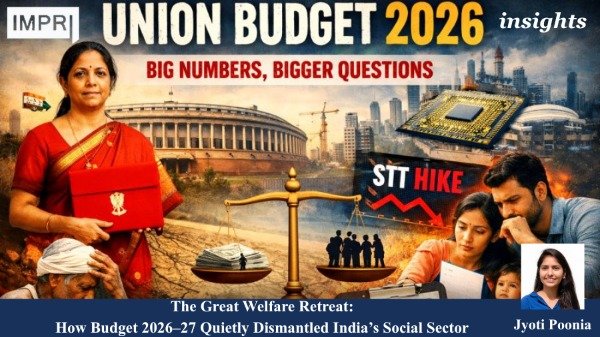
New data and political developments since February reveal the deepening stakes behind the replacement of MGNREGA, cuts to health and environment, and the reduction in LPG subsidies.
Introduction
When Finance Minister Nirmala Sitharaman presented the Union Budget 2026–27, public discourse largely emphasised macroeconomic stability, infrastructure expansion, and fiscal consolidation. However, a closer reading of budgetary allocations, combined with post-Budget developments, reveals a less visible yet significant shift in India’s welfare architecture.
This article builds on an earlier policy brief and incorporates recent developments, including political responses from states, emerging data on LPG pricing, and independent sectoral analyses, to argue that Budget 2026–27 reflects a broader transition from a rights-based welfare framework toward a more discretionary and fiscally decentralised model.
Reconfiguring Rural Welfare: From Legal Entitlement to Administrative Discretion
The replacement of MGNREGA with the proposed VB-G RAM G marks a fundamental shift in India’s rural employment policy.
MGNREGA has historically functioned as a rights-based mechanism, legally guaranteeing wage employment to rural households while embedding accountability provisions. The transition to a notification-based framework introduces administrative discretion, thereby weakening the enforceability of entitlements.
Recent political developments, such as a state assembly resolution urging the continuation of MGNREGA, highlight the significance of this shift (PTI, 2026). Concerns regarding exclusion, uncertainty, and implementation gaps are no longer theoretical but actively contested in the political arena.
Further, the absence of a notified allocation formula months after the Budget has introduced ambiguity in fiscal planning. As reported, several states have begun allocating funds based on past expenditure patterns, despite lacking clarity on future central support (The Hindu, 2026).
Fiscal Federalism and Redistribution of Responsibility
The shift from full central funding to a 60:40 cost-sharing model represents a critical reconfiguration of Centre–state fiscal relations.
This change occurs in a context where many states face fiscal stress due to declining transfers and rising liabilities. As such, the increased financial burden may constrain states’ ability to effectively implement welfare schemes, particularly in poorer regions.
Scholarly and policy discussions have long emphasised that decentralisation must be accompanied by adequate fiscal capacity. In its absence, such restructuring risks widening inter-state disparities and undermining the principle of cooperative federalism.
Energy Access and Subsidy Rationalisation
Post-Budget developments in the energy sector further illuminate the tensions between fiscal discipline and social protection. In March 2026, LPG prices were increased by ₹60 per cylinder, exacerbating affordability concerns (Vasisht, 2026).
India’s dependence on imported LPG, primarily from West Asia, renders domestic pricing vulnerable to geopolitical disruptions. While global factors play a role, domestic subsidy rationalisation has amplified the impact on low-income households.
As noted in recent analyses, oil marketing companies are facing substantial under-recoveries due to high international prices (Aditya & Choudhary, 2026). In this context, reduced subsidies risk reversing gains in clean fuel adoption, pushing households back toward biomass fuels with adverse implications for health and gender equity.
Environmental Governance and Policy Gaps
The reduction in allocations for pollution control, particularly under the National Clean Air Programme, reflects a concerning mismatch between environmental priorities and fiscal commitments.
Independent analyses indicate that current funding levels are insufficient to sustain city-level action plans, which require consistent investment in monitoring, enforcement, and mitigation strategies (Iyer, 2026).
Moreover, the absence of targeted allocations for pollution hotspots and limited support for clean mobility initiatives suggest a fragmented approach to environmental governance. This is particularly problematic given the well-documented links between air pollution, public health outcomes, and economic productivity.
Public Health: Persistent Underinvestment
Despite increased policy attention, public health expenditure remains significantly below the targets set in national policy frameworks. Post-Budget announcements have emphasised skill development and medical tourism, but these initiatives do not address systemic deficiencies in domestic healthcare provision.
Health policy experts have argued that current allocations fall short of achieving universal health coverage and reflect a disconnect between stated objectives and fiscal priorities (Jan Swasthya Abhiyan, 2026).
Persistent underinvestment in primary healthcare infrastructure, combined with high out-of-pocket expenditure, continues to limit access for vulnerable populations.
Towards a Structural Interpretation
Taken together, these developments suggest a broader transformation in India’s welfare state. Four interrelated trends can be identified:
- A shift from rights-based entitlements to discretionary frameworks
- Redistribution of fiscal responsibility to states
- Prioritisation of growth-oriented sectors over social expenditure
- Fragmented policy responses across interconnected domains
This pattern indicates that the observed changes are not isolated adjustments but elements of a systemic restructuring.
Conclusion
The Union Budget 2026–27 represents a critical moment in India’s policy trajectory. While the emphasis on economic growth and fiscal prudence is evident, the concurrent restructuring of the social sector raises important concerns regarding equity, access, and accountability.
The transition toward discretionary welfare mechanisms, combined with shifting fiscal responsibilities, may have long-term implications for the social contract between the state and its citizens.
A more balanced approach, integrating fiscal discipline with sustained investment in social protection, will be essential to ensure that development remains inclusive and equitable.
References
Aditya, A., & Choudhary, P. K. (2026, March 10). India’s subsidy rationalisation: Fiscal discipline vs social protection. Telangana Today.
Iyer, S. R. (2026, March 5). Budget 2025–26: Clean Air Still an Afterthought. TERI.
Jan Swasthya Abhiyan. (2026, February 2). The Union health budget betrays national health policy promises. Reported in The Indian Express.
PTI. (2026, March 18). Jharkhand assembly passes resolution urging Centre to continue with MGNREGA. ThePrint.
The Hindu. (2026a, March 19). Despite the Centre’s delay, States set aside funds for rural jobs programmes.
The Hindu. (2026b, March 17). Opposition’s protest against new rural jobs Act is a failure: Shivraj Singh Chouhan.
Vasisht, P. (2026, March 16). Explainer: Why there’s an LPG crisis in India. Financial Express.
Down To Earth. (2026, January 31). Budget 2026–27: Drastic cuts in allocation for LPG connections to the poor.
About the Contributor: Jyoti Poonia is a Post -Graduate in Political Science from the University of Delhi. She is a fellow of the Public Policy Youth Fellowship and a Research and Editorial Intern at IMPRI.
Disclaimer: All views expressed in the article belong solely to the author and not necessarily to the organisation.
Read more at IMPRI:
Beyond the Summit: Bridging the Gap Between Policy and Funding
Why India Should Not Reverse Course on the US Trade Deal
Acknowledgement: This article was posted by Anish Pujapanda, a Research and Editorial Intern at IMPRI.