TK Arun
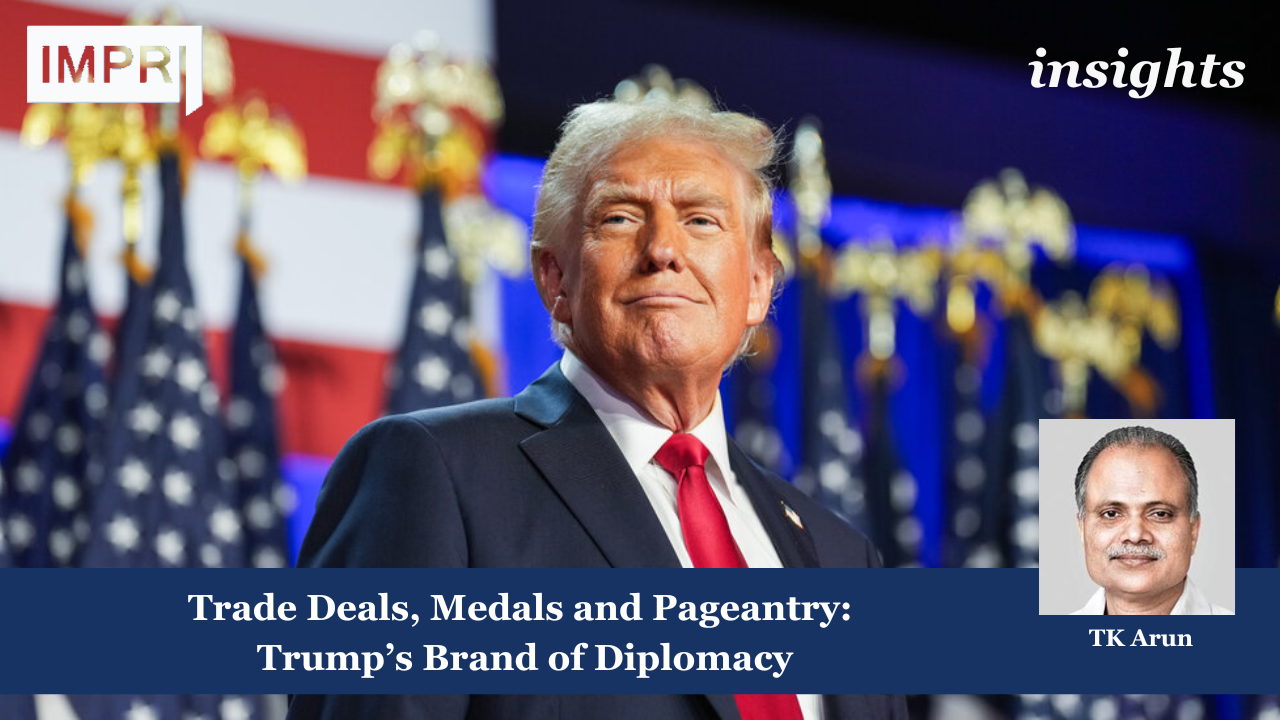
Even as Hurricane Melissa ripped off roofs in Jamaica, killed dozens in Haiti, and wreaked damage in the Dominican Republic and Cuba, another kind of whirlwind swept through South-East and East Asia. US president Donald Trump visited Malaysia, Japan and South Korea in rapid succession, taking home trade deals, a gold medal and a gold crown, the latter two artefacts being gifts — bribes, say the uncharitable — from South Korea.
The highlight of Trump’s Asian tour was, of course, his meeting with Chinese leader Xi Jinping. While no trade deal has been finalised and published after the meeting, Trump claimed that the meeting between the leaders of the world’s largest and second-largest economies scored 12 on a scale of 0-10.
Benefit For India?
The details are scarce, except for China suspending its export restrictions on rare-earth products for a year. Additionally, the US has reduced the 20% penal import duty levied on imports from China, linked to the alleged crime of exporting fentanyl precursor chemicals,by half. China, which had stopped agricultural imports from the US, causing much heartburn among Trump’s ardent rural voters, has placed an order for one shipload of soybeans.
The suspension of the export restriction on rare earth exports is likely to benefit all countries, including India. It is politic for China to suspend export restrictions in general, rather than to appear to have succumbed to American pressure.
Diplomacy, Trump-Style
In Japan, Trump visited the Imperial Palace in Tokyo, to call on Emperor Naruhito, where he was greeted with much pomp and ceremony. Then, Trump met with Japan’s newly elected woman prime minister, Takaichi Sanae, whose proximity to the late Shinzo Abe, who had had a good relationship with president Trump in his first term, helped her get along well with the US president.
Again, while no formal deals have been signed, it seems probable that the import duty on car exports from Japan would be reduced to 15%, on par with automobile imports from other major auto exporters. Japan made some progress in identifying how precisely Japanese companies would make good on the ransom of $550 billion investment in the US that Trump had extracted from Takaichi’s predecessor in return for agreeing to a trade deal.
South Korea also appears to have won reprieve on automobile tariffs, now bringing them down to the 15% all other major automobile exporters face in the US. At the same time, there is less clarity than in Japan’s case on how the ransom of $350 billion of Korean investment in the US that Trump had extracted in the past would be delivered.
In Malaysia, to attend the ASEAN summit, Trump fortified his claim to a Nobel prize for peace by getting the leaders of Cambodia and Thailand, who had exchanged hostilities recently, to commit themselves to peace. On his Asian tour, Trump repeated his claim to have averted a war between India and Pakistan, adding a detail not mentioned earlier: he claimed to have threatened both countries with US import duties of 250%, if they did not stop hostilities.
Peace At A Price
Trump’s biggest claim to a Nobel Peace Prize is, of course, the Gaza peace plan. This seems to be unravelling, with Israel killing 104 Palestinians in one major attack, supposedly in retaliation for a Hamas attack on an Israeli soldier. Trump says the peace deal holds. If that is true, it would give Palestinians the unique distinction of being killed peaceably in a military strike.
Back home in the US, the US Fed cut the Federal Funds rate by 25 basis points to between 3.75% and 4%. However, given that inflation stays sticky, further rate cuts in the current calendar year should not be taken for granted, warned Fed chairman J Powell. This went against the expectation of yet another rate cut in the current year, and sent the yield on 10-year US treasuries soaring above 4%.
Highs And Lows Of AI
The market capitalisation of NVIDIA, the predominant maker of AI chips, rose above $5 trillion. Microsoft’s valuation rose above $4 trillion, given its status as the single largest investor in OpenAI, whose restructuring opens the way to an initial public offering. OpenAI began with a dual structure, a non-profit and a for-profit arm controlled by the non-profit.
Now, the for-profit part has been converted into a public benefit company (PBC), which makes profits but is committed to meeting some social goals, and the non-profit, the OpenAI foundation, becomes a shareholder with a large stake, worth $130 billion, in OpenAI Group PBC. Microsoft’s stake, at 27%, is valued at $135 billion. Open AI Group PBC is expected to be valued anything between $500 billion and $1 trillion, when it goes public. Apple is the third of the trio to float in this bit of stratosphere reserved for companies valued at more than $4 trillion.
Even as AI is pushing up stock market indices, it is also eating into jobs. Amazon announced it would reduce its corporate workforce by 14,000, thanks to the deployment of AI. Meta is laying off 8,000. Challenger, Gray and Christmas, a company that goes by the delicate description of an executive outplacement firm, gave an estimate of combined job losses of 172,000 in corporate America, with tech and finance leading the downsizing. That, of course, is scary Halloween stuff, rather than Christmas cheer. Unemployment is contained by the investment spree in the US in data centres for AI, and in power generation to feed the data centres.
Populism And Penalty
Trump acolyte and libertarian Javier Milei secured a surprising victory in mid-term elections to the Argentine legislature. Trump had said that the continuance of America’s $20 billion swap line extended to Argentina was conditional on Milei’s party coming out on top in the elections. Milei lives to die another day.
However, the rise of the populist right is not a universal global trend. In the Netherlands, a centrist formation has emerged the leader in elections to constitute a new legislature, after the previous one, in which Islamophobe Geert Wilders had secured the most seats, proved incapable of sustaining a stable coalition.
Trump has announced an extra 10% tariffs on imports from Canada, as a penalty for the Ontario provincial government running TV ads that show Republican idol Ronald Reagan roundly criticising tariffs on imports. Steve Bannon, widely considered a Trump Consigliere, has told The Economist that Trump would be president for a third term, even if that goes against the US Constitution as it stands. Trump has since refused to rule out the possibility.
In India, the electoral battle for Bihar is warming up. The Election Commission is gearing up to carry out Special Intensive Revision of electoral rolls in other states as well. However, the exercise is likely to be less controversial than the one in Bihar, given that Aadhaar and the ration card would be accepted as valid ID documents.
Justice Surya Kant is slated to succeed Justice BR Gavai as the next Chief Justice of India. Some of the agenda has already been set for him by the Allahabad high court, which has asked the Supreme Court to refrain from interfering with service rules for the subordinate judiciary, leaving that to the high courts.
HSBC’s flash PMI failed to show any great growth momentum being imparted to the Indian economy by the GST rate cuts. The composite output index for October showed a decline from the previous month, and stood at the lowest point since June. The index for manufacturing did rise a bit but that rise was offset by the decline in the index for services.
India awaits concrete steps by the government to raise the growth momentum.
TK Arun is a Journalist, formerly Editor, Opinion at the Economic Times
The article was first published in The Core as Trade deals, A Gold Medal And A Crown: Diplomacy Trump Style on October 31, 2025
Disclaimer: All views expressed in the article belong to the author and not necessarily to the organisation.
Read More at IMPRI:
Trump’s “Make It in America” Push Is Falling Flat
Acknowledgment: This article was posted by Urvashi Singhal, Visiting Researcher and Assistant Editor at IMPRI.