Event Report
Organiser: IMPRI Gender Impact Studies Centre (GISC), IMPRI Impact and Policy Research Institute, New Delhi
Date: 10th December 2025
Format: #WebPolicyTalk – Panel Discussion(Zoom | YouTube Live | Spotify)
Introduction
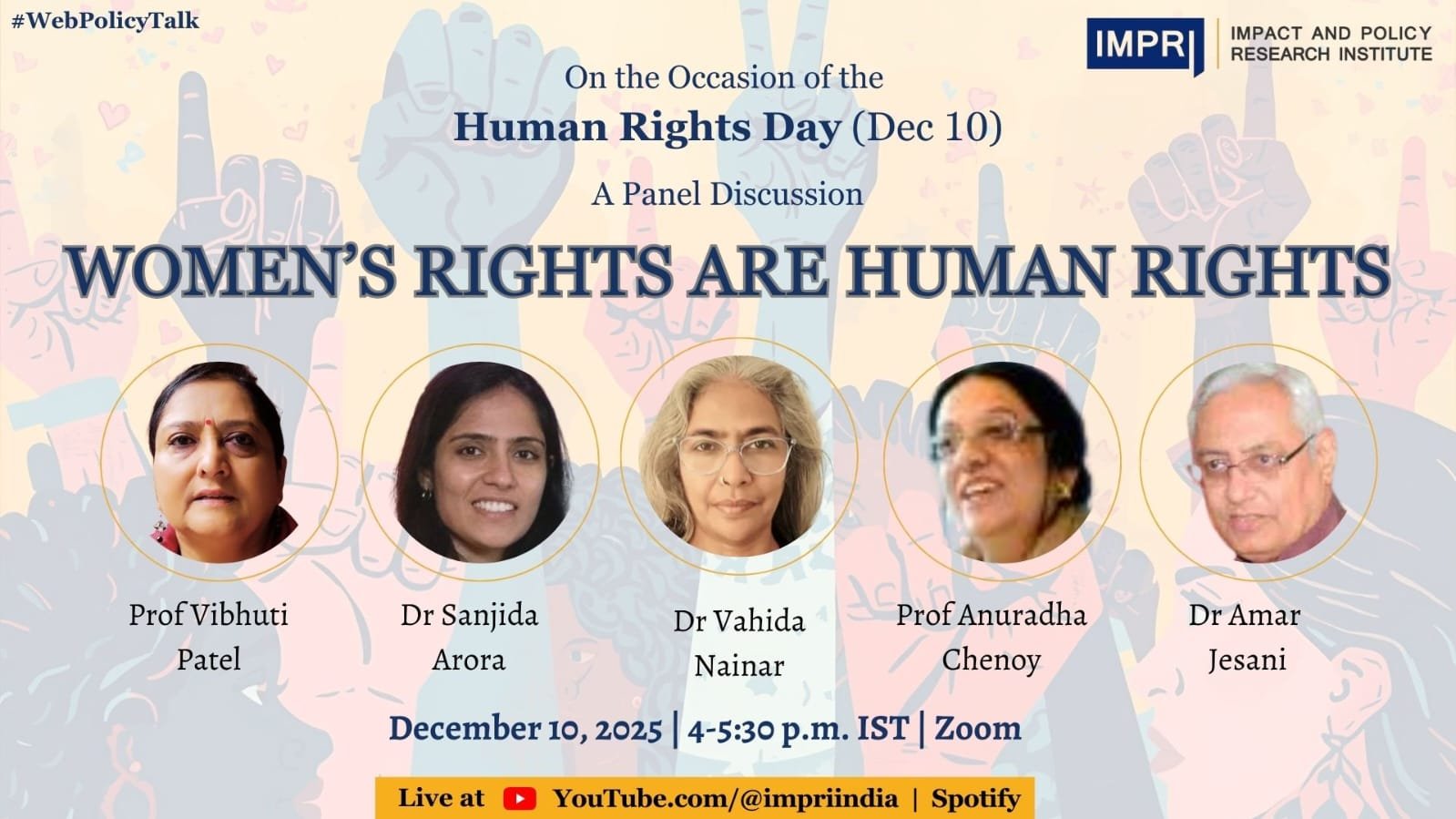
On the Occasion of Human Rights Day (10th December 2025), the IMPRI Gender Impact Studies Centre(GISC), under Impact and Policy Research Institute(IMPRI), New Delhi, brought together leading researchers, bioethicists, and scholars for a critical and interdisciplinary dialogue for a Gender Gap #WebPolicyTalk on “Women’s Rights are Human Rights”. This online panel discussion reaffirms a core principle of global justice: women’s rights are inseparable from human rights.
Despite decades of activism and legal progress, women, especially in India, continue to face systemic discrimination, violence, and exclusion. This discussion looks closely at the development of women’s human rights, ongoing legal and institutional gaps, and the need for greater accountability and better implementation. By focusing on real experiences along with policy viewpoints, the session enhances understanding of intersectional challenges and examines ways to achieve rights-based empowerment and true universal equality and justice.
Session Overview
The two-hour workshop was chaired by Professor Vibhuti Patel, Visiting Distinguished Professor, IMPRI. The expert panelists included Dr Vahida Nainar, Independent Researcher and Gender & Human Rights Consultant and Senior Fellow at IMPRI; Professor Anuradha M. Chenoy, Adjunct Professor at the Jindal School of International Affairs, O.P. Jindal Global University, and Former Dean at the School of International Studies, Jawaharlal Nehru University, New Delhi; Dr Sanjida Arora, Senior Research Officer at the Centre for Enquiry into Health and Allied Themes (CEHAT); and Dr Amar Jesani, Independent Researcher and Teacher in Bioethics and Public Health, Editor of the Indian Journal of Medical Ethics, and Visiting Senior Fellow at IMPRI.
The programme was convened by Dr Simi Mehta and Dr Arjun Kumar, with moderation support by Ayush Verma, Research Intern at IMPRI.
Opening Remarks
Opening the session, the moderator highlighted that Human Rights Day serves not only as a commemoration of the Universal Declaration of Human Rights (UDHR), adopted in 1948, but also as a moment of reflection on whose rights have been historically recognised and whose have been systematically excluded. While the UDHR established a global moral framework, its early formulations largely reflected patriarchal assumptions, marginalising women’s lived realities. Feminist scholars and activists have long argued that the “universal” was, in practice, deeply gendered.
Inaugural Perspective: From Recognition to Implementation
The session traced the long struggle through which women’s concerns were brought into the human rights framework, from early feminist critiques of the UDHR, to the 1979 Convention on the Elimination of All Forms of Discrimination Against Women (CEDAW), and most notably, the 1993 Vienna World Conference on Human Rights, where the rallying call “Women’s Rights are Human Rights” gained international recognition. Yet, as the discussion underscored, formal recognition has not automatically translated into substantive equality or justice for women.
Speaker Section
Historical Evolution of Women’s Human Rights: A Global Perspective
In her opening remarks, Professor Vibhuti Patil contextualised women’s rights within the broader history of international human rights law. She noted that it was only after sustained feminist pressure that women’s issues, particularly violence against women, were acknowledged as legitimate human rights concerns. Civil society activism, public tribunals, and transnational feminist networks played a critical role in challenging the public–private divide that had long excluded domestic violence, sexual violence, and reproductive rights from human rights discourse.
Building on this, Professor Anuradha M. Chenoy offered a global political economy perspective on women’s human rights. She argued that current setbacks in women’s rights cannot be separated from larger geopolitical and economic processes. She pointed out ongoing conflicts, especially in Gaza, and highlighted how women often face severe violence during war and occupation. Citing recent UN expert reports, she described the arbitrary detention, sexual abuse, and inhumane treatment of Palestinian women. She emphasised that men still make most decisions about war and peace, while women remain excluded from negotiation discussions.
Professor Chenoy further argued that the current global backlash against women’s rights is closely linked to neoliberal capitalism, the rise of oligarchic power, militarisation, and the strengthening of hyper-masculine political cultures. According to her, feminist movements challenge these structures. This explains why women’s rights are often the first to be rolled back during political and economic crises. She stressed that without safeguarding women’s rights, the broader human rights framework itself remains fragile and incomplete.
Feminist Movements and Human Rights Frameworks
Dr Vahida Nainar reflected on her decades-long engagement with the global women’s movement, particularly recalling the historic Women’s Human Rights Tribunal at the Vienna Conference in 1993. She emphasised that recognising women’s rights as human rights provided feminist movements with a powerful conceptual and legal tool to reframe gender-based injustices as universal violations rather than “private” or cultural matters.
Dr Nainar outlined key principles that support the women’s human rights framework. These include the universality of rights, which rejects cultural or religious justifications for practices like child marriage and female genital mutilation. Another principle is breaking down the public and private divide through the doctrine of due diligence. This principle requires states to prevent, prosecute, and punish violence, even when it is committed by private individuals. Lastly, there is a focus on substantive equality instead of formal equality, acknowledging the need for actions that address historical disadvantages.
She also emphasised the importance of intersectionality. She noted that women’s experiences of discrimination are influenced by caste, class, religion, ethnicity, disability, and migration status. Dr Nainar argued that a rights-based approach must tackle these overlapping vulnerabilities to be effective. This includes areas such as political participation, reproductive rights, and access to housing, health, and justice.
Gender-Based Violence and Public Health Interventions
Shifting the focus to India, Dr Sanjida Arora talked about CEHAT’s important work in recognising violence against women as a public health issue. She explained why Dilaasa was created. This hospital-based crisis intervention centre started in 2000 in partnership with the Brihanmumbai Municipal Corporation. Placing crisis response within the health system, she argued, allows for early intervention, provides survivors with non-judgmental support, and reduces further victimisation.
Dr Arora detailed CEHAT’s work to change medical education and healthcare practices by adding gender sensitivity, intersectionality, and human rights to clinical training. She also talked about advocating for respectful maternity care, creating gender-sensitive medico-legal protocols for survivors of sexual violence, and the challenges from new forms of violence like cyber abuse. She noted that digital violence often overlaps with domestic and sexual violence, which calls for new legal and institutional approaches.
Reproductive Rights, Abortion, and Legal Contradictions
Dr Amar Jesani provided a nuanced analysis of women’s reproductive rights, particularly abortion access in India. He noted that India’s Medical Termination of Pregnancy Act, first enacted in 1971, remains relatively progressive compared to many countries. However, he cautioned that legal permission does not automatically ensure access. Socio-cultural stigma, lack of confidentiality in public health facilities, and provider bias continue to restrict women’s reproductive autonomy.
Dr Jesani also highlighted legal contradictions between the MTP Act and the Protection of Children from Sexual Offences (POCSO) Act, which mandates reporting of sexual activity involving minors. This conflict, he argued, often deters adolescent girls from seeking safe abortion services, pushing them toward unsafe alternatives. He stressed the need to view abortion not only as a legal right but as a socio-economic right, requiring state-supported, accessible, and non-discriminatory healthcare systems.
Conflict, State Violence, and the Erosion of Health Rights
Reflecting on five decades of public health activism, Dr Jesani also discussed the erosion of universal healthcare systems under neoliberal policies. He noted that privatisation, underfunding of public health infrastructure, and market-driven healthcare disproportionately harm women, children, minorities, and the poor. In conflict zones, he warned, health systems themselves have become targets, as seen in Gaza and other war-torn regions, undermining long-standing humanitarian principles of medical neutrality.
Voices from Participants and Way Forward
The interactive discussion that followed had participants posing important questions about women’s political representation, honour crimes, the situation of women in Afghanistan, sex workers’ rights, and the empowerment of rural women. panellists highlighted the need for ongoing feminist organising, legal accountability, economic empowerment, and support from institutions. They also pointed out that raising awareness must be ongoing and based in local contexts, blending grassroots mobilisation with policy advocacy.
In her concluding remarks, Professor Vibhuti Patil reflected on the journey of the women’s movement, which has included street protests, tribunals, institutional interventions, and policy engagement. She noted that patriarchy is adaptive and persistent, demanding constant vigilance and resistance. By connecting women’s rights to political economy, budgeting, and global governance, she argued that real gender justice cannot happen without structural change.
Conclusion
The session confirmed that women’s rights are not just symbolic statements; they are real experiences shaped by laws, policies, institutions, and power dynamics. As global and national environments face increased resistance against gender equality, the discussion highlighted the need for collective action, intersectional understanding, and governance focused on rights. On Human Rights Day, the panel reminded us that the fight for women’s rights is linked to the fight for democracy, justice, and human dignity.
Acknowledgements
IMPRI Gender Impact Studies Centre (GISC) expresses its sincere gratitude to Professor Vibhuti Patel for chairing the session and guiding the discussion with depth and clarity. We thank the esteemed panellists: Dr Vahida Nainar, Professor Anuradha M. Chenoy, Dr Sanjida Arora, and Dr Amar Jesani, for their insightful and thought-provoking contributions.
We also acknowledge the efforts of the conveners, Dr Simi Mehta and Dr Arjun Kumar, and appreciate the moderation support by Ayush Verma, a Research Intern at IMPRI. IMPRI is grateful to all participants for their active engagement, which enriched the dialogue and reinforced the collective commitment to advancing women’s rights as human rights.
Acknowledgement: This session report was written by Vatsala Sinha, a research intern at IMPRI.