
Srishti Sharma
The heart-wrenching pictures of the amusement park in Khan Younis capture a devastating
contrast, where vibrant echoes of children’s laughter are replaced by screams of horror, a
grim depiction of how Israeli bombardment has left Palestine, particularly Gaza, in ruins.
Even after the ceasefire that was announced on 10th October, 2025, there have been multiple
violations by the Israeli government in Gaza. As of the latest data, the government media
office in Gaza has reported approximately 393 violations, and the death toll has only been
increasing instead of what was expected out of this ceasefire.
While the inhumanity and destruction of epic proportions have nearly destroyed Gaza, the
constant bombing, displacement, blockage of humanitarian aid, electricity outage, food
shortage, and psychological trauma have led to a humanitarian exacerbation of the entire
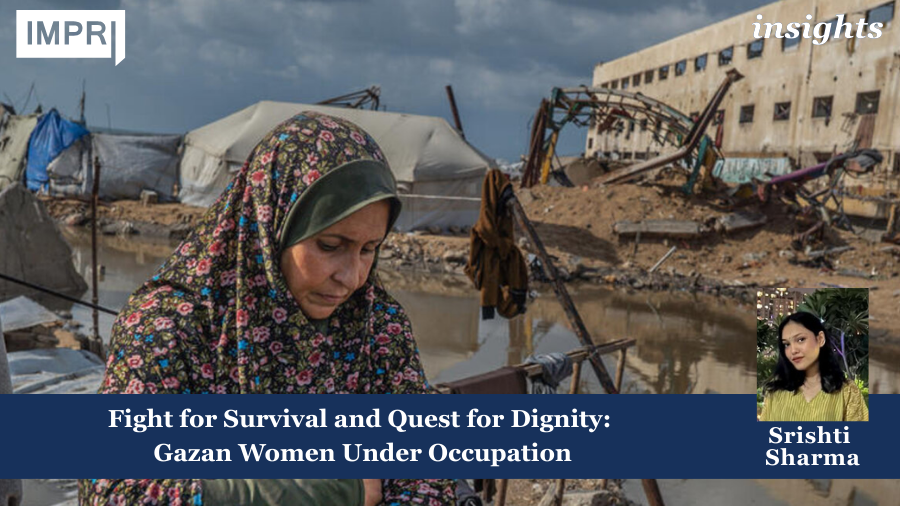
population of Gaza. Behind this cruel brutality lies a human story, and among these stand the
women who, along with these challenges, are fighting not only for their survival but for their
dignity as well. The war has impacted women in ways that the mainstream media has
overlooked and excluded from the humanitarian discourse. The gendered suffering that
Gazan women are being exposed to can be understood through Maslow’s hierarchy of needs.
This model can help us in exploring the unmet psychological, physical, and reproductive
needs of these women.
Now, if we look at the lowest rung of Maslow’s hierarchy of needs, the physiological needs.
Women in Gaza are battling for basic necessities, food, water, and shelter. With them being
the primary caretakers in most cases, they are the ones who prioritise feeding their whole
family, while starving themselves; they are the ones who struggle to access clean water and
hygiene products during menstruation, and they are the ones who give birth in unfathomable
conditions. Many women avoid going through extra struggle due to a scarce supply of water
and hygiene products, and indulge in contraceptives, which then leads to irregular cycles,
abnormal bleeding, and mental distress. Pregnant women are forced to give birth in broken
infrastructures, without anaesthesia or any proper care. The cases of miscarriage and
premature births have skyrocketed since the war. These women not only lack proper
facilities, but they also experience certain abnormalities or the death of their newborns. This
not only infringes on the lowest set of needs in the hierarchy, but it also violates other needs,
such as safety, mental or emotional needs, and security needs. Moreover, the top-most need,
self-actualisation, seems like a far-fetched idea for the women in Gaza. With women
struggling even to meet their basic needs, the attainment of self-actualisation seems beyond
imagination at the moment. Maslow’s theory of needs was developed as a motivational
model, not to elaborate on human suffering. However, the model is now being used to expose
the extent of humanitarian collapse in Gaza. Seeing the dismantling of the entire hierarchy in
the context of Gaza is not just representing deprivation of needs, but the level of
dehumanisation. For Gazan women, these unfulfilled needs are not just an abstract theory
but a daily reality along with erosion of mind, body, and spirit. Acknowledging this deprivation is the initial step, and taking action on this is a collective moral responsibility of
the global community.
Talking about global support, while the entire community should come forward to support
this cause, more specifically, assistance from countries that have adopted a feminist foreign
policy, such as Canada, Germany, and France, is a crucial test of this policy in action. The
FFP framework emphasises advocacy for peace-building, lived experiences, and the
protection of marginalised individuals. Yet in reality, most FFP states have taken political
positions that prioritise geopolitical interests over feminist commitments. Many have failed to
acknowledge this humanitarian exacerbation, restricted pro-Palestine demonstrations, or
withdrawn funding from UNRWA following Israeli allegations that remain unproven.
The contradiction between these nations’ commitment to feminist values and their actual
response or action showcases hypocrisy in the global application of feminist foreign policy.
This suffering cannot be seen as something which is a mere product or collateral damage of
war; the damages are far beyond, exposing the exacerbation of basic human rights,
reproductive or sexual rights and freedom, and the psychological trauma. The breakdown of
every layer of Maslow’s hierarchy portrays how women are being deprived not only of
survival needs but are also stripped of their dignity, mental health, and autonomy. The
international community has failed to protect Gazan women, especially the nations that
profess values of feminism. This ignorance underscores the urgent need to rethink global
feminist and humanitarian responses.
Gazan women are not passive or silent victims; they are enduring, fighting, resisting, caring,
rebuilding, and mourning all at once. Recognising their pain, listening to or sharing their
stories, and advocating for immediate cessation of violence is not merely a political
gameplay; it is a moral obligation. The world must act collectively, not through selective
solidarity but through a shared understanding that the rights of Gazan women are inseparable
from the universal principles of humanity, justice, and peace.
About the author
Srishti Sharma is a Ph.D. scholar at the Central University of Punjab whose research examines Feminist Foreign Policy in India. Her work engages with feminist IR theory, the Women, Peace and Security agenda, and gendered policymaking to advance inclusive approaches in global governance.
Disclaimer
All views expressed in the article belong to the author and not necessarily to the organisation.
Read Also
The Scars Remain: Gaza Beyond the Trump–Netanyahu Ceasefire
Flickers of Hope, Shadows of Uncertainty in Gaza’s Elusive Peace