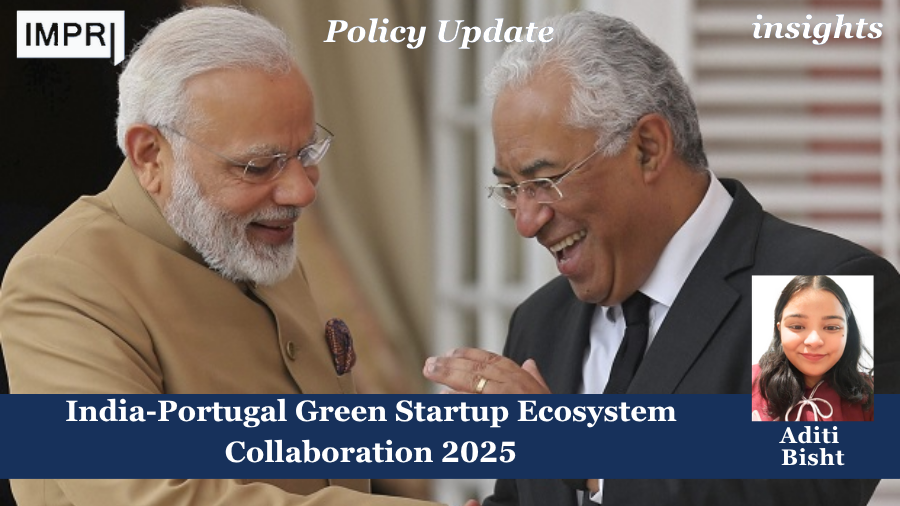
Policy Update
Aditi Bisht
Background
India and Portugal have a deep-rooted and growing partnership that has developed into a modern partnership based on technology, innovation, and sustainability. The bilateral relationship, which dates to the establishment of diplomatic relations in 1975, will celebrate its 50th anniversary in 2025. Over the years, the relationship has developed through political goodwill and high-level exchanges and a series of strategic agreements that have given that relationship a foundation for cooperation in diverse sectors, including renewable energy, defense, science, and technology, and information technology.
This future-looking partnership has regained forward momentum since Prime Minister Narendra Modi’s meeting on the sidelines of the G20 Summit in Rio with Portuguese Prime Minister Luís Montenegro in November 2024. The formal visit of H.E. Mr Paulo Rangel, Portugal’s Minister of State and Foreign Affairs, to India in December 2024 reinforced both sides’ shared commitment to expanding collaboration related to green hydrogen, renewable energy, collaboration on startups, and youth mobility and travel.
The Discussion Mr. Rangel had with India’s External Affairs Minister Dr S. Jaishankar showed potential for cooperation in the areas of IT, innovation and sustainable development, which is important to both India and Portugal’s growth strategies. At the same time, India’s expanding engagement with the European Union has heightened its access to cutting-edge research and high-tech innovation and products in Portugal and the future of young entrepreneurship in India will benefit from Portugal and further increase the two sides’ collaboration.
Functioning
The functioning of the India–Portugal green startup collaboration has emerged from a robust institutional structure and other ongoing programs, sponsored by both national and European programs. The India–Portugal Startup Hub was launched in 2020, as a platform for connecting entrepreneurs, investors, and innovators from both countries that allows for cross-border collaboration, business mentored programs, and technology transfers in sustainability-related sectors (renewable energy, waste management, etc.), including green hydrogen. It exists as a complementary structure to the larger EU research framework of Horizon Europe, in which India participates in multiple projects through co-funding.
Within this institutional structure, India and Portugal coordinate through a variety of mechanisms that include Joint Economic Committees, as well as Bilateral Working Groups with specific mandates for Renewable Energy, IT & Electronics, and Agriculture. In addition, the Portugal–India Business Hub (PIB Hub) connects private sector actors in both countries, particularly startups and small and medium enterprises (SMEs) to government-sponsored innovation programs. Portuguese technology companies, such as VisionBox, Efacec, and Petrotec Group, have established themselves in India in industry-related machinery and automation and green engineering.
At the same time, Indian firms including Wipro, TCS, Mahindra, and Aurobindo Pharma have made investments in Portugal to leverage its strategic location in the EU and access to Portuguese-speaking countries such as Brazil and Mozambique.
The operational structure of India-EU clean tech collaboration, under which Portugal actively participates in projects funded by the European Union, aims at specific research areas in these initiatives, such as EV battery recycling, marine plastic litter reduction, and waste-to-hydrogen technology. The total funding for these joint projects amounts to around EUR 60 million, with the Horizon Europe programme contributing and India matching the funds. These projects aim to promote cooperation across continents between research institutions, startups and public agencies. Portugal and India’s collaboration with respect to innovation, while also providing entrepreneurial activities within a clean technology framework, allows green startups to convert research outputs into scalable business solutions.
Performance
In recent years, there have been encouraging improvements in India-Portugal bilateral cooperation on trade, innovation and clean technology. According to data from the Government of India, bilateral trade was approximately US$1.20 billion in FY 2022-23, with India having a healthy trade balance. In FY 2022-23, India’s exports to Portugal were US$1.00 billion and imports were US$196 million. Major exports from India included petroleum products, cotton yarns, iron and steel and pharmaceuticals, while exports from Portugal were largely paper goods, industrial machinery and chemicals.
This data shows the strength of the former industrial sectors, while new collaborations in renewable energy and startups demonstrate an evolving technology-based partnership.
With respect to innovation, innovation ecosystems in both countries are now more formally aligned with agreements and collaborative institutions. The 2017 MoU between Invest India and Startup Portugal was a foundational step that enabled a more structured focus on entrepreneurship and technology transfer. Since that initial agreement, several bilateral workshops, hackathons and innovation exchanges have taken place. The 2025 India-EU TTC meeting further advanced innovation cooperation by prioritizing technology market uptake and joint research and innovation initiatives focusing on startups and incubators. The TTC also facilitated a Matchmaking Event for Indian and European startups focusing on clean technology.
Another indicator of the effectiveness of the bilateral framework is seen through sectoral investments. From 2000 to 2022, total Portuguese FDI inflows to India have seen US$120.91 million in FDI inflows from Portuguese companies such as Martifer, Visabeira and Petrotec in the infrastructure and green energy sectors. Indian investments are estimated to be energy sources of 450 million dollars in Portugal, led by Indian companies Aurobindo Pharma (Generis), Wipro, and Mahindra, among others. Thus, this reciprocal investment between India and Portugal indicates a balanced partnership based on similarly identified growth priorities and a nexus for technology.
Impact
The influence of the India–Portugal green collaboration is multifaceted—combining environmental, economic, and institutional benefits. On the environmental front, integrated research in conservation of EV battery recycling and hydrogen energy is directly reducing carbon emissions and supporting circular economy systems. Portugal’s capability in renewable energy and India’s flourishing electric vehicle ecosystem creates a potent synergy for sustainable innovation. Joint research initiatives in marine plastic litter reduction are both in alignment with the commitment of the two countries to greater global sustainability and the protection of marine biodiversity from marine pollution.
From an economic perspective, these initiatives are producing new opportunities for green startups. The India–Portugal Startup Hub provides entrepreneurs access to different market spaces, research infrastructure, and funding mechanisms. Both Indian and Portuguese startups are increasingly engaging with acceleration programs from ARAI(Automotive Research Association of India) or the EU with JRC (Joint Research Centre). Experts from India have been trained at JRC’s E-Mobility Lab in Italy, bringing expertise in EV interoperability and electromagnetic compatibility (essential for scaling electric mobility solutions) back to India. On a strategic level, the collaboration enhances India’s integration into European green technology networks while providing Portugal access to India’s vast innovation ecosystem. It also supports India’s local sustainability goals, beyond India’s 2070 net-zero target, in support of the EU’s climate neutrality for 2050. Plus, by participating in multilateral forums and joint ideathons, such as those focused on marine plastic pollution, India and Portugal are contributing to global knowledge sharing for sustainable development.
Emerging Issues
- Regulatory divergence: Aligning standards for EV charging infrastructure and hydrogen safety is still complex due to variations in technical regulations across jurisdictions. A continued commitment to policy coordination is needed under the TTC lens.
- Funding Challenges: While Horizon Europe offers a lot of funding opportunities, scaling projects into commercially viable undertakings requires ongoing public-private investment and less-complicated grant processes.
- Scaling Challenges for Startups: Many green startups in both countries face limited access to venture capital and commercialization pathways, especially at a scale beyond a pilot project.
- Data and Knowledge Fragmentation: Fragmented data on environmental impact, coupled with limited knowledge sharing on research outputs, potentially constrains the ability to co-create innovations.
- Awareness and Capacity Gaps: More structured training and capacity-building programs are required to fill skill gaps identified in green engineering, hydrogen technologies and sustainable manufacturing
Recommended Actions
- Establish a joint Green Innovation Fund to co-finance Indo-Portuguese startups within the renewable energy/circular economy sectors.
- Expand bilateral incubator-to-incubator exchanges through Startup Portugal and Invest India.
- Supporting workshops for policy standardization on EV charging infrastructure and hydrogen safety under the TTC working groups;
- Create an open-access digital archive for bilateral project data, research outputs and activity performance data;
- Host an India–Portugal Green Innovation Forum annually to bring together policymakers, investors and entrepreneurs to exchange ideas.
Way Forward
The India-Portugal relationship is at a critical point of entering into a model partnership for transnational green innovation. Coincidentally, the year 2025 is the mark of fifty years of diplomatic relations and shared goals of sustainability-driven economic transformation. The potential to marry India’s scale and innovative capacity with Portugal’s experience in renewable energy and the EU context gives birth to a new partnership that could hold promise for industrially deploying clean technology globally.
The next steps should focus on prioritising further incremental joint R&D projects through Horizon Europe, establishing structured funding for green startups, and addressing regulatory convergence around clean technologies, working collaboratively to address this at each step of the way.
Continuously building effective linkages between the research, private, and government sectors will enable the joint developments to convert to action as government, company and part of the global sustainability purpose.
In summary, the India-Portugal green startup collaboration reflects the essence of sustainable growth, inclusivity, and systematic innovation. As the collaboration between the two countries develops, converging economic and environmental priorities, the partnership will create sustainable and economically prosperous futures while setting a precedent towards international collaboration for a cleaner, sustainable future worldwide.
References
India and EU strengthen green technology partnership, will take up joint research projects. (2025, July 18). Indianewsnetwork.com; IndiaNewsNetwork. https://www.indianewsnetwork.com/en/20250301/india-and-eu-strengthen-green-technology-partnership-will-take-up-joint-research-projects
Visit of H.E. Mr. Paulo Rangel, Minister of State and Foreign Affairs of Portugal
Briefing, I. (2024, September 16). India-Portugal: Bilateral Trade and Investment Profile. India Briefing News.
https://share.google/9jIEqh7T98Zhuj9Pe
About the Contributor
Aditi Bisht is a Research Intern at IMPRI. She holds a bachelor’s degree in Journalism and Mass Communication from Vivekananda Institute of Professional Studies (VIPS). Her research interests lie in government policy and economics
Acknowledgment
The author sincerely thanks Ms. Aasthaba Jadeja and the IMPRI team for their valuable support.
Disclaimer
All views expressed in the article belong solely to the author and not necessarily to the organisation.
Read more at IMPRI
En route to Unlocking the Power of Green Hydrogen: The India Story
National Mission for Sustaining the Himalayan Ecosystem (NM-SHE)