Policy Update
Ashutosh Shukla
Background
India, a country that has adhered to the principles of Dharma and Ahimsa since its inception, upholds its multilateral tenets of non-violence. The country has pursued peace and the concept of non-violence since the time of Ashoka, even before. India has consistently prioritised the idea of global peace and stability. This idea of Neutrality, along with the concept of Dharma, has been reflected in its engagement in peacekeeping. This engagement is not merely strategic, but it holds more meaning. Along with strategy, there is a philosophical thought behind the idea of peacekeeping operations by India, which is “Vasudhaiva Kutumbakam”.
India, with more than 265,000 personnel, has served more than 49 missions since its independence, remaining one of the largest contributors to the United Nations peacekeeping. India has been an active participant in various missions carried out by the United Nations, with its peacemaking and logistical capacity in terms of battalions. India supports the United Nations Disengagement Observer Force in the Golan Heights. Under UNIFIL, India sends an infantry battalion group to Lebanon. Furthermore, Indian officers serve as military observers and staff in Cyprus under the United Nations Peacekeeping Force in Cyprus and also play a key role in MONUSCO. All these deployments show India’s commitment to global peacekeeping.
Current Status and Performance
India, within its peacekeeping operations under the United Nations, continues to be a top contributor to United Nations Peacekeeping Operations (UNPKOs). India has deployed approximately 5,211-5,375 military personnel as peacekeepers and has also invested strategically in terms of capacity building and training through the establishment of the Centre for United Nations Peacekeeping in New Delhi, training more than 120,000 peacekeepers annually, also at the diplomatic level.
In September 2024, the country reaffirmed its commitment to the United Nations’ Action for Peacekeeping Plus initiative. India is currently engaged in key missions, including the United Nations Mission in South Sudan and the United Nations Stabilising Mission in the Democratic Republic of Congo, to protect civilian property and convoy escort. India also consistently contributes to UNPKOs across the conflict zones in the Central Asian Republic. India has deployed Formal Police Units since 2014 in South Sudan. Since the year 2012, India has contributed an infantry battalion and medical personnel.
Women’s Empowerment with Peacekeeping
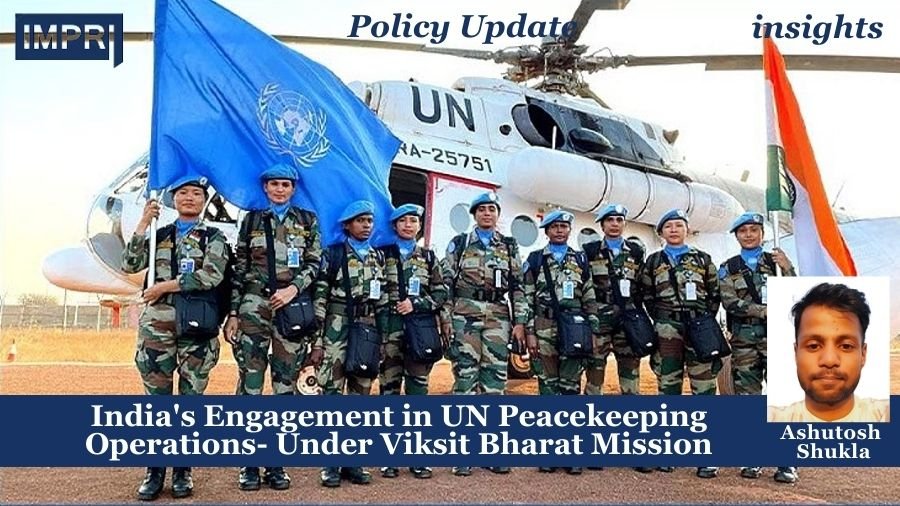
India, with the idea of Viksit Bharat, has equally contributed to gender parity in UN peacekeeping missions. This idea has focused on the alignment with the frameworks of UNSC Resolution 1325. India, which was the first country to deploy an all-women Formed Police Unit to Liberia in the year 2007, showcases India’s gender inclusivity.
By the year 2024, India had more than 150 women peacekeepers deployed across more than 6 active missions, including MONUSCO, UNMISS, UNIFIL, Western Sahara, and Golan Heights. The United Nations under Secretary General for peace operations highlighted the strategic value of Indian women peacekeepers. At “Women Peacekeepers of the Global South” in February 2025 in New Delhi. President Draupadi Murmu mentioned that “missions with a higher presence of females have led to more effective violence reduction and sustainable peace-related outcomes.”
India’s Performance in Missions
India performed very well, and its performance has been characterised by the number of peacekeepers, commitment and operational discipline of peacekeepers. Over the past 70 years, India has participated in more than 50 peacekeeping missions. The contribution and development have spread across the globe, including Africa, the Middle East, Southeast Asia, Balkans. India’s peacekeeping has been very impactful in conflict-prone African states. For instance, in Congo, the Indian peacekeepers helped stabilise the Ituri region in the mission MONUSCO, and India has currently deployed around 900 troops to Lebanon in the mission UNIFIL.
Training of whom, mention has also been integrated as part of India’s peacekeeping ambition under the Viksit Bharat Mission relating to peacekeeping. The mentioned centre trains more than 85 foreign contingents, including areas of cyber security and humanitarian law, with the help of simulation-based training. At the strategic level, India’s performance has been transformed into a “Strategic tool of Soft Power”, troops welcomed by host nations for cultural sensitivity, adaptability to their language, and their dedication to win the trust, which has been proven in areas such as Abyei (UNISFA) and Western Sahara (MINURSO). With the constraints on resources, commitment remains hard towards its duty to establish peace across the globe.
Impacts
The impact India has created in conflict-affected areas has been multidimensional, starting from India’s diplomatic and soft power gain, where India’s image has been significantly enhanced and its credentials of peacekeeping, also with a strong image of “Peacebuilder” and as a leading voice for the Global South, supporting India’s campaign for permanent membership at the UNSC. With the inclusion of women peacekeepers in deployment in ongoing missions, these women in uniform broke the old gender norms while inspiring the recruitment of more women peacekeepers, which led to women’s empowerment.
With all these efforts and establishing a training centre at New Delhi, impacting the globe with hybrid knowledge regarding peacekeeping, Initiatives like UN C4ISR Academy for Peace Operations, where Indian experts played a very crucial role, at the same time India with its diverse, rich and traditional knowledge like yoga and meditations leveraged these practices in conflict zones with the blend of soft power.
Challenges and Issues
India’s success at UN missions serves as a benchmark for various nations, but it also presents several challenges. Indian peacekeepers contributed to many missions across the globe, but they had inadequate representation in decision-making in terms of command hierarchy. With technology and the significant role of non-state actors, the nature of the conflict is changing aggressively. These modern conflict zones now do not follow the traditional line but asymmetric warfare, terrorist organisations with drones and cyber capabilities, which make it difficult to operate in new conflict zones due to resource constraints in certain geographical areas.
The cost of the financial operation and chances of misconduct by the peacekeepers of any origin can also hamper India’s longstanding reputation as a mandated peacekeeping country. Another challenge is the underutilisation of the peacekeepers, especially of women peacekeepers, despite their leadership skills. The scale of deployment of Indian women peacekeepers remains limited in comparison to that of male peacekeepers.
Way Forward
The roadmap of India in UNPKOs must be clear as part of its ambitious Viksit Bharat Mission with its leadership, growth and humanitarian values. India, as a leader of the Global South, should prioritise the missions aligning with its geostrategic-geopolitical interests and bilateral relations with its diaspora concerns without evolving itself politically.
As these conflict zones have turned into asymmetric conflict zones, expanding their technological aspiration with the use of AI, satellite communication and predictive analytics, where joint programs with respect to Research and Development will be helpful.
India should also include more women peacekeepers, not only as troops but as supporting roles, setting quantifiable targets for them in both leadership and non-leadership roles. At the same time, India should focus on the Indic Solution for the peace and stability of the missions. India, as a leader in peacekeeping, should advocate for the structural reforms and equal rights of representation and decision-making. Advocating for South-South cooperation.
Conclusion
India is one of the major contributors to the UNPKOs; its commitment and contribution reflect both strategic and civilisational ethos of the idea- Vasudhaiva Kutumbakam under the vision of the “Viksit Bharat’’ India blended its strategic ambitions with modern innovations. India has actively deployed both men and women peacekeepers, emerging as a trusted peacebuilder.
Its efforts covered a wide range of the spectrum, from training initiatives to operational excellence; in both cases, India has enhanced its capacity by enhancing its global reach, image and diplomatic outreach. India’s emphasis has always been on the idea of peace, not conflict and also its emphasis on technology, gender inclusion and an equitable approach rooted in its idea of dharma. With its ideals and values and strategic goals, India continues to shape a peaceful and inclusive global order.
References
- United Nations. Peace and security. United Nations. https://www.un.org/en/global-issues/peace-and-security
- Press Information Bureau. (2025, March 9). India’s legacy in UN peacekeeping: Leadership, commitment, and sacrifice. Ministry of External Affairs, Government of India. https://www.pib.gov.in/PressReleasePage.aspx?PRID=2109587
- Permanent Mission of India to the United Nations. India and United Nations peacekeeping and peacebuilding. https://www.pminewyork.gov.in/pdf/menu/49151pkeeping.pdf
- United Nations Peacekeeping. India. https://peacekeeping.un.org/en/india
- Peri, D. (2025, February 27). Indian peacekeepers present in most of our peacekeeping missions serve with commitment: U.N. official. The Hindu. https://www.thehindu.com/news/national/indian-peacekeepers-in-most-of-our-peace-keeping-missions-serve-with-commitment-un-official/article69267067.ece
- Taneja, N. (2025, April 30). Reassessing India’s role in UN peacekeeping operations. Centre for Joint Warfare Studies. https://cenjows.in/reassessing-indias-role-in-un-peacekeeping-operations/
- Mukherjee, A. (2015, October 20). At the crossroads: India and the future of UN peacekeeping in Africa. Brookings Institution. https://www.brookings.edu/articles/at-the-crossroads-india-and-the-future-of-un-peacekeeping-in-africa/
About Author: Ashutosh Shukla is a Research Intern at IMPRI, with a Master’s in International Relations and Strategic Studies from the University of Mumbai. His research interests include foreign policy, diplomacy, and International Relations.
Acknowledgement: The author extends his sincere gratitude to the IMPRI team and Ms Aasthaba Jadeja for their invaluable guidance throughout the process.
Disclaimer: All views expressed in the article belong to the author and not necessarily to the organisation.
Read more at IMPRI
India–Bhutan: Defence Infrastructure and Training Cooperation
Ayushman Bharat Digital Mission (ABDM)- 2020