
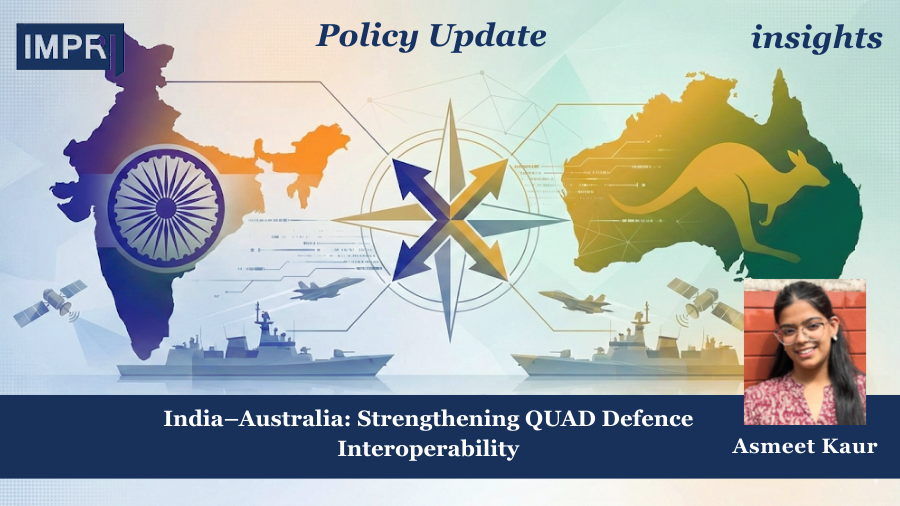
In the 21st century, the Indo-Pacific has emerged as the epicentre of global geopolitics due to shifting power dynamics, competing naval claims, supply-chain competition, and increased defence postures. With the Indo-Pacific region lofty ambitions to become the world’s strategic and economic centre of gravity, partnerships among like-minded democracies continue to grow in significance. In this regard, the India–Australia relationship has become a fundamental stabilising element in the broader Quad Security Dialogue (QUAD) context.
The strengthening of QUAD defence interoperability between India and Australia is no longer a tertiary aim; it is now a core strategy. The Indo-Pacific is witnessing increased naval militarisation, coercive diplomacy, and grey-zone manipulation, and the capacity of the Indian and Australian militaries to operate together seamlessly under such conditions is critical to maintaining deterrence, securing the maritime commons, and supporting a rules-based regional order. Over the last decade, both countries have committed to moving from limited defence engagement to deep, structured cooperation across the spectrum of naval exercises, intelligence sharing, technological collaboration, and logistics provision.
Background
India and Australia have not always had a solid defence partnership. In fact, for the majority of the Cold War, the two countries remained strategically distant because of their different geopolitical allegiances. India was non-aligned, while Australia was a US treaty ally under ANZUS. Additionally, the vast maritime distance between the oceans further hindered any genuine cooperation between India and Australia.
Recent tectonic shifts have emerged in the Indo-Pacific super region, changing the bilateral equation. The rise of China, characterized by increasingly aggressive behaviour in the South China Sea, a growing naval presence in the Indian Ocean, military modernisation and a more coherent use of economic coercion led to strategic recalibrations in New Delhi and Canberra. India was facing greater tensions with China over the Line of Actual Control, while Australia was facing economic coercion, cyber intrusions and allegations of political interference.
The diplomatic relationship increased in depth and breadth after the countries were elevated to a “Comprehensive Strategic Partnership” (CSP) in 2014 and, later, with the signing of the Mutual Logistics Support Agreement (MLSA) in 2020, allowing reciprocal access to military bases. Also, QUAD was revived around the same time, moving from informal meetings in 2007 to a firm basis by 2021, dealing mainly in vaccines and resilient supply chains for technology, maritime security, and defence.
Australia’s renewed participation in the Malabar naval exercise in 2020 was a milestone, representing increased confidence and converging security interests. Since then, and through multilateral engagements such as the Indo-Pacific Oceans Initiative, ASEAN, and trilateral relationships with Japan, France and Indonesia, India and Australia have developed a closer alignment. The strategic environment – characterised by militarisation in the region, vulnerabilities in supply chains and challenges to maritime norms – has made defence interoperability both aspirational and necessary.
Functioning
Alliance-building between India and Australia in the context of the Quad security arrangement involves such elements as bilateral arrangements, multilateral military exercises, mutual technological exchanges, and shared approaches to strategic military posturing. Consequently, the heightened structural relationship between both countries has moved from episodic to continual forms of cooperation.
The Joint Logistics Support Agreement (JLSA) significantly alters the manner in which military units on both sides will act in the region. Indian naval vessels visiting ports in Western Australia and Darwin Ports under the JLSA will be able to maintain longer deployments in the area because of better access to refuelling, resupply, and repair at Australian naval ports. On the other hand, Australian naval vessels will be able to operate from Indian ports, hence gaining greater operational reach in the Indian Ocean. With the JLSA providing a better logistical basis for both countries in terms of military interoperability, the agreement currently stands as a prime driver of military cooperation and partnership between India and Australia.
Joint military exercises are another major: The Malabar naval exercise (which now has, a permanent position for Australia), provides opportunities for advanced training in anti-submarine warfare, Carrier Strike Group operations and coordinated maritime surveillance; other examples include bi-lateral tactical/communications and fleet manoeuvre training, such as AUSINDEX and Pitch Black, which provide opportunities for air combat interoperability through large force employment missions.Through this training, both India and Australia develop, refine and test their common operating standards, evaluate their systems compatibility, and expose their personnel to each other’s procedures.
Collaborative technologies are also being developed by QUAD’s various working groups to support interoperability. India & Australia are also collaborating on the development of resilient cyber security frameworks, sharing their collective intelligence about new and emerging threat vectors, improving their capabilities for space-based maritime domain awareness, and coordinating the development of critical technology platforms like AI-enabled reconnaissance and secure communication systems; through their concerted effort to build integrated early warning systems and satellite network, QUAD will continue to enhance opportunities for both sides to jointly employ their resources during real-time operations. Thus, interoperability includes not only joint military training, but also technology collaboration, information sharing, alignment of policy, and the joint development of operational capabilities.
Impact
Strategically, interoperability enhances deterrence by showing a united front of democratic countries in the region. In such a case, the ability to seamlessly integrate forces raises the price of coercion for an actor to unilaterally change the regional balance. It also contributes to collective security because crises-whether natural disasters or territorial disputes-can be resolved more efficiently and effectively now through coordinated responses.
Operationally, interoperability enhances maritime domain awareness and provides greater situational intelligence. When combined with the strengths of Australia (in the South Pacific) and India (in the Western Indian Ocean), a more effective and comprehensive network of surveillance exists and thus improves monitoring capabilities against illegal fishing operations, piracy, human trafficking, and gray-zone naval activities. Humanitarian Assistance & Disaster Relief operations can also benefit from the capability for both nations to quickly deploy interoperable assets in cases of natural disasters occurring, e.g., cyclone, tsunami, or regional emergencies.
In terms of diplomacy, the strengthening of defense relations between India and Australia also demonstrates that QUAD is no longer just a diplomatic discussion forum. The establishment of these defense relations shows that QUAD is capable of producing tangible results. This also enhances the perception of the Indo-Pacific Region as one that is governed through cooperation and mutual obligation, rather than by dominance or hierarchy.
Smaller nations in the Indo-Pacific will see that the partnership between India and Australia creates an alternative to building military capabilities within their own countries or looking to larger powers for support. Furthermore, these nations can have confidence that the democratic states of the region are committed to supporting the maintenance of stability, without forcing them to make a hard choice about which side they will support.
Performance
Recently, the partnership between India and Australia under the QUAD has grown immensely. The rate of growth in Logistics Cooperation between India and Australia has increased dramatically. In addition to the usage of each country’s naval facilities, in a way that was not possible less than a decade ago, each of the Malabar exercises has become highly complex and has leveraged emerging technologies as indicators of advancing maturity in the operational synergy that exists between the two nations. Both nations have had increased participation in each other’s Defense Dialogues and Ministerial Consultations; additionally, both are involved in each other’s strategic planning processes.
According to the 2024 Defense Strategic Review prepared by Australia, India has been identified as Australia’s most important Indo-Pacific security partner, and as such, the Government of Australia is reaffirming its long-term commitment to India at the policy level. In addition to this, India has now included Australia as part of the IPOI. There are ongoing trilateral collaborations involving Japan, Indonesia, and France. This indicates that the India-Australia bilateral Defense relationship has now become part of greater regional frameworks at the same time. Lastly, another measure of success in the relationship is the increase in the amount of information and intelligence exchanged by both nations, particularly concerning Maritime Activities, Cyber Threats, and Regional Security Challenges.
Although important initiatives exist to enhance the bilateral relationship, there are many challenges still to overcome. For example, there are still many differences between Australian and Indian strategic cultures due to cultural differences; Indian views on alliances have historically been cautious, and there are many instances of divergence between both countries’ threat perspectives that hinder deeper collaboration between them.
Australia’s close defense relationship with the U.S. and its involvement in AUKUS introduce more complications for India to navigate in the partnership. Nonetheless, the accomplishments of the partnership have far outweighed the challenges thus far, with an overwhelming momentum from each nation to pursue the partnership and develop strong institutional mechanisms for the partnership to formalize and sustain.
Way Forward
An increase in interoperable defence practices between India and Australia can be accomplished by expanding both the quantity and kind of ways in which both countries work together, while ensuring that the operations remain sensitive to the strategic nature of each country and the inclusion of all countries in the region.
As an initial measure towards enhancing the ability to work together through collaboration at sea in the future, the establishment of a QUAD Maritime Coordination Mechanism is essential. This will allow both countries to integrate their intelligence fusion centres, enhance their satellite surveillance capabilities and improve how they share information in real-time. By developing a formalised structure through which both countries may leverage these capabilities together. By working together through this mechanism, both India and Australia will significantly enhance their ability to provide early warning and identify potential threats within the maritime domain.
The second primary focus area for India and Australia is to further enhance collaboration in the area of defence and industrial capabilities. Given that India’s manufacturing capabilities are on the rise and that Australia has an increasingly sophisticated defence R&D sector, both of these capabilities can be leveraged to develop joint capabilities, such as UAVs, anti-submarine warfare technologies, cyber defence, space-based sensors and secure communication systems. By leveraging each other, both countries could develop an Indo-Pacific Defence Innovation Corridor which would reduce their individual dependence on suppliers outside of the region and enhance their ability to work together to counter the gravitational pull of China in the critical technology supply chain.
The development and sharing of personnel and training are important in sustainability and growth of interoperability over time. Developing existing QUAD Academies, creating Coast Guard & Navy ‘War-Gaming’ Labs for Joint Training, sharing Officers (Cross-Posting) in their respective countries’ Naval & Air Force Commands will assist in collaboratively building an operational culture between the member nations which, in turn, will enable enhanced Technical Co-ordination amongst the member nations.
In addition to these 3 activities, enhancing Trilateral Cooperation with Japan and France, as well as engaging ASEAN and Pacific Islands through Capacity-Building programs will reinforce QUAD’s defence role in the region as being supportive, as opposed to confrontative.
India and Australia also need to mutually support QUAD’s identity to remain a Non-Military Coalition stabilising the region based on its continuing commitment to Open and Free Sovereignty & Peaceful Development. An essential part of creating that perception will be building an effective Strategic Communication Plan in conjunction with transparency and continuing with the significant Diplomatic Effort that has already produced positive results.
References
- Australian Government, Department of Defence. (2020, June 4). Australia and India sign Defence arrangement . Minister for Defence. https://www.minister.defence.gov.au/media-releases/2020-06-04/australia-india-sign-defence-arrangement
- Australian Government, Department of Defence. (2025, October 9). Joint Statement on the 2025 Australia–India Defense Ministers’ Dialogue . https://www.minister.defence.gov.au/statements/2025-10-09/joint-statement-2025-australia-india-defence-ministers-dialogue
- Australian Government, Department of Defence. (2023, November 20). Joint Statement: Second India–Australia 2+2 Ministerial Dialogue, New Delhi . https://www.minister.defence.gov.au/statements/2023-11-20/joint-statement-second-india-australia-22-ministerial-dialogue-new-delhi
- Australian Institute of International Affairs. (2024). Australia–India Defense Partnership: From Strategic Alignment to Operational Realization . Australian Outlook. https://www.internationalaffairs.org.au/australianoutlook/australia-india-defence-partnership-from-strategic-alignment-to-operational-realization/
- The Diplomat. (2024, April). India’s Place in Australia’s National Defense Strategy 2024 . https://thediplomat.com/2024/04/indias-place-in-australias-national-defense-strategy-2024/
- IISS (International Institute for Strategic Studies). (2024). Asia-Pacific Regional Security Assessment 2024 . IISS Strategic Dossier. https://www.iiss.org/globalassets/media-library—content–migration/files/publications—free-files/aprsa-2024/asia-pacific-regional-security-assessment-2024_sp.pdf
About the Author
Asmeet Kaur is a researcher at IMPRI and an undergraduate student at Indraprastha College for Women, Delhi University, with a keen interest in Public policy and administration.
Acknowledgement: The author extends his sincere gratitude to the IMPRI team, Ms Aasthaba Jadeja and Bhaktiba Jadeja for their invaluable guidance throughout the process.
Disclaimer: All views expressed in the article belong solely to the author and not necessarily to the organization.
Read More on IMPRI:
India–Bhutan: Defence Infrastructure and Training Cooperation