
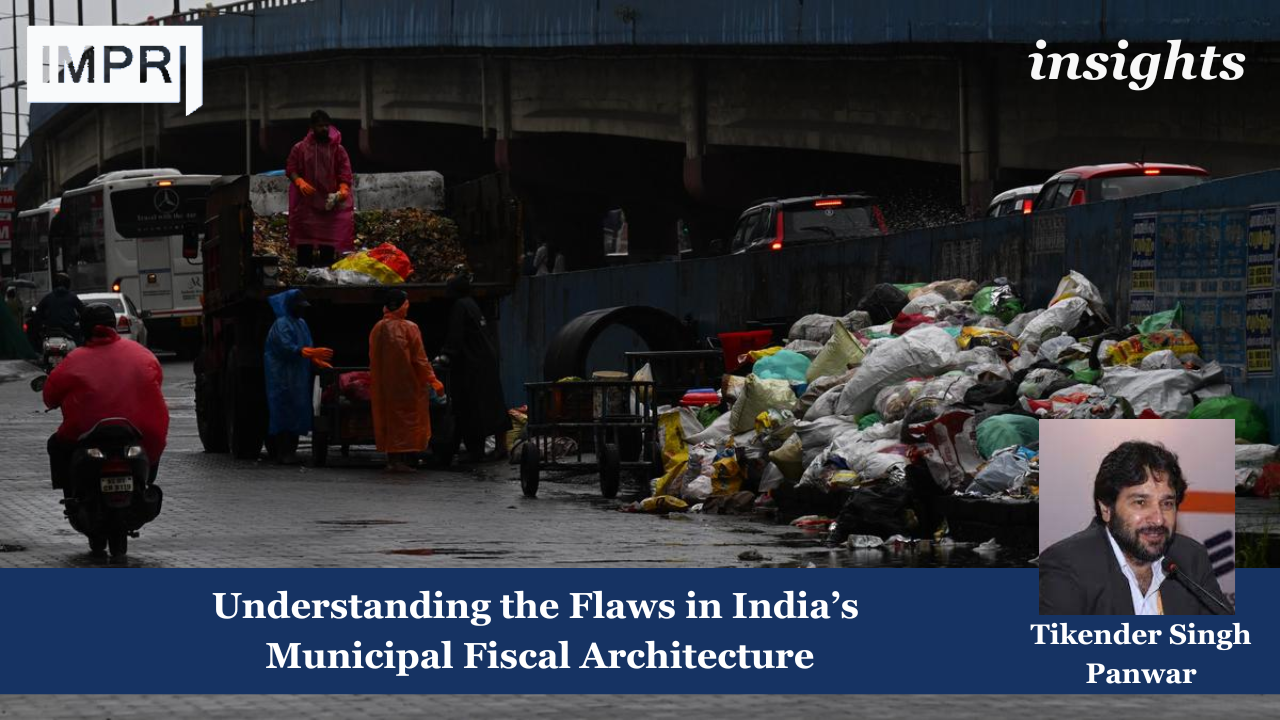
Tikender Singh Panwar
Urban India generates nearly two-thirds of the national GDP, yet its municipalities control less than one per cent of the country’s tax revenue. Indian cities are not generating revenue, not because they are inefficient, but because the fiscal architecture has failed them. Today, municipal finance is dependent on intergovernmental transfers, loans, and schemes. The core of the problem lies in the centralisation of taxation powers.
After the introduction of the Goods and Services Tax (GST), Indian cities lost nearly 19% of their own revenue sources. Octroi, entry tax, and local surcharges — the traditional lifelines of municipal budgets — were subsumed into the GST framework. Promised compensatory mechanisms have largely bypassed the municipal level, deepening cities’ dependence on State and Central grants.
Therefore, municipalities lack both fiscal autonomy and predictable revenue streams. The result is a peculiar inversion of democracy — where power is centralised and responsibility decentralised. Cities are expected to deliver solid waste management, affordable housing, climate resilience, and digital infrastructure, but without the resources to fund such services.
What about municipal bonds?
Every major policy pronouncement — from NITI Aayog’s urban strategy to the latest reform-linked incentive grant — promotes bonds as the new frontier of local finance. However, the credibility of Indian municipal bonds remains abysmally low. It is not merely that cities are unable to generate capital to back their bonds; it is that the very framework of assessing credibility is skewed. A city’s creditworthiness is often judged narrowly by its “own revenue” performance — property taxes, user charges, and fees — while completely discounting the regular flow of grants and transfers from higher levels of government.
This is not just an accounting error; it is an ideological one. When the RBI or credit rating agencies discount grants as “non-recurring income,” they perpetuate the myth that cities survive on charity. In truth, these grants are legitimate entitlements, part of a redistributive compact enshrined in the Constitution. The 74th Amendment did not conceive of cities as beggars before the State or the Union but as equal tiers of governance entitled to a share of the tax pool.
Similarly, institutions like the World Bank and Asian Development Bank have long argued that cities should become “self-reliant” by focusing on property tax collection and user fees. While property tax reform is important, this narrow prescription is inadequate and unjust. It is inadequate because property tax typically accounts for only 20-25% of a city’s total revenue potential, and is often politically and administratively constrained. It is unjust because it shifts the burden of urban financing disproportionately onto residents, especially in lower-income settlements already struggling with poor services. The obsession with “user pays” logic converts public goods into private commodities. Clean water, sanitation, public lighting, and mobility — these are not marketable products but collective entitlements.
What is the way ahead?
India must democratise the fiscal contract. In Scandinavian countries, where cities enjoy strong fiscal health, the local tax base is not an afterthought — it is the foundation of the welfare state. Municipalities in Denmark, Sweden, and Norway have the right to levy and collect income taxes directly, ensuring a transparent and accountable relationship between citizens and local governments.
This decentralised model has produced both efficiency and equity: citizens can see where their money goes, and cities have the flexibility to plan for the long term. Most importantly, transfers from higher levels of government are treated as part of a shared fiscal ecosystem, not as discretionary favours. India can learn from this. What is needed is a reimagined model of fiscal federalism, where municipalities have predictable, adequate, and untied revenues — both from their own sources and from constitutionally mandated transfers.
Similarly, for municipal bonds to become credible instruments, the first step is to recognise grants and shared taxes as legitimate components of city income. Only then can cities build a trustworthy balance sheet. Second, the rating system must account for the governance capacity of a city — transparency, audit compliance, citizen participation — rather than solely relying on financial metrics. Third, cities should be empowered to earmark a portion of their GST compensation or State share as collateral for municipal borrowing. Such reforms would restore the principle of cooperative federalism that the Constitution envisaged.
India’s urban future depends on fiscal justice. Municipal finance must be seen not as a bookkeeping exercise but as a moral and political question. The grants that flow to cities are not gifts; they are part of a social contract. The revenues that cities generate are not charity; they are a right. True reform will begin only when India accepts that cities are not cost centres — they are the foundation of national prosperity.
Tikender Singh Panwar is a former Deputy Mayor of Shimla and currently a member of the Kerala Urban Commission.
The article was first published in The Hindu as Why is the fiscal architecture of municipalities flawed? on October 16, 2025
Disclaimer: All views expressed in the article belong solely to the author and not necessarily to the organisation.
Read more at IMPRI:
Tariffs on Life: The Cost of Politicizing Healthcare
Politics as Performance: Trump’s Theatrics and India’s Petty Rivalries
Acknowledgment: This article was posted by Urvashi Singhal, Visiting Researcher at IMPRI.