Category Center for International Relations and Strategic Studies

Bilateral Investment

The India–UAE Bilateral Investment Treaty (2024): Implications for Investment and Economic Diplomacy

A deep-rooted Comprehensive Strategic Partnership has replaced the old marine commercial link between India and the United Arab Emirates (UAE). With Prime Minister Narendra Modi's historic visit in 2015—the first by an Indian premier in 34 years—diplomatic relations, which were initially established in 1972, gained fresh impetus. This visit changed the emphasis from a buyer-seller energy dynamic to a multifaceted combination of infrastructure, security, and high technology.

shivanshi poster 3

India–UK Comprehensive Economic and Trade Agreement 2026: Trade and Investment Cooperation

The India–UK Comprehensive Economic and Trade Agreement (CETA) is a major bilateral agreement aimed at deepening trade, investment, and professional mobility between the two economies. Negotiations were formally launched in January 2022 and continued over roughly 15 rounds between 2022 and 2025 (UK Parliament, 2026). The agreement was signed on 24 July 2025 in London by India's Commerce and Industry Minister Piyush Goyal and the UK's then Secretary of State for Business and Trade Jonathan Reynolds, and came into effect on 15 July 2026 alongside a companion Agreement on Social Security (Double Contribution Convention, DCC) (PIB, 2026b).

Teesa troubled

Troubled Waters: Revisiting the India-Bangladesh Teesta River Agreement (1983, 2011 and Beyond)

The Teesta is a 414-kilometre transboundary river originating from the Pahunri (Teesta Kangse) glacier in the Sikkim Himalaya. It flows through Sikkim and West Bengal before entering Bangladesh, where it eventually joins the Brahmaputra. The river is joined by tributaries such as the Rangeet. The Teesta is a fast-flowing Himalayan river characterised by high velocities, heavy sediment loads and seasonal fluctuations in discharge

WhatsApp Image 2026 08 09 at 17.14.49 1

India’s Parliamentary Diplomacy with North Macedonia: Significance of the Presidential Visit (2026)

India isn’t just looking at the usual big players in Europe anymore. Lately, it’s turning more eyes toward Southeast Europe and the Western Balkans. Why? Because New Delhi wants to shake up its diplomatic strategy and spread its influence , build more varied partnerships in a Europe that keeps changing shape. North Macedonia, for instance, has started to matter more. It sits in a key spot in the Balkans, has solid democratic foundations, and opens new doors for India in trade, technology, education, research, and sustainable growth.

CopyofInsights 1 e1786472718650

Regional Proxy Competition and the Constraints of Global Governance in Sudan

The African Continent has been marred by civil wars for a long time but none as severe as the ones in Sudan that since its independence in 1956 has witnessed 20 military coup attempts. However, the most recent civil war that started in 2023 and has continued till present is also one of the worst humanitarian crises ever faced by Sudan with over 13.6 million people currently displaced, 20 million people in need of health assistance and estimated 21 million people facing food insecurity.

2026 08 1119353

Protecting the Diaspora: Evacuation Planning for a Volatile Gulf

Policy UpdateAsmatwali Background India’s diaspora in the Gulf Cooperation Council (GCC) countries numbers approximately 9.7 million out of a total overseas Indian population of 35.4 million, according to data submitted to Parliament by the Minister of State for External Affairs,…

2026 08 1118200

The Pakistan-Saudi Defence Pact and India’s Gulf Diplomacy

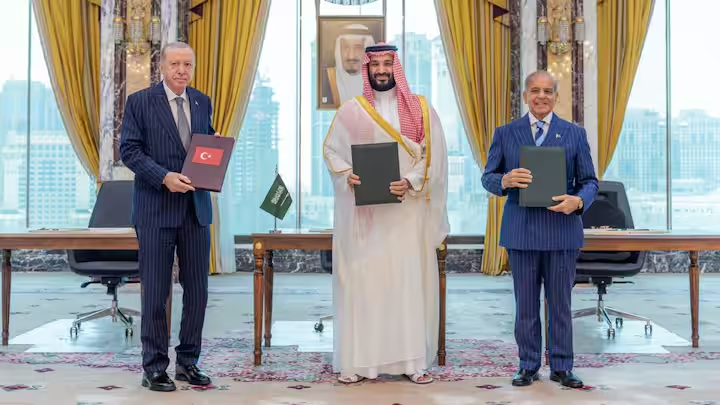
Policy UpdateAsmatwali Background On 17 September 2025, Saudi Crown Prince and Prime Minister Mohammed bin Salman and Pakistani Prime Minister Shehbaz Sharif signed the Strategic Mutual Defence Agreement (SMDA) in Riyadh, formalising decades of informal Pakistan-Saudi security cooperation into a…

Talk to Us