Public Policy Qualitative Participatory Action Research Fieldwork Fellowship- Cohort 7.0
Center for Human Dignity and Development (CHDD), IMPRI Impact and Policy Research Institute, New Delhi, invites you to #WebPolicyLearning
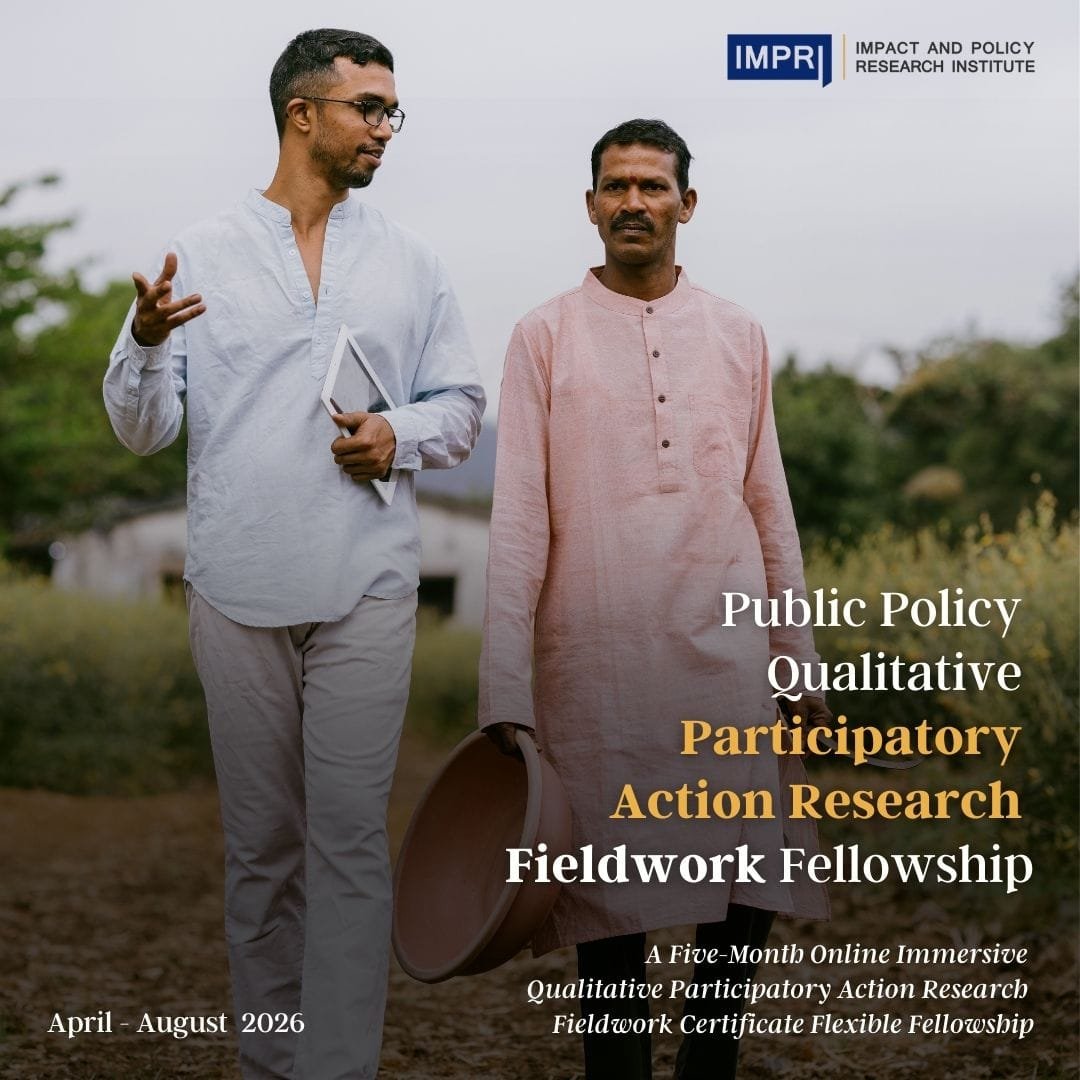
Public Policy Qualitative Participatory Action Research Fieldwork Fellowship- Cohort 7.0
A hands-on field immersion fellowship empowering young researchers to drive impact through qualitative and participatory action research.
Learning, Training, Capacity Building, Interactions & Networking with Leading Experts with Flexibility
Fellowship Project- Blog, Creative Presentation, ISBN Book Chapter Publication Opportunities
Timeline
An Online National Spring & Summer School Program
A Five-Month Online Immersive Qualitative Participatory Action Research Fieldwork Certificate Flexible Training Fellowship
April – Aug 2026
Details of the #WebPolicyLearning:
The fellowship duration is a total of 5 months. The first 4 months comprise weekly two-hour Zoom classes covering both technical and program sessions. The next 1 month is dedicated to the finalisation of the fellowship project.
Live Sessions with Experts & Program Team-
Dates: April 5 – July 19, 2026
Ten Sunday Mornings
Time: 11 am – 1 p.m. IST
Platform: Zoom
Fellowship Project Timeline-
Blog Article Submission: 8 June, 2026
To be published on the IMPRI Insights Blog.
Creative Presentation: July 19, 2026
To be presented live on IMPRI’s YouTube Channel–Fellows Presentation Playlist.
Book Chapter Publication Milestones
A structured pathway for the fellowship project culminating in the final publication to be published by IMPRI Books in an IMPRI ISBN Edited Volume titled the Anthology of Essays.
Abstract Submission: April 20, 2026
Fellowship Project Discussion: Throughout the fellowship
Extended Abstract Submission: 6 July, 2026
Draft Final Chapter Submission: 26 July, 2026
Final Book Chapter (Post-Review): 16 Aug, 2026
Note: Detailed session dates & time will be shared via the Guidelines Document.
Registration & Scholarships
Registration form link: https://forms.gle/bfXcnHkwqNzjmPi89
Course Fee in INR (inclusive of GST):
| Professionals | Students | |
| Early Bird Discounted Fee (till March 20th) | 16,400 | 12,500 |
| After Early Bird | 22,000 | 16,000 |
Special 20 percent discount for IMPRI Alumni. Bulk Discounts can be availed for groups of more than 5 participants. IMPRI Alumni can avail benefits through the IMPRI Referral Policy for Alumni & Friends.
Payment of Course Fee: https://pages.razorpay.com/impricoursefee
Alternatively, can use any payment method from here: https://www.impriindia.com/payment-details/
Scholarship Details
To apply for the scholarships, please complete the
Scholarship Form link: https://forms.gle/UtatJcjYFwS3Dqmo7
| Category | Number of Seats | Scholarship Details | Fee/Benefit |
| Fellowship Batch Size | 28 | Total number of participants in the cohort | — |
| Merit Scholarship | 4 | Awarded to top-performing applicants based on merit | Join at a nominal token fee of INR 9,600 |
| Partial Scholarship | 8 | Granted to deserving candidates based on merit and need | Up to 40% discount on the course fee |
Last Date to Apply: Feb 20th, 2026
Notification: Selected candidates will be informed via email.
About, Objectives & For Whom
The Public Policy Qualitative Participatory Action Research Fieldwork Fellowship – Cohort 7.0 is an immersive certificate training program designed to develop emerging researchers and practitioners committed to evidence-based public policy. Organized by the IMPRI Center for Human Dignity and Development (CHDD), this fellowship offers a dynamic platform for learning, dialogue, and hands-on engagement with real-world policy challenges. Through a blend of expert-led sessions, participatory methodologies, and field-based practice, the program equips participants to analyze complex issues, work collaboratively with communities, and generate actionable policy insights grounded in rigorous qualitative research.
The Public Policy Qualitative Participatory Action Research Fieldwork Fellowship is an immersive learning experience designed to equip emerging researchers with the skills, confidence, and perspective to engage meaningfully with real-world public policy challenges. Grounded in qualitative and participatory action research approaches, the fellowship blends conceptual understanding with hands-on field engagement to develop well-rounded policy practitioners.
The curriculum spans essential components of qualitative field research, including research design, participatory methodologies, tool development (such as interviews, focus group discussions, and key informant interviews), and stakeholder mapping. Fellows gain practical experience in tool testing, conducting fieldwork, and preparing analytical reports. Emphasis is placed on strengthening research writing, critical thinking, and the ability to translate field insights into evidence-based policy recommendations.
A core feature of the fellowship is independent fieldwork, where each participant investigates a policy issue within their local context. The resulting field reports capture their findings, reflections, and policy-relevant analysis. By the conclusion of the program, participants emerge better prepared to navigate complex policy landscapes, collaborate with diverse stakeholders, and contribute to positive social change through informed, community-centered public policy research.
Objectives
To build a strong foundational understanding of public policy, governance systems, and the socio-economic issues shaping India’s development.
To equip and empower young leaders to critically analyze public challenges, question existing structures, and engage meaningfully with policy and governance processes.
To develop confident communicators who can articulate ideas effectively through writing, presentations, dialogue, and evidence-based arguments.
To foster analytical and research skills through hands-on learning, data interpretation, and exposure to practical case studies across diverse policy domains.
To nurture leadership capacity for informed participation in decision-making spaces, community engagement, and problem-solving initiatives.
To encourage meaningful contributions to public policy and social development through research outputs, publications, collaborations, and stakeholder engagement.
To cultivate a network of emerging practitioners committed to advancing inclusive, sustainable, and equity-driven policy and governance practices.
Key Highlights: Immersive fieldwork; Participatory action research; Expert-led sessions; Qualitative research methods; Tool development (interviews, FGDs, KIIs); Stakeholder mapping; Hands-on learning; Peer collaboration; Research writing; Critical analysis; Community engagement; Field report submission; Policy-oriented insights; Networking and mentorship; Blogs, Presentations & Publication Opportunities; Limited Scholarships Available.
For Whom
Professionals: Practitioners, researchers, policymakers, administrators, and development professionals across sectors.
Academia & Subject Experts: Faculty members, scholars, and domain specialists engaged in research or policy work.
Civil Society & Community Actors: Individuals working in NGOs, social enterprises, advocacy groups, or grassroots initiatives.
Interdisciplinary Thinkers: Those bringing cross-sector perspectives to policy, governance, and societal challenges.
Students: UG, PG, MPhil, and PhD learners from any discipline.
Applications from participants across disciplines, sectors, and regions are encouraged. IMPRI fellowships promote a multidisciplinary, inclusive learning environment that brings together diverse stakeholders to engage with real-world policy challenges.
Program Experts
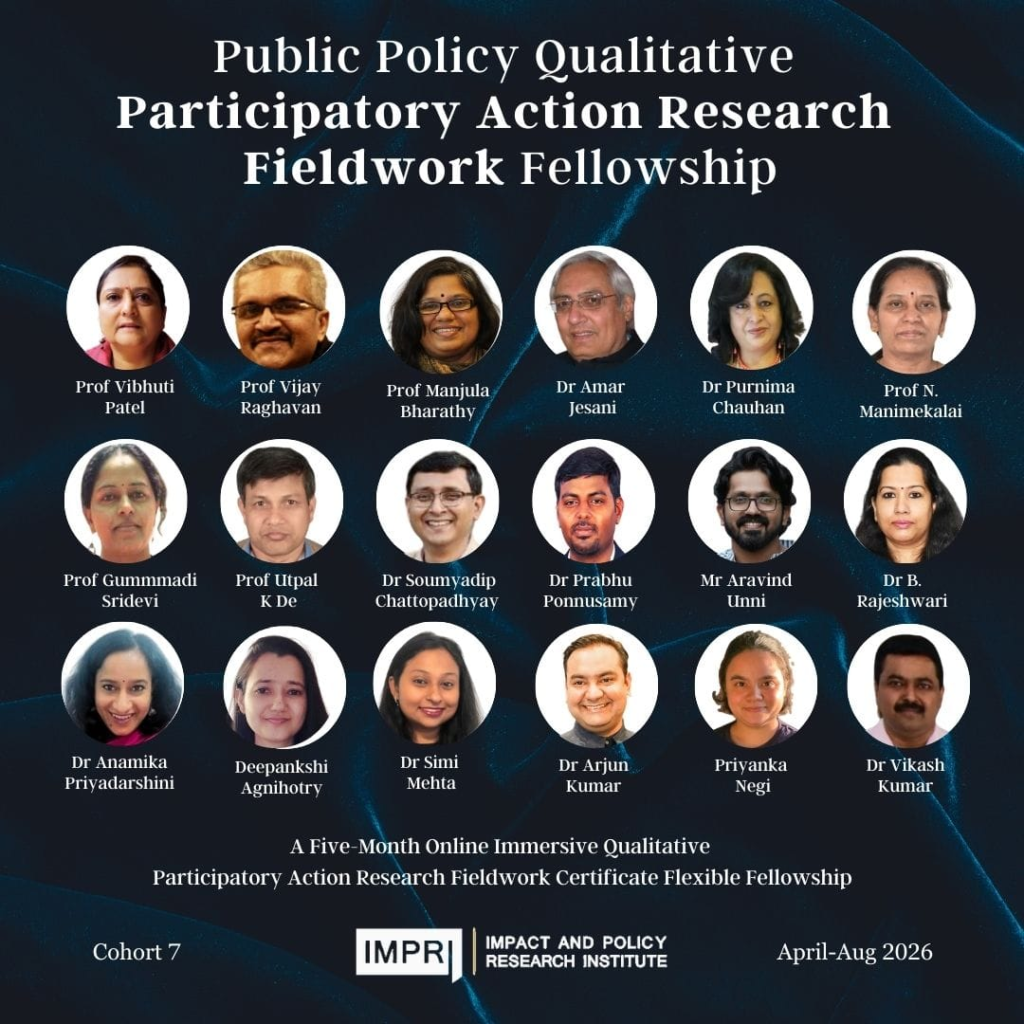
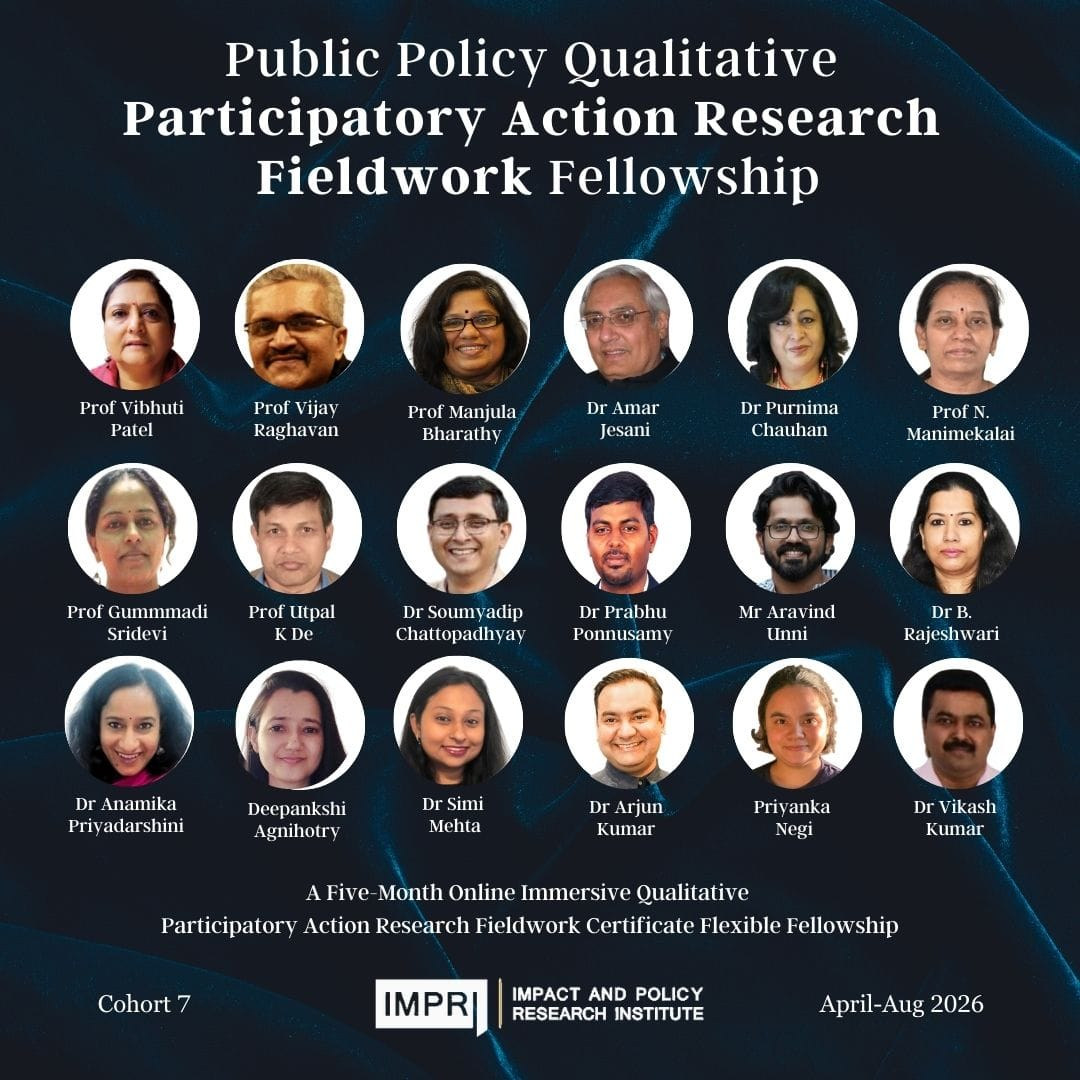
Chair: Prof Vibhuti Patel, Visiting Distinguished Professor, IMPRI
Session Experts:
Prof Vijay Raghavan, Professor, Centre for Criminology and Justice, School of Social Work, Tata Institute of Social Sciences (TISS), Mumbai Campus
Dr Amar Jesani, Independent Researcher and Teacher (Bioethics and Public Health); Editor, Indian Journal of Medical Ethics
Dr Purnima Chauhan, IAS (Retd), Former Secretary, Govt. of Himachal Pradesh & Director Himachal Pradesh Institute of Public Administration (HIPA)
Prof N. Manimekalai, Director and Head, Department of Women’s Studies, Bharathidasan University, Tiruchirapalli
Prof Gummadi Sridevi, Professor, School of Economics, University of Hyderabad; Visiting Professor, IMPRI
Prof Utpal K De, Professor and Former Head, Department of Economics, North Eastern Hill University (NEHU), Shillong, Meghalaya
Dr Soumyadip Chattopadhyay, Associate Professor, Economics, Visva-Bharati, Santiniketan; Visiting Senior Fellow at IMPRI.
Dr Prabhu Ponnusamy, Founder/CEO at Iotalytics Research and Analytics Solutions Pvt Ltd
Mr Aravind Unni, Urban Poverty Thematic Lead at Indo-Global Social Service Society; Visiting Senior Fellow at IMPRI
Dr B. Rajeshwari, Senior Consultant at Niiti Consulting; Visiting Senior Fellow (Honorary) at IMPRI
Prof Manjula Bharathy, Professor at Centre for Urban Policy and Governance & Dean of the School of Habitat Studies, TISS, Mumbai; Visiting Professor at IMPRI
Dr Vikash Kumar, Assistant Professor, Centre for Research in Rural and Industrial Development
Convenors:
Dr Simi Mehta, CEO & Editorial Director, IMPRI
Dr Arjun Kumar, Director, IMPRI
Note: The final experts’ list along with session dates & time will be updated shortly.
Previous Cohort
Public Policy Qualitative Participatory Action Research Fieldwork Fellowship
Cohort 6.0 | July-Nov 2025
Fellows List
Fellows Creative Project PPT Video
Anthology of Essays by Fellows ISBN Book
Cohort 5.0 | Jan–May 2025
Fellows List
Fellows Creative Project PPT Video
Anthology of Essays by Fellows ISBN Book
Cohort 4.0 | September 2024 – January 2025
Fellows List
Fellows Creative Project PPT Video
Event Outcome Report
Cohort 3.0 – May – August 2024
Fellows List
Fellows Creative Project PPT Video
Fellows Essays ISBN Anthology Book
Cohort 2.0 – December 2023 – April 2024
Fellows List
Fellows Essays ISBN Anthology Book
Cohort 1.0 – July – August 2023
Fellows List
Fellows Essays ISBN Anthology Book
Program Approach, Outcome & Benefits
Program Approach
The fellowship uses a flexible, interactive, and applied learning model to help participants develop strong foundations in public policy and governance.
1. Flexible Learning
An online structure with live sessions, recordings, curated readings, and peer-support channels enables participants to learn at their own pace alongside academic or professional commitments.
2. Capacity Building
Expert-led webinars, thematic masterclasses, and guided research tasks build analytical, writing, and policy skills across governance, development, social justice, environmental issues, and related areas.
3. Applied Leadership
Through creative projects, research writing, and presentations, fellows engage critically with real-world challenges and practice leadership in policy dialogue and public communication.
Outcomes
Foundational Understanding: Develop a strong grasp of the public policy landscape, institutional processes, and key governance challenges.
Expert Guidance: Learn from domain experts through webinars, masterclasses, and structured mentoring.
Research & Writing Skills: Conduct focused research and produce well-reasoned analytical work.
Creative & Practical Application: Present insights through visual, narrative, or audio-visual formats that support wider discourse.
Publication Pathways: Contribute to IMPRI blogs, reports, and ISBN book chapters.
Peer & Professional Networks: Build relationships with peers, practitioners, scholars, and mentors.
Public Presentation: Present research in live YouTube sessions with expert feedback.
Benefits
- Membership in the IMPRI Alumni Network of emerging professionals and changemakers.
- Flexible online learning with live sessions, recordings, and accessible resources.
- Milestone-based structure to support steady progress alongside work or studies.
- Expert-led sessions to build strong analytical, research, and policy skills.
- Guided projects to apply concepts to real-world governance and development issues.
- Opportunities to present work, lead discussions, and collaborate with peers.
- Engagement with scholars, practitioners, and policymakers for deeper insights.
- Access to curated readings, course materials, and session recordings.
- Publication opportunities through blogs, reports, and ISBN book chapters.
- Presentation of work on live YouTube sessions with expert feedback.
- Recognition on IMPRI Insights, social media, and event outcome reports.
- Official IMPRI Certificate of Participation & Completion.
Session Details
The fellowship duration is a total of 5 months. The first 4 months comprise weekly two-hour Zoom classes covering both technical and program sessions. The next 1 month is dedicated to the finalisation of the fellowship project.
1. Technical Sessions
Live classes, interactive discussions and networking with leading experts, covering the core curriculum and subject matter in depth.
Session Topics & Experts:
| Expert | Session Topic |
|---|---|
| Prof Vijay Raghavan | Policy-Influenced Participatory Research Methodologies |
| Dr Amar Jesani | Ethics in Participatory Action Research and Fieldwork |
| Dr B Rajeshwari | Qualitative Fieldwork Research Case Studies |
| Dr Prabhu Ponnusamy | Computing, Technological, and AI Skills for Researchers |
| Mr Aravind Unni | From Action Research to Policy Action and Impact |
| Dr Soumyadip Chattopadhyay | Fieldwork and Qualitative Research Methods and Questionnaire Design |
| Prof Vibhuti Patel | Qualitative Research and Reporting |
| Prof Manjula Bharathy | Qualitative Fieldwork Research Case Studies |
| Dr Purnima Chauhan | Action Research, Policy, and Impact: A Bureaucrat’s Experience |
| Dr Vikash Kumar | Case Studies on Rural Development Field Research |
| Prof Gummadi Sridevi | Qualitative Fieldwork Research Case Studies |
| Prof N Manimekalai | Careers for Researchers and Publications |
2. Program Sessions
The program sessions help in building the projects chosen by the fellows. These sessions feature live interaction with the experts regarding the projects. Sessions include:
- Participant introduction session
- Fellowship project discussion session
- Project Update Discussion Session
- Research article writing session
- Presentation session
- Feedback & Careers Session
Note: Exact session dates, times, and expert details will be communicated through the program Guidelines Document.
The Guidelines Document comprises the Templates for all required submissions, Submission guidelines and timelines, Reference materials for each submission, Reading resources shared by experts and Communication and coordination support.
Fellowship Assistance & Coordination: Dedicated Coordinators support participants throughout the program with the help of WhatsApp groups and IMPRI email.
Flexible Learning: All session recordings are available for 2 weeks post live session.
Fellowship Project
The Fellowship Project is the central experiential component of all IMPRI Fellowship Programs. It enables participants to apply their learning through research, analysis, and creative expression on contemporary policy, governance, and development issues. The project aims to generate original, high-quality insights that inform academic, professional, and public policy dialogues.
Project Outputs
Fellows produce three core outputs that become part of IMPRI’s public-domain documentation ecosystem—IMPRI Insights, IMPRI Books, and IMPRI’s YouTube Channel—ensuring safety, transparency, and long-term accessibility:
- Book Chapter: A well-researched, original written piece developed through structured stages—Abstract, Extended Abstract, Draft Chapter, and Final Chapter. Final chapters are published in an IMPRI ISBN Edited Volume (Anthology of Essays).
- Blog Article: A concise analytical or reflective write-up published on IMPRI Insights, highlighting key perspectives, findings, or thematic insights from the fellow’s work.
- Creative Presentation: A live presentation of the fellowship project on IMPRI’s YouTube Channel, using formats such as presentations, short films, documentaries, spoken word, poetry, or visual storytelling.
- Additional visibility is provided through IMPRI’s social media platforms, including Meet Our Fellows announcements, blog posts, fellows’ publication announcements, and the YouTube live presentation of the fellowship project.
- Fellows are encouraged to present their work — in seminars, conferences, and workshops — and are also expected to publish in journals, magazines, newspapers, blogs, books, and other platforms to broaden the reach and policy impact of their work. In this regard, the IMPRI team will provide all necessary assistance.
- A certificate of completion will be awarded to fellows and will be issued after the final publication is released.
- Overall, the outcome is to equip and empower fellows to engage critically with the issue, communicate their insights with confidence, and contribute meaningfully to advancing further research, advocacy, and social impact.
All submissions undergo plagiarism checks, quality review, and relevance assessment to ensure academic integrity.
Process & Support
- Mentorship from chair experts and the program team through live learning and training sessions on the fellowship project.
- Continuous feedback and guidance provided via email, WhatsApp groups, calls, and direct coordinator support to ensure steady progress.
- Access to templates, guidelines, reading resources, and timelines through a detailed Guidelines Document.
- Encouragement to present or publish research beyond IMPRI—at seminars, conferences, journals, and policy forums—to expand impact.
- All sessions and project presentations are highlighted across IMPRI’s social media and outreach channels, enhancing visibility and placing fellows’ work in the public domain.
Note: To explore some of the featured projects and outcomes, visit the “In Focus” segment below on this webpage.
Testimonials & Fellows’ Work In Focus
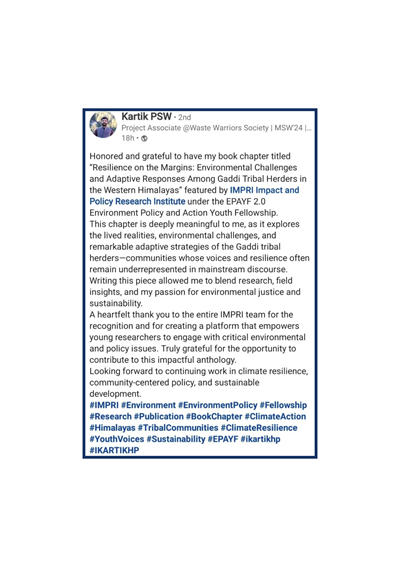
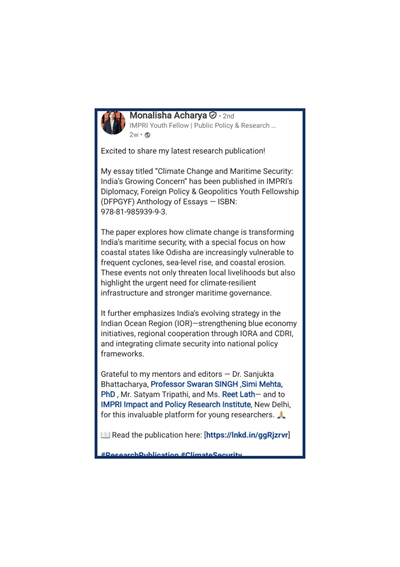
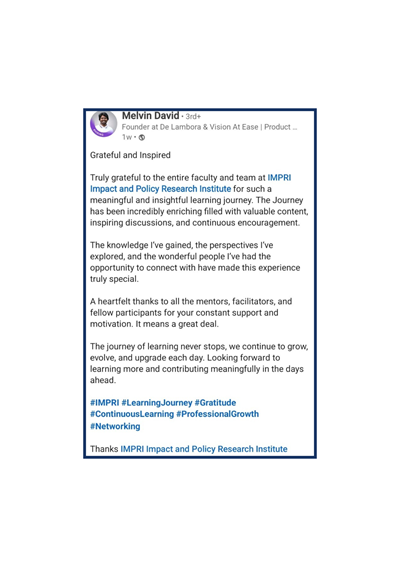
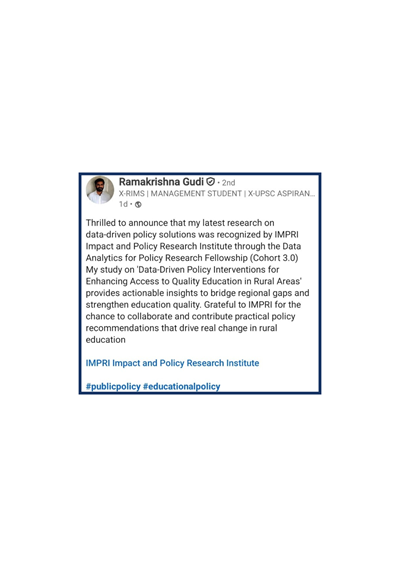
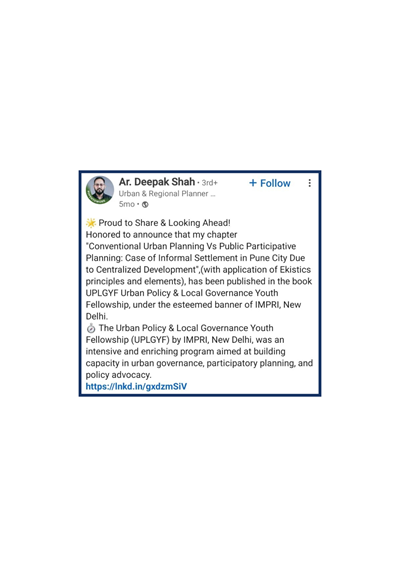



Fellows’ Work in Focus
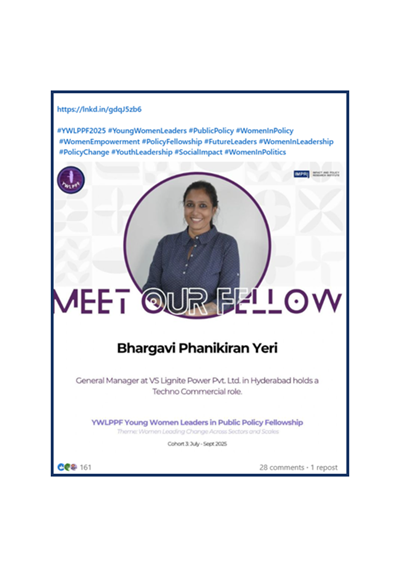
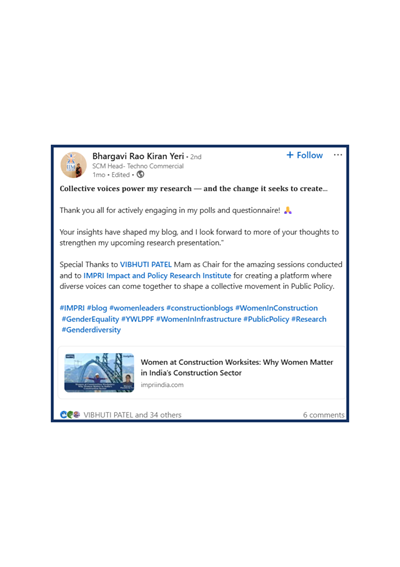
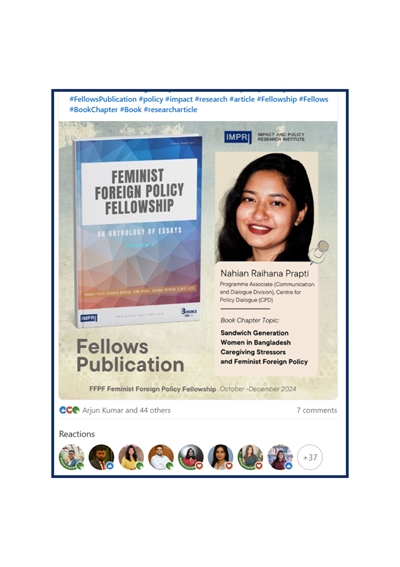
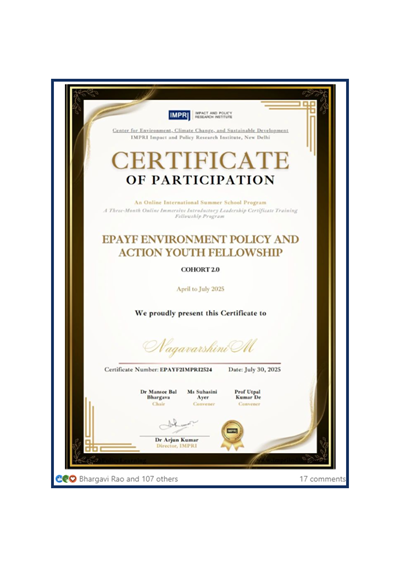
IMPRI’s social media captures the fellowship experience at every stage — from welcoming fellows and featuring their work to sharing final publications and certificates. Selected samples are presented below.
FAQs
1. Do I need prior knowledge or an academic background in public policy or governance?
No prior background is required. The fellowship builds foundational to advanced understanding and is suitable for beginners as well as experienced learners.
2. What is the time commitment? Can full-time working professionals apply?
Yes, full-time professionals can apply. The program requires about 2–3 hours per week, including live sessions and preparation.
3. Will the online sessions be recorded?
Yes. All live sessions are recorded, and participants can access the recordings for 15 days after each session.
4. Will I receive an e-certificate?
Yes. All participants who complete the program requirements will receive an official IMPRI e-Certificate of Participation & Completion.
5. Will I get networking opportunities?
Absolutely. Fellows engage with experts, mentors, and peers through sessions, discussions, and collaborative work, becoming part of the wider IMPRI learning and alumni network.
Previous Similar Programs
LPPYF – Cohort 4.0 Winter’24 – Theme: Inclusivity in Peace and Conflict Resolution: Rethinking Policy, Advocacy and Implementation
LPPYF – Cohort 3.0 Summer’24 – Theme: Advancing Justice: Bridging Gaps in Public Policy Enforcement
LPPYF – Cohort 2.0 Winter’23 – Theme: Promoting Human Rights and Ending Gender-Based Violence
LPPYF Law and Public Policy Youth Fellowship Summer’23
You might like IMPRI #WebPolicyTalk Series –
The State of Governance – #PublicPolicy | YouTube Channel & Playlists
IMPRI’s 3rd Annual Series of Thematic Deliberations and Analysis of Union Budget 2023-24 | February 2023 | IMPRI #WebPolicyTalk
Upcoming and Previous IMPRI #WebPolicyLearning Events: See here
For queries, write to: learningatimpri@gmail.com
Public Policy Qualitative Participatory Action Research Fieldwork Fellowship- Cohort 7.0 | A Five-Month Online Immersive Qualitative Participatory Action Research Fieldwork Certificate Fellowship | Feb-June 2026 | IMPRI #WebPolicyLearning
Organizer
IMPRI, a startup research think tank, is a platform for pro-active, independent, non-partisan and policy-based research. It contributes to debates and deliberations for action-based solutions to a host of strategic issues. IMPRI is committed to democracy, mobilization and community building.