Maithreyi Govindula
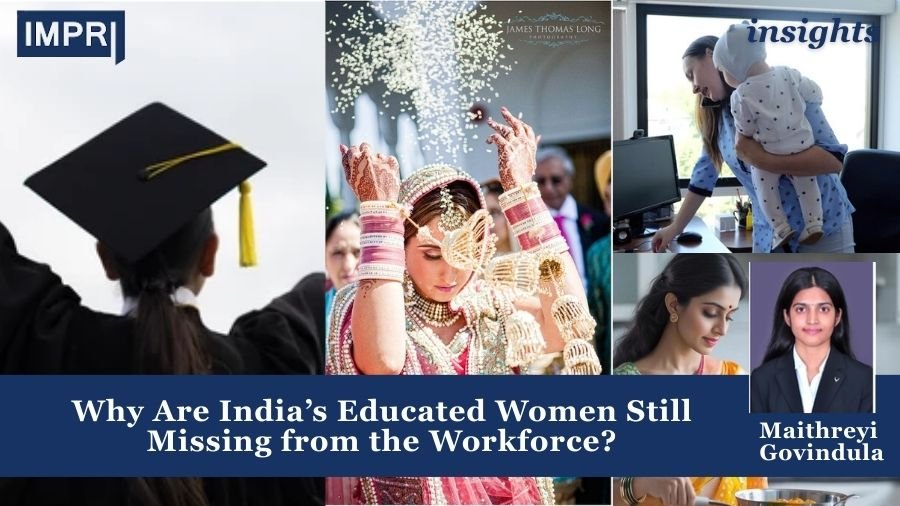
In India’s classrooms, young women are leading the way. They lead merit lists, claim competitive scholarships, and enter fields once dominated by men. Almost half of the nation’s students in higher education are now women. A startling jump from a generation past.
But when it comes to the workforce, a different picture emerges. A mere one in four Indian women works in paid employment. The paradox cannot be missed: education levels are climbing, but workforce participation is flat. It begs a greater question: what is going on between the school and the job?
The Education–Employment Paradox
India has registered near gender equality in higher education enrolment over the last two decades. Schemes initiated by the government, better transport facilities, scholarship schemes, and altering family aspirations have provided women with opportunities to earn degrees in engineering, medicine, law, and the arts.
But the transition from degree to desk is riddled with obstacles. Many women never join the labour force at all. Others quit within a few years, particularly around times of life change, such as marriage or motherhood.
The reasons vary from cultural expectations that place greater importance on women’s roles at home to structural ones such as unsafe commutes, inflexible work schedules, and unaffordable childcare. The upshot is a disconcerting loss of talent not only for women themselves, but for the overall economy.
The Quiet Drop-Off
Data indicate that the decline is most evident in city-educated women. Rural women could engage in farming or household businesses, but city women frequently have a more dramatic decision between career and household.
Safety issues when traveling, re-location following marriage, and anticipation of permanent caregiving make long-term work challenging. Employers tend to still define commitment through time at the desk, not productivity, so flexibility is an exception.
Even for those who want to come back after a career break, the path ahead is tough. Skills can be stale, contacts lost, and prejudices ingrained, with employers doubting their “seriousness” about the workplace.
Beyond Numbers: The Human Impact
Behind the statistics are personal journeys. There’s the woman who topped her engineering batch but left her IT job after childbirth when her employer refused flexible hours. The law graduate who moved cities after marriage and couldn’t find a role matching her qualifications. The teacher, who took a two-year break for caregiving and returned to find her pay and responsibilities reduced.
These stories show that the issue is not a lack of ambition or talent. It is the lack of enabling conditions to sustain women’s careers.
Affirmative Action: A Start, not a Solution
India has implemented affirmative action to promote women’s entry into public life and work. Government job reservations, legislation such as the Maternity Benefit (Amendment) Act, and skill programs with a focus are significant measures.
But their effect on the labour force participation of educated women has been uneven. They tend to concentrate on entry, with little consideration for retention or career advancement. For instance, longer maternity leave is progressive but, without an effective childcare infrastructure, could inadvertently deter employers from hiring women of childbearing age.
Employer-initiated initiatives also yield mixed results. Diversity recruitment drives, mentorship initiatives, and returnships are beneficial, but they are sometimes token efforts. Unless workplaces transform their culture, evaluation systems, and promotion routes, these programs cannot bridge the opportunity-outcome gap.
What Keeps Women Out
Several structural and social barriers combine to push women out of the workforce:
- Unpaid care work: Women shoulder a disproportionate share of household and caregiving duties.
- Rigid workplace structures: Long, inflexible hours and presenteeism make balancing work and family difficult.
- Safety and mobility issues: Concerns about harassment or unsafe travel deter many from pursuing or continuing work.
- Stigma around career breaks: Time away from paid work is often seen as a professional liability.
Closing the Gap
Addressing the education–employment gap requires action from both the state and
employers:
- Rethink workplace design: Flexible hours, hybrid roles, and outcome-based evaluations should become standard.
- Invest in the care economy: Public childcare centres, employer-subsidized daycare, and eldercare support can free up women’s time.
- Monitor and measure: Gender audits, transparent reporting, and linking incentives to diversity outcomes can hold organizations accountable.
- Challenge mindsets: Societal attitudes that see women’s careers as optional need to change through media, education, and public campaigns.
Why Inclusion Matters
This is not merely a question of equity. The World Bank estimates that bridging gender gaps in labour force participation would raise India’s GDP by over 20%. The nation cannot afford, economically, socially, and politically, to bench almost half of its talent pool.
Diverse workplaces make more informed decisions, generate innovation, and develop policies that serve the interests of all citizens. Keeping educated women out of the workforce is a waste of years of education investment and reduces the growth potential of the nation.
From Classroom to Career And Beyond
India’s achievement in opening classroom doors to women cannot be disputed. The challenge now is to make sure those doors open to something, to careers, leadership, and decision-making tables.
This requires more than token affirmative action to fundamental structural change. It requires workplaces that operate flexibility as a norm, rather than an accommodation. It requires recognizing career continuity and investing in re-entry without penalty. And it requires changing the question from why women “choose” to leave to why our systems make staying so hard.
Women have shown they belong in universities. It is time to make them belong to every domain of work and leadership, not merely as participants, but as builders of India’s future.
About the contributor: Maithreyi Govindula is a Public Policy student at IIT Kharagpur, West Bengal, India. She is a fellow of the YWLPPF 3.0 – Young Women Leaders in Public Policy Fellowship, Cohort 3.0.
Disclaimer: All views expressed in the article belong solely to the author and not necessarily to the organisation.
Read more at IMPRI:
Raksha Mantri Ex-Servicemen Welfare Fund (RMEWF),2023
Climate Finance Politics: India’s Strategic Push Ahead of COP30
Acknowledgement: This article was posted by Rashmi Kumari, a research intern at IMPRI.