Policy Update
Muskan Thakur
Background
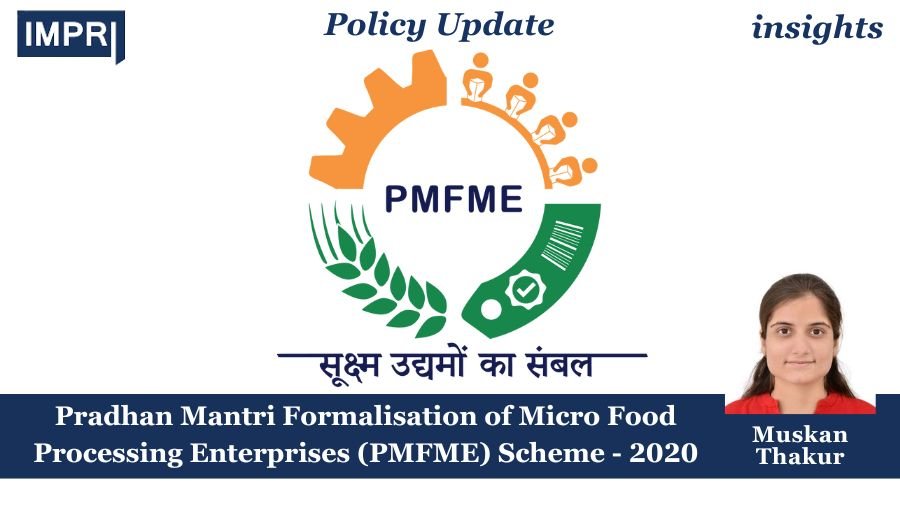
The Pradhan Mantri Formalisation of Micro Food Processing Enterprises (PMFME) Scheme is a centrally sponsored initiative of the Ministry of Food Processing Industries (MoFPI) launched in June 2020 under the Atmanirbhar Bharat Abhiyan. With a total outlay of ₹10,000 crore over five years (2020-21 to 2024-25), the scheme aims to strengthen and formalise India’s unorganised micro food processing sector, which employs millions of people yet remains outside the formal economy.
India’s food processing sector comprises over 25 lakh unorganised micro enterprises, which often lack access to credit, technology, branding, and quality certification. The PMFME Scheme was designed to address these gaps by providing financial, technical, and institutional support to help micro units integrate into the formal value chain.
Its key objectives include:
- Enhancing the competitiveness of existing unorganised micro food processing enterprises.
- Promoting formalisation through registration, licensing (FSSAI, Udyam, GST), and providing access to credit.
- Supporting the One District One Product (ODOP) approach to leverage unique local produce.
- Generating employment opportunities and empowering women and rural entrepreneurs through Self Help Groups (SHGs), Farmer Producer Organisations (FPOs), and cooperatives.
The scheme operates in a centrally sponsored mode, with cost-sharing between the Centre and States in a 60:40 ratio (90:10 for NE and Himalayan states, 100% for UTs).
Functioning
The PMFME Scheme operates through a structured implementation framework that combines financial support, capacity building, and branding assistance to strengthen micro food enterprises.
- Credit-Linked Subsidy: Individual units can avail up to 35% credit-linked capital subsidy on project costs (up to ₹10 lakh per unit) with a minimum beneficiary contribution of 10%. The remaining cost is financed through bank loans. This support enables small entrepreneurs to upgrade technology and expand production.
- Seed Capital for SHGs: Each member of a self-help group (SHG) can receive up to ₹40,000 as seed capital for working capital and small tools, encouraging local entrepreneurship, particularly among women.
- Branding and Marketing Support: FPOs, cooperatives, and SHG federations involved in food processing are eligible for up to 50% grant for branding, packaging, marketing, and quality certification helping strengthen the value chain under the One District One Product (ODOP) initiative.
- Common Infrastructure Support: Funds are provided for shared facilities such as processing centres, cold storage, warehouses, and incubation units, creating economies of scale and lowering overhead costs for micro units.
- Capacity Building and Training: Training and handholding support are delivered through institutions like NIFTEM, IIFPT, and state resource centres to enhance managerial and technical skills among entrepreneurs.
Applications are submitted through the PMFME online portal (pmfme.mofpi.gov.in), where proposals are evaluated, linked to banks, and tracked through a dedicated Management Information System (MIS).
Despite its inclusive design, the scheme faces challenges such as low awareness, complex banking procedures, and limited capacity among beneficiaries to prepare project reports. Many small entrepreneurs also struggle with formalisation requirements like GST and FSSAI registration, slowing early adoption in some regions.
Performance
The PMFME Scheme has recorded steady progress after its initial implementation phase. Data from the Ministry of Food Processing Industries (MoFPI) and the Press Information Bureau (PIB) reflect a clear upward trend in both fund utilisation and enterprise participation:
- As of June 2025, more than 1.44 lakh loans have been sanctioned under the credit-linked subsidy component.
- The Centre’s contribution of ₹3,791 crore has been released to States and UTs since 2020, marking consistent financial support.
- Around 31,978 enterprises have been formalised, while nearly 92,677 beneficiaries have participated in the training and capacity-building sessions.
- Gujarat, Maharashtra, Uttar Pradesh, and Tamil Nadu have emerged as strong performers, backed by effective coordination and higher awareness levels.
However, progress remains uneven. Many northeastern and smaller states continue to lag in fund utilisation and beneficiary outreach. Limited credit absorption capacity and weak institutional mechanisms are key challenges that hinder uniform implementation across India.
Impact
The PMFME Scheme is gradually transforming India’s micro food processing sector, though its full potential is yet to be achieved. By encouraging formalisation and easier access to finance, it is helping rural entrepreneurs scale up production, improve packaging, and tap into new markets.
On the ground, several success stories show its positive impact. Many women-led SHGs have reported more stable incomes after receiving seed capital and training. ODOP-based clusters such as jackfruit in Kerala, tamarind in Chhattisgarh, and mango in Uttar Pradesh are gaining visibility and building distinct local brands.
The scheme also supports broader economic objectives by:
- Strengthening local value chains and reducing post-harvest losses.
- Creating self-employment opportunities in rural areas.
- Promoting food safety and hygiene through skill training.
- Improving the competitiveness of Indian processed food in domestic and global markets.
However, the impact remains uneven. Formalisation has been slow, and many micro enterprises still function outside the organised system. Limited awareness, delays in credit flow, and weak market linkages continue to restrict the scheme’s overall reach.
Emerging Issues
- Limited Awareness: Many micro-entrepreneurs are still unaware of the scheme or face digital barriers that prevent them from accessing benefits of the scheme.
- Credit and Collateral Challenges: Despite providing credit-linked incentives, formal credit access still remains low due to collateral requirements and lengthy procedures.
- Implementation Gaps: The uneven state-level execution and delays in fund disbursal have slowed the overall progress of the scheme.
- Fragmented Supply Chains: Weak backward linkages, poor logistics and inadequate infrastructure in certain districts reduce operational efficiency.
- Quality and Standardization: Limited access to testing, certification and branding facilities for micro-entrepreneurs affects the competitiveness of processed food exports.
- Monitoring and Evaluation: Real-time data tracking and consistent evaluation across states need strengthening to increase transparency and ensure accountability.
Way Forward
The PMFME scheme’s long term success will depend on how effectively the remaining units are formalised and sustained beyond the government subsidy support. The focus should now shift from achieving numerical targets to ensuring that the beneficiary enterprises remain competitive and profitable.
The next step for policymakers should be to integrate PMFME beneficiaries into the larger agri-food value chains and also encourage their participation in the digital and e-commerce platforms. Strengthening and expanding the One District One Product (ODOP) framework can further help rural producers build strong regional identities and also reach global markets.
If consolidated effectively, this scheme has the potential to become a cornerstone of India’s food processing revolution by creating a robust ecosystem for micro entrepreneurs, strengthening rural livelihoods, and contributing to the vision of a self-reliant, “Vocal for Local” India.
References
- Economic Times. (2023, July 5). PMFME scheme helping small food businesses scale up through credit and skill support. The Economic Times. Retrieved from https://economictimes.indiatimes.com
- IMPRI Insights. (2022, November). Policy Update: Pradhan Mantri Formalisation of Micro Food Processing Enterprises (PMFME) Scheme – Impact and Implementation Review. IMPRI India. Retrieved from https://www.impriindia.com/insights
- Invest India. (2024). Pradhan Mantri Formalisation of Micro Food Processing Enterprises (PMFME) Scheme overview. Government of India. Retrieved from https://www.investindia.gov.in
- Ministry of Food Processing Industries (MoFPI). (2020). Guidelines for the Pradhan Mantri Formalisation of Micro Food Processing Enterprises (PMFME) Scheme. Government of India. Retrieved from https://www.mofpi.gov.in
- Ministry of Food Processing Industries (MoFPI). (2023). Annual report 2022-23. Government of India. Retrieved from https://www.mofpi.gov.in/resources/annual-report
- NITI Aayog. (2023). Atmanirbhar Bharat and food processing sector reforms: Progress and opportunities. Government of India. Retrieved from https://www.niti.gov.in
- Press Information Bureau (PIB). (2024, May 17). PMFME Scheme propelling growth of micro food processing sector across India. Government of India. Retrieved from https://pib.gov.in
- PRS India. (2023). Food processing sector in India: Policy landscape and schemes overview. PRS Legislative Research. Retrieved from https://prsindia.org
About the contributor
Muskan Thakur is a Research Intern at IMPRI and a Master’s student in Economics at Gokhale Institute of Politics and Economics, Pune.
Acknowledgement: The author extends her sincere gratitude to the IMPRI team and Ms. Aasthaba Jadeja for her invaluable guidance throughout the process.
Disclaimer: All views expressed in the article belong solely to the author and not necessarily to the organisation.
Read More at IMPRI:
Mission LiFE – Lifestyle for Environment – Policy Update 2025
Department of Legal Affairs, India – Policy Update 2025