Manorama Bakshi
Arjun Kumar
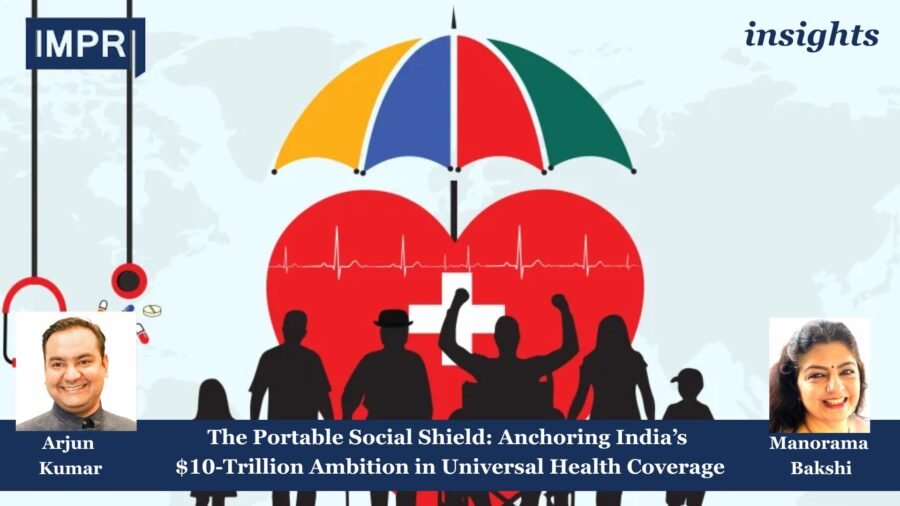
As India navigates the transformative journey toward becoming the world’s third-largest economy by 2027, the benchmarks of national progress are undergoing a fundamental shift. No longer can “development” be viewed solely through the prism of industrial output or fiscal deficits. In the 2026–27 policy landscape, it has become axiomatic that India’s macroeconomic trajectory is inextricably linked to the resilience of its human capital. A nation’s economic ascent is only as sustainable as the health security of its labor force. Consequently, the transition toward Universal Health Coverage (UHC) has evolved from a social welfare objective into a foundational geopolitical and economic strategy.
While the Ayushman Bharat (PM-JAY) framework has successfully established a historic safety net for the bottom 40% of the population, a critical structural gap remains: the “Missing Middle.” This segment—comprising nearly 400 million self-employed individuals, gig workers, and informal laborers—serves as the engine of India’s burgeoning service and manufacturing sectors. Yet, they remain among the most vulnerable to the “medical poverty trap.” To achieve the Viksit Bharat 2047 vision, India must accelerate the evolution of its healthcare architecture from a fragmented safety net into a universal, portable social shield.
The Macroeconomic Imperative of Health Equity
The urgency of UHC is grounded in the persistent reality of “catastrophic health expenditure.” Despite progressive strides, Indian households still bear roughly 40–45% of total health expenditure out-of-pocket (OOPE). Health shocks continue to push millions of Indians into poverty each year. For an economy targeting a $10-trillion valuation, this erosion of middle-class savings represents a significant leakage of domestic capital.
The 2026–27 Union Budget signaled a transition, with a notable capital outlay for health infrastructure under PM-ABHIM (₹4,770 crore) and the integration of senior citizens (70+) into the public insurance fold. However, with total public health spending hovering around 2–2.1% of GDP, the gap between current investment and the 2.5% benchmark remains a fiscal challenge. To sustain the momentum required for a global top-three ranking, health spending must be redefined. It is not a fiscal drain but a high-yield investment; global evidence suggests that every ₹1 invested in universal health generates multiplier effects through enhanced labor productivity and the release of precautionary household savings into broader economic circulation.
The Gender Dividend: Health as a Catalyst for ‘Nari Shakti’
A central pillar of the “Viksit Bharat” agenda is the economic empowerment of women. However, India’s Female Labor Force Participation (FLFP) remains constrained by the structural reality of “time-poverty.” In the absence of a robust public health continuum, women frequently serve as the state’s default, unpaid primary caregivers. A single health crisis in the family can necessitate a woman’s exit from the formal workforce.
Universal Health Coverage serves as a powerful gender leveller. By providing a reliable social shield, the state reduces the domestic care burden, thereby facilitating women’s sustained participation in the labor market. Furthermore, the expansion of preventive initiatives—such as the national HPV vaccination drive—represents a strategic economic intervention. Healthier women participate more consistently in the economy, drive intergenerational social mobility, and strengthen educational outcomes for the next generation. For India to emerge as a global brain trust, the “health-labor” nexus for women must form the centerpiece of our social contract.
Social Security for the Digital Generation
India’s demographic dividend is increasingly concentrated in the high-growth gig and informal sectors. The Social Security Code has formally recognised gig and platform workers within the social protection architecture, and recent budget announcements signal the intent to extend health protection under Ayushman Bharat to this workforce. Yet, nationwide seamless enrollment, portability mechanisms, and full digital interoperability are still evolving.
With the gig workforce projected to reach nearly 25 million by 2030, the traditional model of employer-linked insurance is increasingly inadequate. The youth of India require “Health Portability.” A gig worker in Ranchi or a freelance consultant in Bengaluru needs a social shield linked to their ABHA ID (Ayushman Bharat Health Account), not to a specific contract. By leveraging the Ayushman Bharat Digital Mission (ABDM), India can progressively move toward a “money-follows-the-patient” model. This digital integration—now encompassing hundreds of millions of ABHA IDs—holds the potential to reduce administrative inefficiencies and ensure that entrepreneurial risk-taking is not constrained by the fear of catastrophic medical debt.
The Path to 2047: A Policy Manifesto
As India ascends the global economic hierarchy, three structural reforms merit serious national consideration:
- Fiscal Re-alignment: Establish a time-bound trajectory to reach 2.5% of GDP in public health spending by 2028, potentially supported through innovative financing instruments such as a calibrated health cess on high-consumption luxury goods.
- Statutory Entitlement: Transition from discretionary “schemes” toward a more predictable, rights-based framework that strengthens continuity and accountability in health protection.
- Payer-Provider Alignment: Utilize digital health infrastructure under ABDM to strengthen transparency, standardization of treatment costs, and faster claim settlements, thereby reducing friction between hospitals, insurers, and beneficiaries.
Conclusion
The road to Viksit Bharat 2047 is paved with the physical and financial well-being of its people. Universal Health Coverage is the great equalizer that can protect our youth, empower our women, and anchor macroeconomic stability. As India moves toward becoming the world’s third-largest economy, its growth must be not only rapid, but resilient. It is time to transform the safety net into a social shield that is universal, portable, and enduring.
Manorama Bakshi is Director & Head of Healthcare & Advocacy at Consocia Advisory, Founder & Director of the Triloki Raj Foundation, and a Senior Visiting Fellow at IMPRI.
Arjun Kumar is the Director of the IMPRI Impact and Policy Research Institute, New Delhi. He holds a Ph.D. in Economics from the Centre for the Study of Regional Development, School of Social Sciences, Jawaharlal Nehru University (JNU), New Delhi.
Disclaimer: All views expressed in the article belong solely to the author and not necessarily to the organisation.
Read more at IMPRI:
Indian Foreign Services : Frontier Of India’s Diplomacy
Feminisation of Labour in India: Gender, Precarity, and Development
Acknowledgment: This article was posted by Shivashish Narayan, a Visiting Researcher at IMPRI.