Policy Update
Shubhika Rathi
The Micro, Small, and Medium Enterprises (MSME) sector is the backbone of the Indian economy, contributing around 30% to the country’s Gross Domestic Product (GDP). According to the Ministry of MSME, India is home to over 58 million MSMEs, which collectively generate approximately 120 million jobs. This makes MSMEs the second-largest employment provider in India, second only to the agriculture sector.
Furthermore, MSMEs contribute about 45% to India’s total manufacturing output and 40% to the country’s exports. One of the primary obstacles is limited access to credit, as many MSMEs struggle to secure financing from traditional banking institutions due to stringent lending criteria and a lack of adequate collateral. This also arises due to another critical issue i.e, high level of informaliṣzation within the sector.
A large proportion of MSMEs operate in the informal economy, which limits their access to formal credit and markets, and often subjects them to exploitative practices. In addition to addressing these challenges, the government is also focusing on the greening of MSMEs. Schemes such as RAMP Scheme, the Prime Minister’s Employment Generation Programme (PMEGP), Credit Guarantee Fund Scheme for Micro and Small Enterprises (CGTMSE) are aimed to resolve the issues revolving around the sector.
Background of the Scheme
On 25th July 2022, the Ministry of micro small and medium enterprises launched a World Bank supported Central Sector Scheme called Raising and Accelerating MSME Performance (RAMP). The scheme aims at strengthening institutions and governance at the Centre and State, improving Centre-State linkages and partnerships and improving access of MSMEs to market and credit, technology upgradation and addressing issues of delayed payments and greening of MSMEs.
The RAMP programme will be implemented over a period of five years. The total outlay for the scheme is ₹6,062.45 crore or USD 808 Million, out of which ₹3750 crore or USD 500 Million would be a loan from the World Bank and the remaining ₹2312.45 crore or USD 308 Million would be funded by the Government of India (GoI).
Objectives
- Improving access to market and credit for MSMEs
- Strengthening institutions and governance at the central and state levels
- Improving center-state linkages and partnerships
- Addressing issues of delayed payments
- Greening of MSMEs
Functioning
The World Bank noted that 40% of MSMEs in India out of a total of 58 million do not have access to a formal source of credit. Hence, RAMP has been set up to target the credit needs of MSMEs, especially to make the sector more productive and competitive after the COVID-19 pandemic. RAMP is set to start in five states in the country, including Tamil Nadu, Punjab, Gujarat, Maharashtra, and Rajasthan. These states contain 54% of India’s MSMEs.
The scheme will focus on improving the credit and liquidity needs of small businesses by incentivising banks and non-banking financial companies (NFBCs) to offer loans to MSMEs. The funding can help MSMEs focus on important areas like hiring staff, launching new and high-quality products, and adopting sustainable business practices.
Eligibility criteria and Application of the Scheme
To avail the benefits of the RAMP scheme, MSMEs need to meet certain eligibility criteria. The scheme is open to enterprises classified as micro, small, or medium under the MSME Development Act, 2006. The eligibility criteria may vary based on the sector, location, and nature of the enterprise. Generally, MSMEs should have a valid Udyog Aadhaar Memorandum (UAM) and comply with the regulatory requirements set by the government.
Applying for the RAMP scheme involves a systematic process where MSMEs need to submit relevant documents and follow specific guidelines. To start the application, MSMEs should visit the Ministry of Micro, Small & Medium Enterprises’ official website. The website offers detailed information about the scheme, including application forms and required supporting documents. MSMEs must accurately fill out the application form, providing details about their business, finances, and growth plans. Seeking professional help or guidance is recommended to ensure the application is thorough and meets all necessary requirements.
Performance
The scheme has two key result areas, Strengthening Institutions and Governance of MSME programmes and Support to market access firm capabilities and access to finance. To enhance the participation of the States/UTs in the RAMP programme, all States/UTs were invited to sign Letters of Undertaking with the Ministry of MSME, and to prepare Strategic Investment Plans (SIPs) that would consist of a roadmap for development and promotion of MSME sector in the States/UTs. Out of 34 States/ UTs that have participated in the RAMP Programme, 22 States, have submitted the Strategic Investment Plans (SIPs). Grants amounting to Rs. 1143.55 crore have been approved for selected projects in 10 states.
Ministry of MSME has launched three new sub-schemes to facilitate affordable credit to micro and small enterprises for greening investments, and for speedy dispute resolutions for delayed payments:-
- MSME GIFT Scheme to provide support to MSEs in accessing institutional finance at a concessional rate for adopting clean / green technologies
- MSE SPICE Scheme to promote circular economy.
- MSE Scheme on Online Dispute Resolution for Delayed Payments for speedy redressal of delayed payments of MSEs.
Apart from these new schemes, RAMP is also supporting the scaling up of the existing schemes of the Ministry for enhancing the competitiveness of the MSME sector.
Impact
An estimated 1.5 million MSMEs can benefit from the RAMP program. RAMP can also improve employment, productivity, and skills in the MSME sector. Additionally, the RAMP scheme highlights the importance of MSME clusters. These clusters are groups of businesses located near each other, working in the same industry, and providing similar products and services. Clusters have the potential to increase the MSME sector’s revenue, but they are still not fully developed in India.
The details of budget allocated to the RAMP programme, and utilization since the launch of the programme is presented in the graph below
Source: Digital Sansad
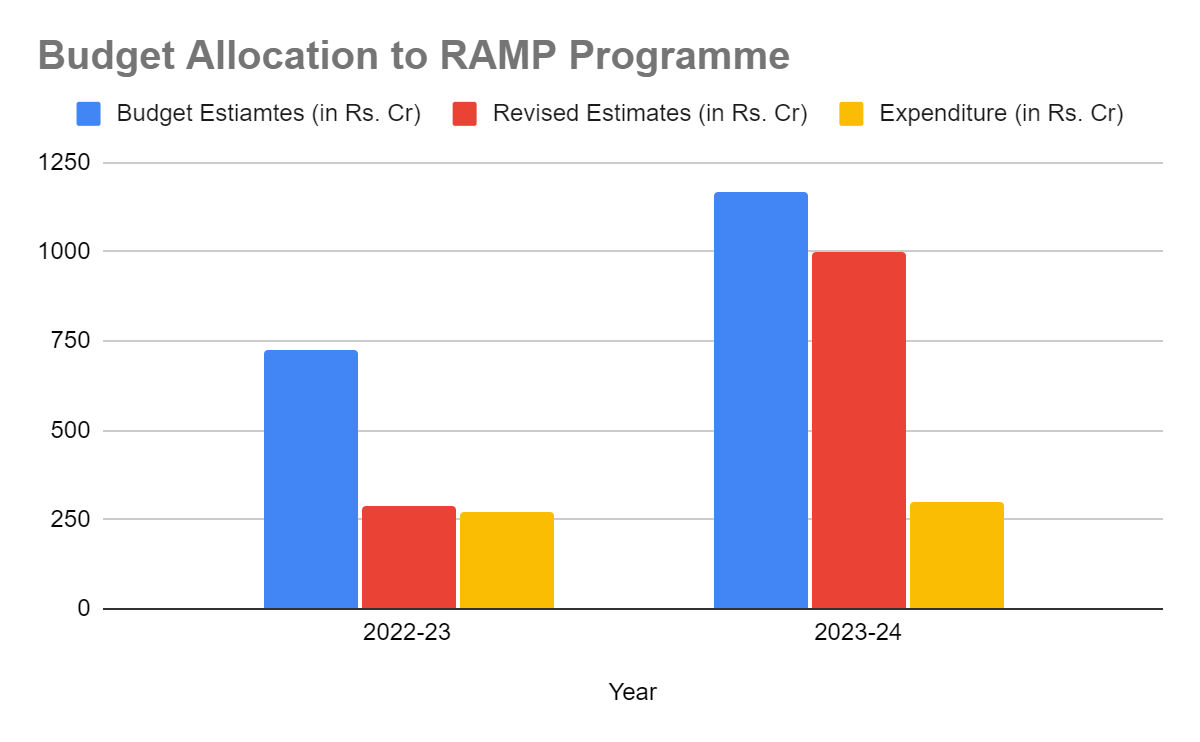
The scheme shows a significant gap between allocated funds and their actual utilization, raising concerns about the efficiency of fund usage. The data indicates that less than 40% of the initial allocation was utilized, highlighting potential inefficiencies or delays in the implementation of the scheme. Regardless of the utilization, we notice an upward trend in budget allocation which underscores the scheme’s expanding scope and the government’s proactive approach in addressing the needs of the MSME sector to foster economic growth and sustainability.
Conclusion
The Raising and Accelerating MSME Productivity (RAMP) scheme has notably advanced the sustainable development and formalization of India’s MSME sector. It has promoted green technologies through initiatives like the MSME GIFT scheme, driving environmental sustainability. Increased registrations on the Trade Receivable Discounting System (TReDS) platform and the Credit Guarantee Fund Trust for Micro and Small Enterprises (CGTMSE) have enhanced transparency, access to finance, and regulatory compliance. Capacity building and technological upgrades under RAMP have empowered MSMEs to innovate and compete effectively.
However, challenges such as bureaucratic delays, limited awareness among MSMEs, and slow technological adoption persist. Addressing these issues through streamlined processes, extensive outreach, and robust technological support will further enhance the scheme’s effectiveness. Overall, while the RAMP scheme has made significant strides, addressing these emerging challenges is crucial to fully realizing its potential in driving sustainable and prosperous growth for the MSME sector.
References
- HDFC Bank. (2024, July 22). What is RAMP Scheme – Its Features & Working. HDFC Bank. Retrieved July 22, 2024, from https://www.hdfcbank.com/personal/resources/learning-centre/sme/what-is-ramp-scheme
- Ministry of MSME. (2020, November 24). Inviting comments of stakeholders on The Draft Environmental and Social Assessment, ESSA under a World Bank funded programme – Raising and Accelerating MSME Productivity, RAMP | Ministry of Micro, Small & Medium Enterprises. MSME. Retrieved July 22, 2024, from https://msme.gov.in/whatsnew/inviting-comments-stakeholders-draft-environmental-and-social-assessment-essa-under-world
- Ministry of MSME. (2024, February 5). RAJYA SABHA UNSTARRED QUESTION No. 256 TO BE ANSWERED ON 05.02.2024. Digital Sansad. Retrieved July 22, 2024, from https://sansad.in/getFile/annex/263/AU256.pdf?source=pqars
- National Institute for Micro, Small and Medium Enterprises. (2023, May 23). Raising & Accelerating MSME Performance (RAMP) Scheme. National Institute for Micro, Small and Medium Enterprises (ni-msme). Retrieved July 22, 2024, from https://www.nimsme.org/news-article/raising-accelerating-msme-performance-ramp-scheme
- Press Information Bureau. (2022, July 25). Scheme Launched by Government for MSME. Press Information Bureau. Retrieved July 22, 2024, from https://pib.gov.in/PressReleasePage.aspx?PRID=1844602
- Tata Capital. (2024, May 16). Unleashing the Potential: A Comprehensive Guide to the RAMP Scheme for MSMEs. Tata Capital. Retrieved July 22, 2024, from https://www.tatacapital.com/blog/loan-for-business/unleashing-the-potential-a-comprehensive-guide-to-the-ramp-scheme-for-msmes/
About the Author
The article is written by Shubhika Rathi, Research Intern at IMPRI, pursuing Bachelor’s in Economics at Symbiosis School of Economics.
Acknowledgement
The author would like to express sincere gratitude to Dr. Arjun Kumar, Ms. Aasthaba Jadeja, Ms. Ansuya Choudhary and Ms. Deepanjali for their invaluable contributions to this article.
Read more at IMPRI:
Expanding Solar Power Access under the PM Surya Ghar Muft Bijli Yojana (2024)
International Day of Parliamentarism 30 June, 2024