Policy Update
Madhur Thapar
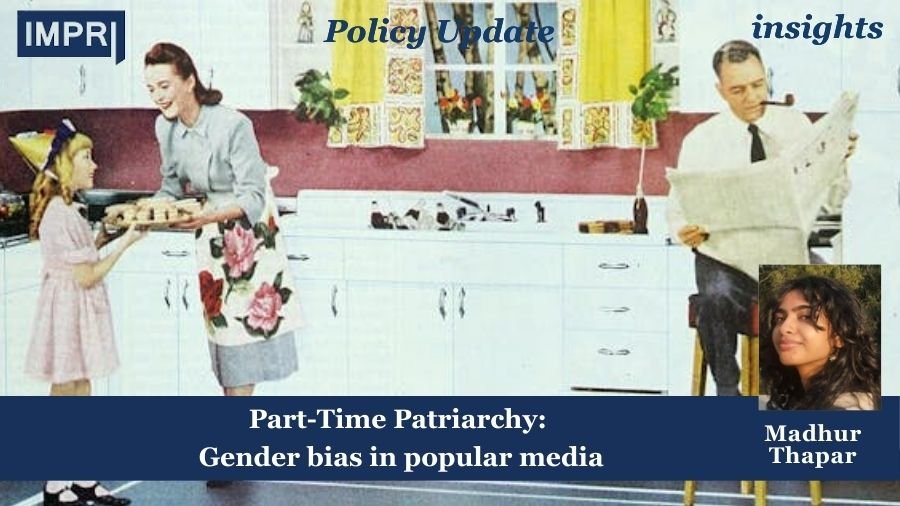
Source-https://study.com/academy/lesson/gender-stereotypes-in-the-media.html
Introduction: Patriarchy, Popular media, and Gender bias
Patriarchy refers to a system of social organisation in which power, authority and privilege are unevenly distributed in favour of men. It works not only through formal institutions like the state, family or workplace but also through culture, stories, symbols, humour, and everyday representations that normalise unequal gender relations. One of the most influential sites where patriarchy is produced and legitimised is popular media.
Popular media like movies, television, advertising, and music reaches a mass audience and shapes collective imagination. In the Indian context, popular media occupies a central role in everyday life, cutting across class, region and language. Its influence lies not only in reflecting the society, but in constructing norms about gender, relationships and morality.
Gender bias within popular media refers to the systematic privilege of the male perspective, experiences, and desires while marginalising women. This bias is not always explicit. It often appears through absence, like women not being centred in narratives, or through framing, women being shown in limited and predictable roles. A key feature of this bias is that popular media is frequently designed with men as the target audience.
Male protagonist dominate screens, their emotions drive plots, and their aspirations define success. As a result, nearly half the population becomes peripheral to stories that claim to represent society at large. This selector visibility produces what can be described as part-time patriarchy: a form of gender power that adapts to modern sensibilities, occasionally adopting the language of equality, while continuing to reproduce deeply unequal gender norms.
Historical background
Historically, Indian cinema and advertising have been structured around male centrality. Early mainstream Hindi cinema positioned men as heroes, decision makers and moral agents while women were framed as caregivers, romantic interests, or symbols of virtue and sacrifice. Feminist film scholars such as Laura Mulvey have described this as the operation of the male gaze, where narratives and visual framing are organised around male pleasure and identification.
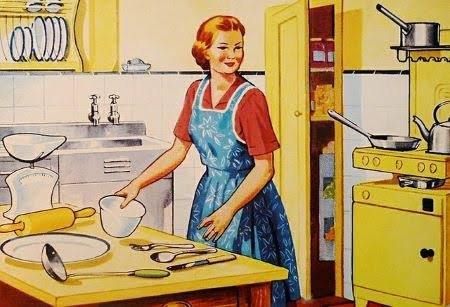
This pattern was reinforced in advertising. Deys on Indian television commercials from the 1990s and early 2000s show that women were predominantly depicted in domestic spaces, associated with beauty, cleanliness, and caregiving, while men were linked to authority, work and consumption. These representations aligned closely with patriarchal divisions between the private and public spheres. Importantly, this was not just a reflection of social reality, but a process of socialisation. By constantly associating masculinity with control and femininity with service, popular media taught viewers how genders were expected to behave. Over time, these representations came to appear natural rather than constructed.
Recent decades have seen an increase in women-centric films, and campaigns; the underlying narrative grammar has changed only partially. Patriarchy has not disappeared, but it has learnt to adapt.
What is happening now?: Analysis of contemporary media.
Contemporary Indian popular media presents itself as progressive. Women are shown working and speaking assertively while also expressing their desires.. However, this apparent progress also exists with persistent male dominance in narrative control, humour, and moral framing.
- Male protagonist and the default audience
Most mainstream films continue to be driven by male protagonists, even when women play significant roles. The male character’s journey remains the emotional core, while women stories are positioned as subplots. This reinforces the idea that male experiences are universal while female experiences are secondary.
Even when women are portrayed as independent, their independence is often contextualised through male approval or emotional validation. The narrative rarely asks what women want beyond romantic fulfilment or moral redemption.
- Constructing male gaze through humour
Advertising offers one of the clearest examples of how popular media constructs gendered ways of seeing. The Imperial Blue’s “Men will be Men” campaign is particularly illustrative. Through humour, these arts show male irresponsibility, public nuisance, and emotional immaturity as natural expressions of masculinity. The phrase “Men will be Men” functions as an excuse framing problematic behaviour as inherent and natural rather than socially learned.
Humour plays a crucial role here. By making the audience laugh, the ads discourage criticism and present such behaviour as harmless and fun, excusing the larger entertainment system rather than calling it out for marginalising women.. By forming narratives such as using this perfume will attract all the women in the vicinity or wearing certain inner wear will make you sexually appealing, it shows that male self-worth is constructed through female validation
So representations do not just entertain, they teach men how to view women and themselves. They reinforce a binary where men are allowed, chaos, pleasure, and imperfection while women are expected to be responsible and patient.
- Gender roles and psychological conditioning
Media psychology research shows that repeated exposure to stereotypical portrayals shapes the audience, expectations, and self-perception. When men consistently see themselves represented as agents and women as objects, these associations become cognitively embedded, this has implications for how gender roles are acted out in everyday lives. Popular media becomes a site of informal gender education.
Implications
The implication of gender bias and popular media beyond representation. They affect how individuals understand power, entitlement, and emotional expression.
Such media sustains unequal gender relations by normalising asymmetry. Men’s desires are portrayed as legitimate and urgent, while women’s desires are often constrained or moralised. This reinforces the idea that men are subjects of action and women are objects of reaction.
Second, it limits women’s imaginative possibilities. When women rarely see themselves as protagonists of their own stories, it narrows aspirations and reinforces internalised constraints. Even empowerment narratives often emphasise individual resilience rather than collective structural change, shifting responsibility onto women to adapt rather than questioning the system itself.
Third, part-time patriarchy blurs accountability. Because it functions subtly through humour, nostalgia, and market-friendly feminism, it becomes harder to challenge. People may believe gender equality has largely been achieved, even as day representations continue to be reproduced by us.
Finally, the psychological impact is cumulative. The media does not cause gender inequality on its own, but it sustains the cultural environment in which inequality feels normal.
The way forward
Addressing gender buyers and popular media requires moving beyond token representation towards structural change.
First, storytelling must diversify its centres. Women need to be shown not just as strong characters, but as complex protagonists whose desires, failures, and contradictions are treated with the same narrative seriousness as men’s.
Second, advertising must abandon humour that relies on gender stereotypes. Brands wield immense cultural power, and responsible representation should be seen as an ethical practice rather than moral policing.
Third, media literacy is crucial. Audiences need tools to critically analyse what they consume, recognising how humour, framing, and omission shape perception.
Finally, structural support for women, creators, writers and directors is essential. Representation behind the camera influences representation on screen by changing the gaze intended.
Conclusion
Patriarchy works because it adapts. It does not openly resist equality, but it selectively works through it. Popular media reflects this flexibility by offering surface-level progress at the same time, preserving deeper hierarchies. As long as the male perspective remains, the default and gendered behaviour is excused as natural or funny, equality will remain incomplete.
Challenging gender bias and popular media is not about censoring content, but about questioning whose stories are told, how they are framed and who is allowed to have the centre. Until popular media fully recognises women as subjects rather than supporting characters, patriarchy will never truly leave the media.
References
Butler, J. (1990). Gender trouble: Feminism and the subversion of identity.Routledge.https://selforganizedseminar.wordpress.com/wp-content/uploads/2011/07/butler-gender_trouble.pdf
Connell, R. W. (1995). *Masculinities*. University of California Press.https://genderandmasculinities.wordpress.com/wp-content/uploads/2017/02/robert-w-connell-masculinities-second-edition-3.pdf
Das, M. (2000). Men and women in Indian magazine advertisements: A preliminary report. *Sex Roles*, 43(9-10), 699-717.https://link.springer.com/article/10.1023/A:1007108725661
Fairclough, N. (1989). *Language and Power*. Longman.https://www.researchgate.net/profile/Norman-Fairclough/publication/49551220_Language_and_Power/links/54db76260cf233119bc62bc2/Language-and-Power.pdf
Mulvey, L. (1975). Visual pleasure and narrative cinema. *Screen*, 16(3), 6-18.https://www.amherst.edu/system/files/media/1021/Laura%20Mulvey%2C%20Visual%20Pleasure.pdf
Munshi, S. (1998). Wife/mother/daughter-in-law: Multiple avatars of homemaker in 1990s Indian advertising. *Media, Culture & Society*, 20(4), 573-591.https://journals.sagepub.com/doi/10.1177/016344398020004004
Ray, N. (2023). Masculinist constructions of nationalism in India: Gender, body politics, and Hindi cinema. *Journal of International Women’s Studies*, 25(3), Article 5.https://vc.bridgew.edu/cgi/viewcontent.cgi?params=/context/jiws/article/3094/&path_info=5._Ray._Masculinist_Construction_of_Nationalism_Discourse_in_India__Gender__Body_Politics_and_Hindi_Cinema.pdf
About the Author: Madhur Thapar is a Research Intern at IMPRI. She is currently pursuing her undergraduate degree in Political Science from Kamala Nehru college, Delhi university. Her research interest include public policy, international relations and psychology
Acknowledgement: The author sincerely thanks Aasthaba Jadeja and other IMPRI fellows for their valuable contribution.
Disclaimer: All views expressed in the article belong solely to the author and not necessarily to the organisation.
Read more at IMPRI:
Decoding India’s Q2 GDP: Growth Drivers and Data Integrity
The Pro-Business Pivot: How Modern Labour Codes Prioritize Industry Over Protection