
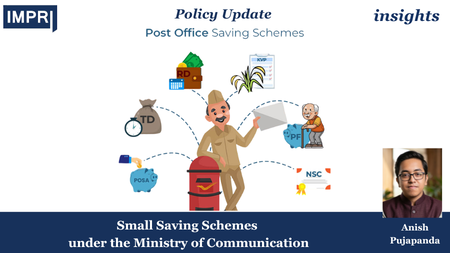
Policy Update
Anish Pujapanda
Background

Saving Schemes can be traced back to the pre – colonial eras, where there was a launch of the Post Office Savings Bank in 1882 to democratise banking, making the savings across India’s vast postal network. After the Independence in 1947, the Government looked to establish different small saving schemes to inculcate the concept of saving amongst the citizens and also make them understand savings as a tool to look into the situations of the emergency, etc. The launch of MIS(1987), Kisan Vikas Patra(1988), Senior Citizen Scheme(2004), etc., were some of the prominent steps to propagate the welfare and inclusion of citizens across different citizens across the country.
Prime Objectives of Small Saving Schemes
i)- Financial Inclusion – The small saving schemes by the Department of Posts are to provide the banking services to the population in the remotest areas who are unable to access the banking services by establishing close to 1.5 Lakh Posts across India .
ii)- Promotion of Social Welfare – The schemes like Senior Citizens Scheme , Mahila Saving Samman Savings Certificate, etc., are launched to promote social security amongst groups like senior citizens and women.
iii)- Long – Term Wealth Creation – The small saving schemes are also providing higher interest rates than the standard bank rates to be protected against inflation over the course of time.
iv)- Creation of Household Savings – One of the most important concepts for small saving schemes is to look for inculcating savings in schemes rather than inculcating them in other cash or informal assets.
Functioning of Schemes
- Post Office Savings Account- The account is similar to a normal bank account, which can be opened with a minimum balance of 500 rupees.
- National Savings Recurring Deposit – This deposit is for a 5-year monthly investment plan for saving a minimum of 100 rupees every month to inculcate a disciplined nature.
- Post Office Monthly Income Scheme – This is basically an income scheme for a lock-in period of 5 years under which the depositor can deposit a lump sum amount and look to receive a fixed interest payment every month, which can be useful for necessary cash flow activities.
- Public Provident Fund- One of the most important small savings schemes is the Public Provident Fund, which is a 15 year long term investment scheme which is basically aimed at developing a good retirement corpus. This scheme is a tax-efficient scheme.
- Kisan Vikas Patra– The scheme was initially launched for the farmers, but currently it is open to all, and this scheme doubles your initial investment amount over a period of 115 months.
- Mahila Samman Savings Certificate- Its a 2-year (one-time deposit scheme) which is exclusively designed to encourage female financial inclusion in the country.
- Senior Citizen Saving Scheme- It’s dedicated to individuals aged above 60 to provide quarterly interest payments and is one of the most dedicated retirement corpus schemes for senior citizens.
Impact and Performance
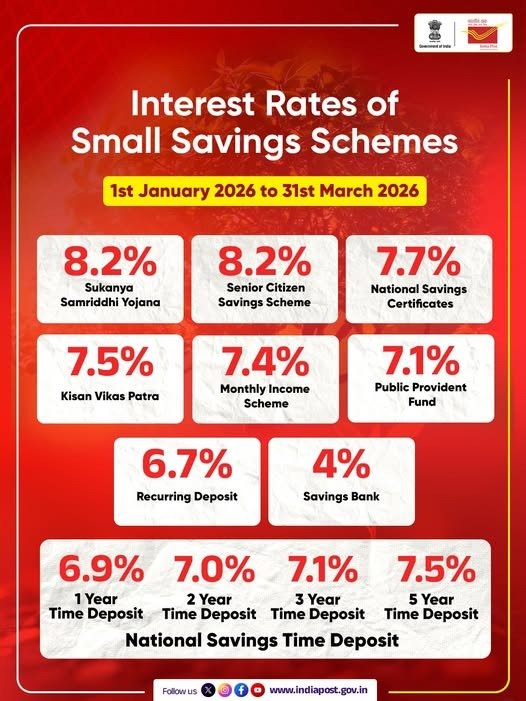
Figure : The National Small Saving Schemes | Credit : India Post
- Investment Holdings – According to RBI reports, the gross deposit holdings in the different national saving schemes are close to 14.2 Lakh Crore as of 2023-2024 in comparison to 11.25 Lakh Crore in 2022-2023. It shows the increasing confidence of investors in investing in national small saving schemes, as being backed by the Government is a major trust-building factor.
- Wider Coverage – According to the National Saving Institute, there are around 3.2 crores women as of 2023-2024, having a Sukanaya Samriddhi Account from each state and union territory in India, showing a wider coverage of their schemes.
- Lucrative Interest Rates – The comparison of interest rates of different small saving schemes along with the Bank FDs shows that they have higher interest rates, which attract the investors to invest in these schemes to gain more return. For instance, PPF provides an interest rate of 7.1% per annum along with tax benefits in comparison to the SBI HDFC banks’ regular FD interest rate of 6.45% per annum.
- Tax Benefits- These schemes, like Public Provident Fund, Sukanaya Samriddhi Yojana, Senior Citizen Saving Scheme, still hold their tax exemption benefit under Section 80 C of the Income Tax Act, 1961, which helps the small-scale investors to keep their profits generated under these different schemes away from tax deduction.
- Continuous Revision of Rates: The small saving schemes have a continuous revision of their rates, mostly annually, in order to meet the increasingly higher inflation rates of current time and also in order to attract new investors.
Emerging Issues
- Liquidity Issues – Most of the Schemes like Public Provident Fund (PPF), Senior Citizen Saving Scheme have lock-in periods ranging from 5 -15 years, which restricts the investors’ withdrawal capacity in situations of real requirements, also it restricts them to adjust to the inflationary requirements of the current time.
- Overlapping Issues – Many of the schemes have the same kind of deposits, like the Recurring Deposits and Term Deposits, which initially becomes confusing for the newer investors.
- Low Technology Integration – The launch of the Digital India initiative has impacted the technology integration in the different sectors in India, but a considerable amount of work still needs to be done in the Small Saving Schemes in India, as most of the offices of the Department of Posts in rural/ remotest areas lack technological devices for work.
- Administrative Issues- The different procedures of opening the accounts or making a deposit are still an issue, which makes the investors worse and worried about their investment and it deters them from investing further due to standing in long queues and long waiting periods. As investor satisfaction would only promote the investments in the schemes, they would also refer to other people based on their experiences.
- Newer Tax Regime – The new revised tax regime under the GST has made very few tax deductions, thus making the old schemes like Public Provident Fund and Senior Citizen Saving Schemes less attractive for the newer investors.
Way Forward
- Maintaining Lucrative Interest Rates is necessary to keep the small-scale investors’ confidence, as they would then only feel attracted to invest in these schemes and look for them to balance the situations of higher inflation, which is continuously increasing.
- Active Management of Accounts should be necessary to monitor the nature of investment of the investor, so that there is also a check-and-balance protocol on the investor and there can be disclosure of accounts of investors which have been inactive for a period of 3 years to stop the misuse of funds by anyone other than the investor.
- Digitalization for Ease of Access is necessary in the form of expanding E-Aaadhar KYC, Digital Accounts opening, etc., should be made in order to lessen the issues being faced by the investors and also enhance investor satisfaction, which is the main requirement for investment in these schemes.
- Awareness Programs are necessary for all these schemes in order to inculcate new young investors in these schemes by giving them the different benefits of these schemes and the sense of security and safety that these schemes uphold in order to increase the investment holdings in these schemes.
REFERENCES
Ministry of Finance. (2014). Small Saving Schemes for the benefit of all including Weaker Sections of Society. https://www.pib.gov.in/newsite/PrintRelease.aspx?relid=107880®=3&lang=2
National Saving Institute. (2023). Statement Showing Collection Under National Savings Schemes w.e.f. 2002-03.https://www.nsiindia.gov.in/(S(stlkye2pvam4dh45avcsku55))/InternalPage.aspx?Id_Pk=152
National Saving Institute. (2017). Annual Report on Analysis of Trends of Small Saving Collection.https://www.nsiindia.gov.in/writereaddata/FileUploads/UpdatedAnnualReport201718.pdf
Press Information Bureau. (2026). From Savings to Strength: Empowering India’s Girls through Sukanya Samriddhi Yojana. https://www.pib.gov.in/PressReleasePage.aspx?PRID=2216748®=3&lang=1
Wójcik-Czerniawska Agnieszka .(2023).Small Saving Schemes and Its Importance .https://www.ijef.latticescipub.com/wp-content/uploads/papers/v3i1/D2520111422.pdf
About the Contributor:
Anish Pujapanda is a Research and Editorial Intern at IMPRI.
Acknowledgement: The author extends sincere gratitude to the IMPRI team for their expert guidance and constructive feedback throughout the process.
Disclaimer: All views expressed in the article belong solely to the author and not necessarily to the organization.
Read more at IMPRI:
The Great Welfare Retreat: How Budget 2026–27 Quietly Dismantled India’s Social Sector
Children at the Centre of Climate-Resilient Cities