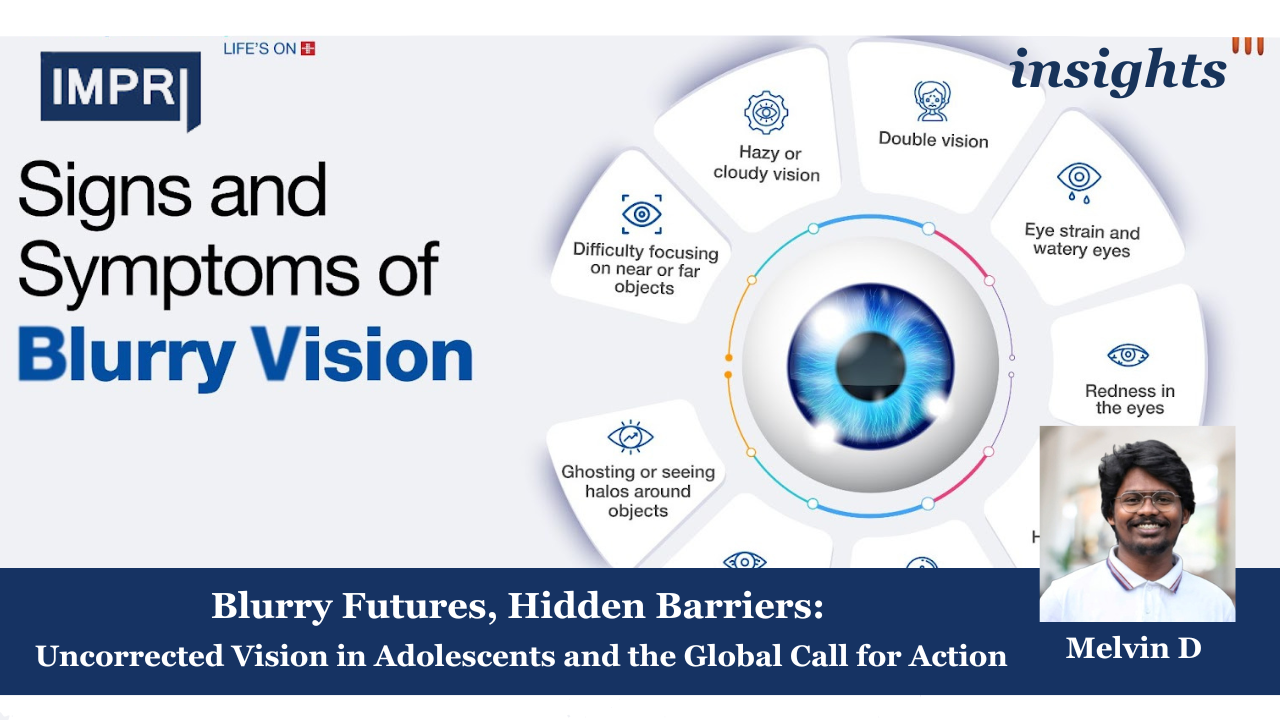
Melvin D
Introduction
Millions of adolescents across the globe suffer silently from uncorrected refractive errors (URE) such as myopia, hyperopia, and astigmatism. Despite being easily treated with corrective lenses, these vision problems remain one of the leading, yet under-addressed, public health challenges for young people. The ripple effects extend far beyond blurry sight, impacting education, psychosocial well-being, and future opportunities especially in low- and middle-income countries (LMICs).
The Global Burden
The World Health Organization estimates that vision impairment causes an annual global productivity loss of $411 billion, with uncorrected refractive errors responsible for 6.3 million lost school years and $173 billion in direct economic losses annually. In India alone, studies reveal that between 8 –11% of children have refractive errors, with urban areas and girls at greater risk. Globally, the burden of refractive error among adolescents rose 8% between 1990 and 2019, driven by population growth and urbanization, especially in Asia.
Impact on Education
Vision impairment is a major obstacle to learning. Large international studies show that children with untreated vision consistently score lower in reading and mathematics, experience more frequent class failures, and have poorer academic engagement results replicated in both high-income settings and LMICs. In China, providing affordable eyeglasses halved the risk of class failure and narrowed achievement gaps for disadvantaged students. However, in India, even after large-scale school vision screenings, as many as 25% of students still have undiagnosed URE, stalling progress toward universal education access.
Social and Psychological Dimensions
The side effects of poor vision extend far beyond academics. Adolescents with uncorrected vision report lower quality of life, decreased participation in social events, and greater anxiety and depression. Girls in particular face more psychological distress due to spectacle stigma, limiting their willingness to seek correction even when needed. Studies in Dakshina Kannada and Bihar, India, have shown that misconceptions and stigma around spectacle use lead to significant hidden psychosocial distress among youth.
Poverty and Access Barriers
Young people in LMICs face higher barriers to care: cost, lack of awareness, and stigma mean many who need glasses never receive them. School and community programs remain patchy, with follow-up compliance poor even where spectacles are provided. National surveys show vision problems remain the second most common cause of blindness among Indian children.
Towards Solutions
The literature is clear: addressing URE is cost-effective and transformative. Every ₹83
(equivalent to $1) invested in school-based vision screening and affordable provision of glasses can yield up to around ₹5,400 (equivalent to $65) in returns through improved educational and future economic productivity.
● Integrating eye health with national school health policies.
● Outreach targeting girls and vulnerable populations to reduce psychosocial barriers and stigma.
● Building partnerships with local NGOs for free or subsidized eyeglass distribution.
● Leveraging hyperlocal data and technology to map and reduce access gaps.
Conclusion
Uncorrected refractive error is a silent epidemic that stalls ambition, education, and health for millions of adolescents worldwide. Targeted, locally adapted interventions in both healthcare and social policy can help every student see and realize their potential. Vision care is an essential foundation for achievement and equity. The evidence is clear: the global community must act now to keep our promise of opportunity in focus for every child.
References
1. Yang, Z., et al. (2021). Global disease burden of uncorrected refractive error among adolescents. PLoS Medicine.
2. Sheeladevi, S., et al. (2018). Prevalence of refractive errors in children in India. Indian Journal of Ophthalmology.
3. World Health Organization. (2023). Blindness and vision impairment — Fact sheet. https://www.who.int/news-room/fact-sheets/detail/blindness-and-vision-impairment
4. International Agency for the Prevention of Blindness (IAPB). (2024). Better education in sight. https://www.iapb.org
5. Li, Y., et al. (2025). Global burden of blindness and vision loss among children. ScienceDirect.
6. Magakwe, T. S. S., et al. (2022). Impact of uncorrected refractive error and visual impairment on quality of life. African Vision and Eye Health Journal (AVEHJ).
7. Savur, S., et al. (2017). Perceptions regarding refractive errors and their psychosocial impact on youth. Journal of Clinical and Diagnostic Research.
8. Pirindhavellie, G. P., et al. (2023). Impact of spectacle correction on the well-being of children. BMC Ophthalmology.
9. Hannum, E., et al. (2012). Poverty and proximate barriers to learning: Vision and education in rural China. International Journal of Educational Development.
10. Nishant, P., et al. (2020). Clinico-demographic profile of young people presenting with refractive errors. Ophthalmology Journal.
11. Sethi, A., et al. (2023). Pre-COVID-19 prevalence of refractive errors in school children. MedPulse International Journal of Ophthalmology.
12. Burton, M. J., et al. (2021). The Lancet Global Health Commission on Global Eye Health. The Lancet Global Health.
13. Marques, A. P., et al. (2021). Global economic productivity losses from vision impairment. ScienceDirect.
14. Kumar, S., et al. (2018). Refractive error, school children, prevalence, myopia. MedPulse International Journal of Ophthalmology.
About the Contributor: Melvin D is a Clinical & Retail Optometrist, Product Manager and Social Impact Enthusiast passionate about bridging healthcare, technology, and policy for equitable change. With over three years of experience in clinical and retail eye care, Melvin has led community health initiatives, managed patient-centered services, and built startups focused on accessibility and awareness. Currently pursuing the Public Policy Qualitative Participatory Action Research Fieldwork Fellowship at the Impact and Policy Research Institute, New Delhi, he brings an interdisciplinary perspective rooted in human-centered design and governance. Through his ventures, Vision at Ease and De Lambora, he continues to explore how innovation, empathy, and evidence-based policy can create lasting social impact.
Disclaimer: All views expressed in the article belong solely to the author and not necessarily to the organisation.
Acknowledgement: This article was posted by Aashvee Prisha, a research intern at IMPRI.
Read more at IMPRI:
Department of Biotechnology (DBT) Outreach Programme: Promoting Excellence since 2010