Policy Update
Atharva Salunke
Background:
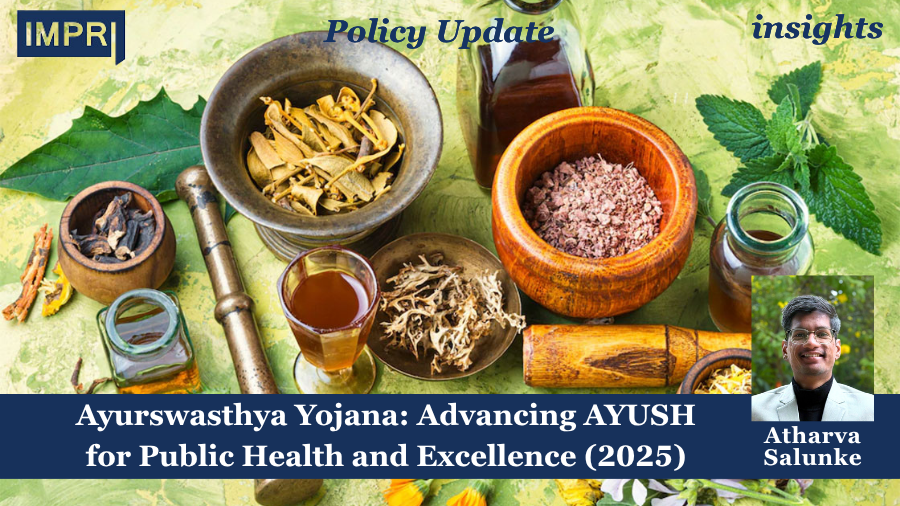
AYURSWASTHYA Yojana, a central sector scheme which was sanctioned for implementation during the period 2021-22 to 2025-26, will enhance the health care in India by realising the potential of AYUSH systems of medicine. India has a triple burden of communicable diseases, non-communicable diseases, reproductive and child health issues, and ongoing epidemics of emerging infections. Lifestyle disorders such as diabetes, hypertension, arthritis, and cancer are also adding to the system’s baggage. To this end, COVID-19 phases revealed a lacuna in healthcare infrastructure and highlighted the role of AYUSH for prevention and control.
Since the 11th Five-Year Plan, the Ministry of AYUSH has sanctioned Public Health Intervention (PHI) projects to test the effectiveness of traditional medicine in managing key health problems. More than 67 projects have been sanctioned across states in the domains of anaemia, musculoskeletal disorders, ante-natal care, and de-addiction. Drawing on this experience, the AYURSWASTHYA Yojana aims to scale up evidence-based AYUSH interventions and mainstream them in national health programmes for broader reach.
Functioning:
The AYURSWASTHYA Yojana operates through two core components: AYUSH and Public Health (PHI) and the Centre of Excellence (CoE), along with a sub-component on AYUSH for Sports Medicine. The PHI component focuses on demonstrating the effectiveness of AYUSH interventions in addressing priority health concerns such as communicable and non-communicable diseases, reproductive and child health issues, musculoskeletal disorders, anaemia, and de-addiction. It aims to promote AYUSH in community healthcare, document evidence, and integrate these practices into national health programmes, thereby contributing to Sustainable Development Goals (SDG-2 and SDG-3).
The Sports Medicine sub-component promotes AYUSH interventions for enhancing the fitness, wellness, and rehabilitation of sportspersons, with particular emphasis on preventive care and treatment of sports-related injuries.
The CoE component supports reputed AYUSH and allopathic institutions, both government and non-government, in establishing specialised AYUSH units.
Funding under the scheme ensures phased and accountable support: up to Rs. 10 crore for CoE, Rs. 1.5 crore for PHI projects, and Rs. 1 crore for Sports Medicine initiatives. For PHI and CoE, money is disbursed in three years in three payments (40%, 40%, 20%), whereas Sports Medicine projects are financed in 18 months in two payments (60%, 40%).
Performance:
Ever since its launch in FY 2021-22, the AYURSWASTHYA Yojana has depicted considerable development in the spread of AYUSH-based care through its dual components, Public Health Interventions (PHI) and Centres of Excellence (CoE). Nine leading national institutions of excellence, including Tata Memorial Centre (Mumbai), IIT Delhi, IISc Bengaluru, JNU New Delhi, and NIMHANS Bengaluru, have been given financial support through the CoE component to establish specialised AYUSH units and research centres. These initiatives are putting emphasis on priority areas such as cancer treatment, metabolic disease, integrative precision medicine, green AYUSH technologies, and yoga-therapy-based innovative research. Rs. 5.51 crore was spent during 2022-23, Rs. 15.42 crore in 2023-24, and Rs. 9.01 crore in 2024-25, showing sustained scale-up of activities.
| S. No. | Name of the Organization | State | Project Name | Fund Released (₹ in Crore) | ||
| 2022-23 | 2023-24 | 2024-25 | ||||
| 1. | Tata Memorial Centre (TMC), Mumbai | Maharashtra | Centre of Excellence for Discovery and Development of AYUSH Medicine for Cancer Care | – | 2.00 | 1.62 |
| 2. | Central Drug Research Institute (CDRI), Lucknow | Uttar Pradesh | Centre of Excellence for Fundamental and Translation Research in Ayurveda | – | 2.00 | 1.99 |
| 3. | Jawaharlal Nehru University (JNU), New Delhi | Delhi | Functional-based CoE on Ayurveda and Systems Medicine | – | 1.01 | 2.44 |
| 4. | Indian Institute of Technology (IIT), Delhi | Delhi | Centre of Excellence in Sustainable Ayush for advanced technological solutions, startup support and net zero sustainable solutions for Rasaushadhies | – | 2.00 | 1.14 |
| 5. | Indian Institute of Science (IISc), Bengaluru | Karnataka | Centre of Excellence in Diabetes and Metabolic Disorders | – | 2.00 | 1.82 |
| 6. | Centre for Integrative Medicine and Research (CIMR), AIIMS New Delhi | Delhi | Centre of Excellence for Yoga & Ayurveda | 2.05 | 2.04 | – |
| 7. | National Institute of Mental Health and Neurosciences (NIMHANS), Bengaluru | Karnataka | Centre of Excellence in Ayush Research | 0.85 | 0.37 | – |
| 8. | Institute of Liver and Biliary Sciences (ILBS), New Delhi | Delhi | Effects of Indian Foods and Ayurvedic Drugs on Healthy and Diseased Liver | 2.61 | – | – |
| 9. | Indian Institute of Technology (IIT), Jodhpur | Rajasthan | Centre of Excellence in AYURTech for Integrative Precision Health and Medicine | – | 4.00 | – |
| Total | 5.51 | 15.42 | 9.01 | |||
Table 1: Nine Organizations of National Repute Funded under Centre of Excellence (CoE) Component of AYURSWASTHYA Scheme
Apart from these, 24 other well-known AYUSH and allied institutions from all over India, such as AIIMS New Delhi, AIIA New Delhi, National Institute of Ayurveda Jaipur, and Institute of Teaching & Research in Ayurveda Jamnagar, were supported by funding under different projects. Disbursements varied extensively, with organizations such as AIIMS, AIIA, and Jamia Hamdard receiving up to Rs. 10 crore each.
| S. No. | Name of the Organization | State/UT | Funds Allocated / Sanctioned | Fund Disbursed | |
| 2021-22 | 2022-23 | ||||
| 1. | Government Ayurvedic College, Jalukabari | Assam | 1000.00 | 400.00 | – |
| 2. | SDM College of Naturopath and Yogic Sciences, Ujjire | Madhya Pradesh | 879.00 | 175.80 | – |
| 3. | Society for Welfare of the Handicapped Persons, Bharosa, Durgapur | West Bengal | 200.00 | 10.00 | – |
| 4. | Regional Research Institute of Unani Medicine (RRIUM), Srinagar | Jammu and Kashmir | 707.16 | 282.87 | – |
| 5. | Rajeev Gandhi Government Ayurveda College, Paprola | Himachal Pradesh | 500.00 | 11.41 | – |
| 6. | Indian Institute of Technology, Jodhpur | Rajasthan | 1000.00 | 400.00 | – |
| 7. | Institute of Liver and Biliary Sciences (ILBS), New Delhi | Delhi | 992.71 | 397.08 | 260.63 |
| 8. | Arya Vaidya Sala (AVS), Kottakkal, Malappuram | Kerala | 664.45 | 265.78 | – |
| 9. | Jamia Hamdard Deemed to be University | Delhi | 1000.00 | 400.00 | – |
| 10. | Banaras Hindu University | Uttar Pradesh | 500.00 | 142.45 | – |
| 11. | Patanjali Ayurveda Hospital, Haridwar | Uttarakhand | 1000.00 | 400.00 | – |
| 12. | National Institute of Mental Health and Neurosciences (NIMHANS), Bangalore | Karnataka | 975.02 | 390.01 | 84.75 |
| 13. | National Institute of Ayurveda (NIA), Jaipur | Rajasthan | 439.35 | 175.74 | 127.88 |
| 14. | Ayurved Seva Sangh’s Ayurved Mahavidyalaya, Nashik | Maharashtra | 130.20 | 42.65 | – |
| 15. | Molecular Diagnostics Counseling Care & Research Centre, Coimbatore | Tamil Nadu | 150.00 | 60.00 | – |
| 16. | Shri B M Kankanawadi Ayurved Mahavidyalaya, Karnataka | Karnataka | 123.10 | 24.62 | – |
| 17. | National Institute of Siddha, Chennai | Tamil Nadu | 149.98 | 59.99 | – |
| 18. | CIMR, AIIMS, New Delhi | Delhi | 964.12 | 204.61 | – |
| 19. | Central Ayurveda Research Institute, Bengaluru | Karnataka | 724.80 | 20.00 | – |
| 20. | Srinath Manav Sewa Mandal, Parli Mumbai | Maharashtra | 149.52 | 29.90 | – |
| 21. | Directorate of Ayush, Maharashtra | Maharashtra | 80.00 | 16.00 | – |
| 22. | All India Institute of Ayurveda (AIIA), New Delhi | Delhi | 897.51 | 288.31 | – |
| 23. | Institute of Teaching and Research in Ayurveda (ITRA), Jamnagar | Gujarat | 149.96 | 29.99 | – |
| 24. | Tilak Ayurved Mahavidyalaya, Pune | Maharashtra | 87.33 | 20.92 | – |
Table 2: Funds Allocated and Disbursed to Institutions under AYURSWASTHYA Yojana (Rs. in lakhs)
Impact:
Yojana has shown a real effect in increasing the role of AYUSH systems in India’s healthcare domain. For the Public Health Intervention (PHI) component, regular support has been provided to various organizations. In 2023-24, seven government and one non-governmental institute were supported with more than ₹6.11 crore along with another ₹56.74 lakh to NIA Jaipur, thus consolidating AYUSH-based interventions for various public health demands. Additionally, new initiatives were proposed for consideration, showing a pipeline of increasing initiatives. In 2024-25, the coverage further expanded with nine organizations being supported under PHI with a total of ₹4.98 crore, showing continuity in scaling AYUSH interventions for community health.
The Centre of Excellence (CoE) element has also generated enduring institutional capacities. In 2023-24, three organizations were awarded ₹5.60 crore, while in 2024-25, nine prestigious institutions were sanctioned ₹24.45 crore to create high-level AYUSH research and clinical facilities. These ongoing investments are accelerating innovation, evidence generation, and AYUSH confluence with allopathic medicine.
Collectively, these accomplishments reflect the increasing importance of AYURSWASTHYA Yojana in enhancing healthcare access, institution building, and AYUSH credibility at national and international levels.
Emerging Issues:
Even with great progress, AYURSWASTHYA Yojana suffers from various challenges. Slow release of funds and delayed approvals tend to hamper the implementation of projects, impacting continuity. Limited involvement of non-government organizations hampers outreach to the grassroots level. Only partial integration of AYUSH with general healthcare services hinders its broader use in public health programs. Additionally, monitoring and evaluation systems need to be strong to ensure measurable impact and accountability. Increased need in sports medicine, lifestyle disease control, and mental health points to shortages in trained manpower and infrastructure. Providing solutions to these issues is necessary in order to maintain impact and expand future interventions.
Way Forward:
It is advisable that the Ministry give utmost priority to the timely disbursement of funds and simplify the procedures for approval to prevent delays in projects. Increasing cooperation with non-government organizations, research institutions, and grassroot bodies will facilitate enhanced outreach and inclusive growth. Improved integration of AYUSH practices into national health programs will facilitate increased acceptance and accessibility. More focus should be given on capacity development, evidence-based studies, and innovation to enhance AYUSH credibility at the national and international levels. Further, focused attention towards sports medicine, lifestyle diseases, and mental well-being will meet evolving demands, backed by strong monitoring and evaluation systems.
References:
- Government of India, Ministry of AYUSH. (2023, July 25). Salient features of Ayurswasthya Yojana (Rajya Sabha Unstarred Question No. 482). https://sansad.in/getFile/annex/260/AU482.pdf?source=pqars
- Government of India, Ministry of AYUSH. (n.d.). Guidelines for Central Sector Scheme for Ayurswasthya Yojana. Government of India. https://ayush.gov.in/resources/pdf/schemes/Ayurswasthya.pdf
- Press Information Bureau. (2022, July 26). Implementation of Ayush schemes. PIB Delhi. https://www.pib.gov.in/Pressreleaseshare.aspx?PRID=1845012
- Press Information Bureau. (2025, March 25). Ministry of Ayush has taken multiple initiatives towards integration of Ayush systems of medicine with allopathic system. PIB Delhi. https://www.pib.gov.in/PressReleasePage.aspx?PRID=2114965#:~:text=The%20Ministry%20of%20Ayush%20has%20been%20implementing%20the%20Central%20Sector,to%20the%20centre%20of%20excellence.
- Government of India, Ministry of Ayush. (2025). Annual report 2024–2025. http://www.dbtayush.gov.in/resources/pdf/annualReport/AR_2024_2025.pdf
- Government of India, Ministry of Ayush. (2024). Annual report 2023–2024. https://ayush.gov.in/resources/pdf/annualReport/English-Annual-Report-12-Dec-2024.pdf
About the Contributor:
Atharva Salunke is a Policy Research Associate at NITI TANTRA and a Research Intern at IMPRI. He has recently graduated with a Bachelor’s degree in Political Science from Sir Parashurambhau College, Pune.
Acknowledgement: The author extends his sincere gratitude to the IMPRI team and Ms. Aasthaba Jadeja for her invaluable guidance throughout the process.
Disclaimer: All views expressed in the article belong solely to the author and not necessarily to the organisation.
Read More at IMPRI:
The Role of the Directorate of Municipal Administration (DMA) & City Governance: Towards Developed Urban India 2047
Pradhan Mantri Kaushal Kendras (PMKK) – Model Training Centres (2025)