Policy Update
Madhu Swaraj
Background
The Rashtriya Yuva Sashaktikaran Karyakram (RYSK) is the flagship Central Sector Umbrella Scheme of the Ministry of Youth Affairs and Sports, Government of India. Formulated during the 12th Five-Year Plan, the scheme was restructured in 2016 to merge several disparate youth-centric programs into a unified framework.
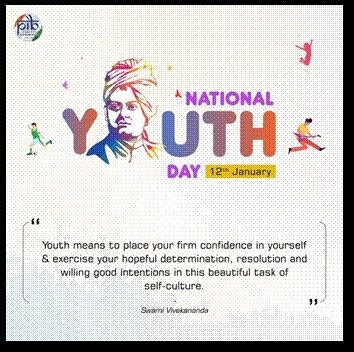
The primary objective of RYSK is to develop the personality and leadership qualities of the youth (aged 15–29 years) and to engage them in nation-building activities. It aligns with the National Youth Policy (NYP) 2014 and the evolving NYP 2021/2025 goals, focusing on social values, community engagement, and the holistic development of India’s demographic dividend.
Functioning
The RYSK operates as an “umbrella” because it consolidates seven distinct sub-schemes that leverage a common administrative structure for better reach and efficiency.
Key Sub-Schemes:
- Nehru Yuva Kendra Sangathan (NYKS): One of the largest youth networks globally, operating through district-level centers to mobilize rural youth.
- National Youth Corps (NYC): Recruits young volunteers to act as a bridge between the government and the community.
- National Programme for Youth and Adolescent Development (NPYAD): Focuses on skill development, adventure activities, and adolescent health.
- International Cooperation: Facilitates youth exchange programs to promote global perspective and cultural diplomacy.
- Youth Hostels: Provides low-cost, safe accommodation for youth traveling for educational or sports purposes.
- Assistance to Scouting and Guiding Organizations: Supports character building through Bharat Scouts and Guides.
- National Young Leaders Programme (NYLP): Aims to identify and nurture leadership talent for social and political spheres.
Performance
As of the 2025-26 fiscal year, RYSK has seen significant budgetary reinforcement and operational expansion.
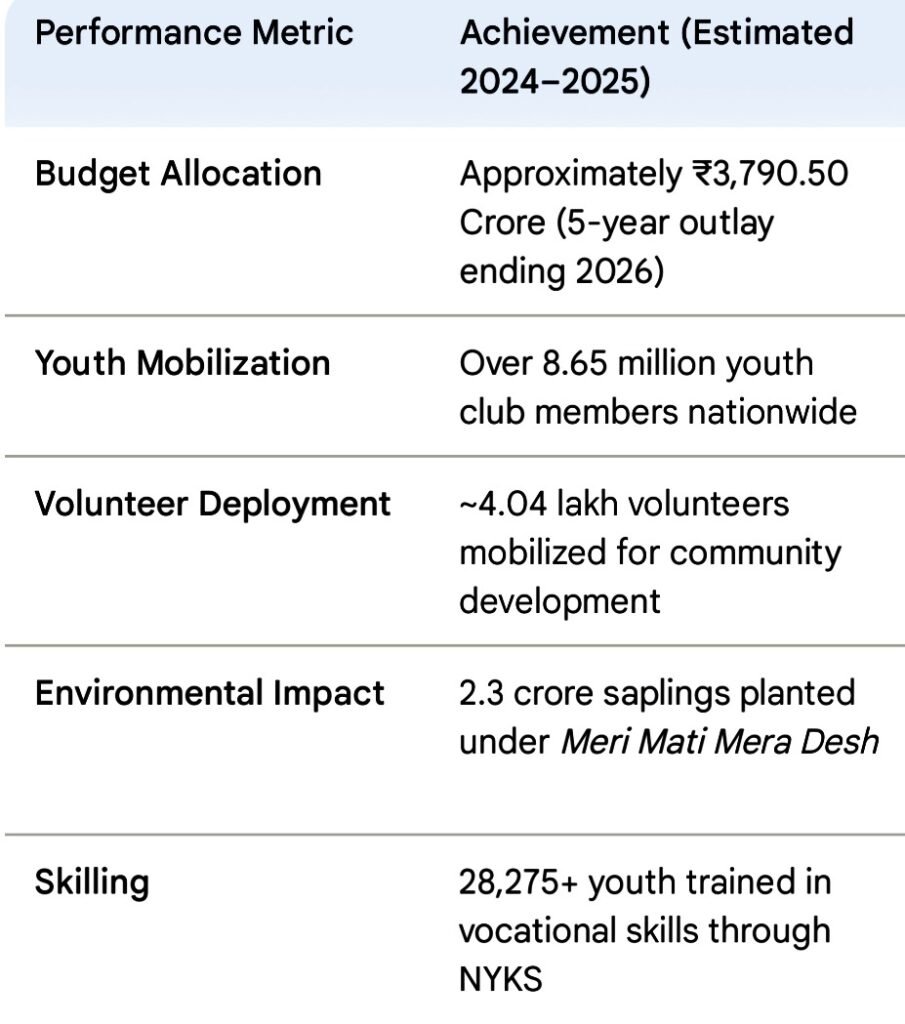
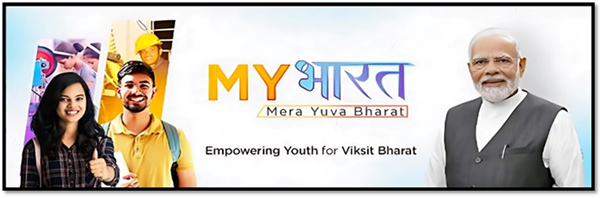
The MY Bharat (Mera Yuva Bharat) platform, launched recently, has become the digital backbone for RYSK, enabling real-time tracking of volunteer work and creating a “National Yuva Volunteer Registry.”
Impact
The impact of RYSK is measured across socio-economic and civic dimensions:
- Civic Awareness: Through initiatives like the National Youth Parliament, the scheme has successfully increased political and civic literacy among participants.
- Labor Force Participation: Studies indicate that youth empowerment initiatives, including RYSK, have contributed to the rise in youth labor force participation (from 38.2% in 2017 to over 46.5% by 2024-25).
- Social Cohesion: Programs like Yuva Utsav and Padyatras (notably for Constitution Day) have fostered national integration and a sense of duty among diverse youth groups.
- Crisis Management: NYC volunteers have played pivotal roles in disaster relief, health campaigns (e.g., Polio immunization), and awareness drives for government flagship schemes like Swachh Bharat.
Emerging Issues
Despite its successes, RYSK faces several contemporary challenges in the 2026 landscape:
- Digital Divide: While the MY Bharat platform is revolutionary, youth in remote or tribal areas still face barriers in accessing digital opportunities.
- Honorarium Stagnation: There is ongoing pressure to enhance the honorarium for National Youth Volunteers (currently approx. ₹5,000) to keep pace with inflation and retain talent.
- Inter-Departmental Coordination: Overlap with other skilling missions (like PMKVY) sometimes leads to fragmentation of efforts.
- Cyber-Resilience: With the shift toward digital registries, protecting the data of millions of young volunteers from cyber threats has become a priority.
Way Forward
To maximize the potential of RYSK by 2030, the following strategies are recommended:
- AI-Driven Mentorship: Integrating AI into the MY Bharat portal to provide personalized career guidance and skill mapping for volunteers.
- Industry-Managed Training: Shifting toward a “Government-Owned, Industry-Managed” model for vocational sub-schemes to ensure training meets current market demands.
- Global Integration: Expanding international exchange programs beyond G20 nations to include more Global South collaborations.
- Sustainability Focus: Transforming every Youth Club into a “Green Cell” to drive India’s Net Zero 2070 goals at the grassroots level.
References
- Press Information Bureau, Government of India. (2026, January 11). National Youth Day 2026 [Press release]. https://www.pib.gov.in/PressReleseDetailm.aspx?PRID=2213415&hl=en-IN®=3&lang=2
- Press Information Bureau, Government of India. (2025, August 15). Yuva Shakti se Samruddha Bharat [Press release]. https://www.pib.gov.in/FactsheetDetails.aspx?Id=149240&hl=en-IN®=3&lang=2
- Impact and Policy Research Institute. (2025, August 12). Ministry of Youth Affairs and Sports: Strengthening India’s Youth and Sports Culture. https://www.impriindia.com/insights/ministry-of-youth-affairs-and-sports/?hl=en-IN
- Press Information Bureau, Government of India. (2022, February 4). Rashtriya Yuva Sashaktikaran Karyakram Scheme for the period 2021-22 to 2025-26 with budget allocation of Rs. 2,710.65 Crore. Ministry of Youth Affairs and Sports [Press release]. https://www.pib.gov.in/Pressreleaseshare.aspx?PRID=1795442&hl=en-IN®=3&lang=2
- Press Information Bureau, Government of India. (2021, February 4). Rashtriya Yuva Sashaktikaran Karyakram. Ministry of Youth Affairs and Sports [Press release]. https://www.pib.gov.in/PressReleasePage.aspx?PRID=1695180&hl=en-IN®=3&lang=2
About the Contributor:
Madhu Swaraj is a Research Intern at IMPRI.
Acknowledgement: The author extends sincere gratitude to the IMPRI team for their expert guidance and constructive feedback throughout the process.
Disclaimer: All views expressed in the article belong solely to the author and not necessarily to the organization.