Policy Update
Akshay Sharma
Introduction
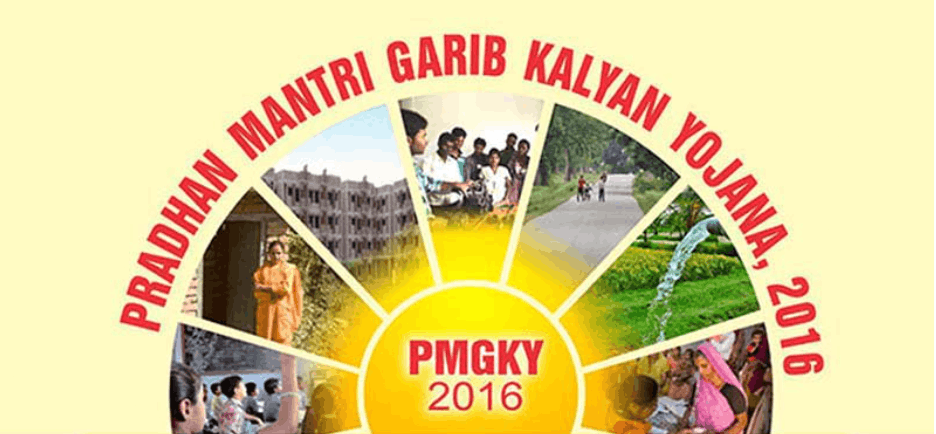
In 2016, the Govt. of India launched Pradhan Mantri Garib Kalyan Yojana as a part of the Taxation Laws Act 2016 (second amendment). The initial objective of the PM Garib Kalyan Yojana scheme was to ensure tax evaders declare unaccounted money and avoid penalty and criminal prosecution. Through this scheme, the govt. intended to use the deposited black money for the welfare of the poor people. Such schemes remind us of how governments work to fulfill the goal of social welfare in society to bring everyone at par. Such expenditure Allocation from budgets aim to improve the living standard of the poor.
The outbreak of the COVID-19 pandemic in early 2020 created an unparalleled public health emergency that swiftly evolved into a socio-economic crisis of historic proportions. In response to this humanitarian and economic emergency, the Government of India announced an extended version of the Pradhan Mantri Garib Kalyan Yojana (PMGKY) in March 2020 with a ₹1.70 lakh crore relief package aimed at mitigating the immediate distress of the poor and vulnerable who lost their livelihood due to lockdowns(PIB Delhi, 2020). 80 crore individuals, i.e., approximately 66% of India’s population were covered under this scheme.
The PMGKAY scheme covers up to 75% of the rural population and 50% of the urban population under TPDS, with a uniform entitlement of 5 kg per person per month under Priority Household (PHH) and 35 kg per household per month under Antyodaya Anna Yojana (AAY) households which constitute poorest of the poor, irrespective of the family size even if the household has only one individual.
The Central Government provides assistance to States in meeting the expenditure incurred by them on the transportation of food grains within the State, its handling and FPS dealers’ margin as per norms devised for this purpose. Provision for food security allowance to entitled beneficiaries in case of non-supply of entitled food grains or meals.
An Umbrella scheme of Benefits
The scheme package introduced various sub-schemes including:
Jan Dhan Yojana – The scheme aimed at transforming unproductive home savings into interest bearing bank deposits through zero balance account. It also provides ₹1500 to women account holders as a one time unilateral transfer for incentivising the involvement of women in the scheme.
Medical insurance – People involved in the healthcare sector worked incessantly despite deadly virus outbreaks all around the world. An insurance scheme to value the health of healthcare workers including doctors, nurses, Asha workers, paramedics, and sanitation workers.
Pradhan Mantri Garib Kalyan Anna Yojana (PMGKAY) – Government provides 5 kg per member ration including wheat, rice, etc. for all those under the category of below poverty line. This scheme was successful in bringing food to the table of people when everything seemed bleak in life during Covid era. The scheme offers free food supplies till date.
PM kisan 2020 – The farmers were given the advances of PM KISAN YOJANA’s first instalments as support amid the pandemic.
Ujjwala Yojana – LPG cylinders were given to around 8 crore heirs of PMUY or Prime Minister Ujjwala Yojana.
Women empowerment – Pregnant women and lactating mothers are also entitled to receive maternity benefits of not less than Rs.6,000. Moreover, ration cards were issued with a woman as head of the family.
Challenges
Ration is provided to people by general fair price shops but people often complain of poor quality food supply and corruption by fair price shop owners. India is ranked 102nd in the 2025 report, with a score of 25.8 categorized as ‘serious’. Critics allege there is a clear rural bias that the scheme exhibits leaving the needs of the urban poor unaddressed. Moreover, unorganised workers are not covered in the scheme package excluding millions of migrant workers and informal sector employees who are likely to face loss of income due to job losses.
Way Ahead
India and the globe have set their intentions to achieve the sustainable development goals by 2030. Schemes like these are a key step taken towards the path of accomplishment for SDG 2- Zero Hunger to ensure that all vulnerable citizens can get safe, nutritious and sufficient food all year round. As India faces jobless growth, this scheme can work on providing employment opportunities as well to the families covered under the benefit. Also, prices should remain regulated for necessities and more basic household and food items can be included in the PMGKAY.
Conclusion
As the world became more globalised, the inequalities kept on rising with richer and affluent groups controlling most resources of the society.The design of PMGKY aligns with the Social Protection Floor (SPF) framework advocated by the International Labour Organization, which emphasises
universal access to basic income security and health care during crises. Thus, this has created a need for social security nets which provide basic facilities and access to people as a protection with pure aims of social welfare.
References
- Artha Global. (2025). *Pradhan Mantri Garib Kalyan Yojana* [White paper]. [https://artha.global/wp-content/uploads/2025/01/final_white_paper_pmgky-2-1.pdf](https://artha.global/wp-content/uploads/2025/01/final_white_paper_pmgky-2-1.pdf)
- Global Alliance Against Hunger and Poverty. (n.d.). *India: Pradhan Mantri Garib Kalyan Yojana (PMGKY)*. February 9, 2026, from https://globalallianceagainsthungerandpoverty.org/country-example/india-pradhan-mantri-garib-kalyan-yojana-pmgky/](https://globalallianceagainsthungerandpoverty.org/country-example/india-pradhan-mantri-garib-kalyan-yojana-pmgky/)
- Global Hunger Index. (2025). *India*. Welthungerhilfe; Concern Worldwide. https://www.globalhungerindex.org/india.html](https://www.globalhungerindex.org/india.html)
- India Brand Equity Foundation. (n.d.). *Pradhan Mantri Garib Kalyan Yojana*. https://www.ibef.org/government-schemes/pradhan-mantri-garib-kalyan-yojana](https://www.ibef.org/government-schemes/pradhan-mantri-garib-kalyan-yojana)
- Press Information Bureau. (2020, March 26). *Finance Minister announces Rs 1.70 Lakh Crore relief package under Pradhan Mantri Garib Kalyan Yojana for the poor to help them fight the battle against Corona Virus* [Press release]. Ministry of Finance, Government of India. https://www.pib.gov.in/Pressreleaseshare.aspx?PRID=1608345®=3&lang=2](https://www.pib.gov.in/Pressreleaseshare.aspx?PRID=1608345®=3&lang=2)
- Shukla, S. K., Shukla, P., & Dwivedi, A. (2025). Post-COVID-19 livelihood recovery: Assessing the impact of the Pradhan Mantri Garib Kalyan Yojana (PMGKY) on rural households in Uttar Pradesh. *International Journal of Innovative Research in Technology*, *12*(7), 2676–2686. https://ijirt.org/publishedpaper/IJIRT188669_PAPER.pdf](https://ijirt.org/publishedpaper/IJIRT188669_PAPER.pdf)
- Sri Venkateswara College. (2022). *Impact assessment of Pradhan Mantri Garib Kalyan Anna Yojna (PMGKAY)* (Report No. SVP-2243). University of Delhi. https://www.svc.ac.in/SVC_MAIN/SRIVIPRA/SRIVIPRA2022/Reports/2022%20SVP-2243%20REPORT-%20PMGKY_.pdf](https://www.svc.ac.in/SVC_MAIN/SRIVIPRA/SRIVIPRA2022/Reports/2022%20SVP-2243%20REPORT-%20PMGKY_.pdf)
- Varshney, D., Kumar, A., Mishra, A. K., Rashid, S., & Joshi, P. K. (2020). *Could Pradhan Mantri Garib Kalyan Yojana (PM-GKY) mitigate COVID-19 shocks in the agricultural sector: Evidence from northern India* (IFPRI Discussion Paper 1990). International Food Policy Research Institute. https://doi.org/10.2499/p15738coll2.134222](https://doi.org/10.2499/p15738coll2.134222)
- Vasanthi, R. (2022). Policyholder’s perception towards Pradhan Mantri Garib Kalyan Yojana scheme. *Journal of Education: Rabindra Bharati University*, *24*(1), 105–107. https://www.researchgate.net/publication/380246248_Policyholder’s_Perception_towards_Pradhan_Mantri_Garib_Kalyan_Yojana_Scheme](https://www.researchgate.net/publication/380246248_Policyholder’s_Perception_towards_Pradhan_Mantri_Garib_Kalyan_Yojana_Scheme)
About the Contributor
Akshay Sharma is a research intern at IMPRI. He’s pursuing B.A.(Hons.) Economics from Atma Ram Sanatan Dharma college, University of Delhi as of January, 2026. Belonging from a humanities background, he has developed strong critical thinking and creative writing skills. His interest lies in economics, education and policy.
Acknowledgement
The author extends sincere gratitude to the IMPRI team for their expert guidance and constructive feedback throughout the process.
Disclaimer
All views expressed in the article belong solely to the author and not necessarily to the organisation.
Read More at IMPRI
Inclusive MSME Growth: The Role of the National SC-ST Hub (2016)
The Need for Proactivity in Policy-Making