Atharva Salunke
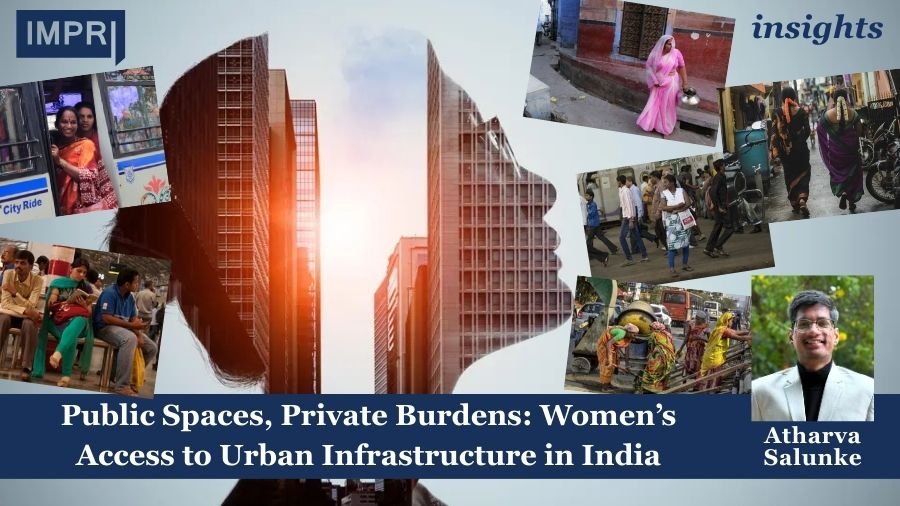
Indian urban policy increasingly frames cities as inclusive, liveable, and gender-sensitive. Yet, this narrative collapses under scrutiny. Women’s everyday engagement with cities reveals a fundamental contradiction: while urban infrastructure is publicly funded and collectively justified, its design failures are privately absorbed by women’s bodies, time, safety, and unpaid labour. The Indian city does not merely exclude women incidentally; it is structured around assumptions that systematically marginalise them as legitimate users of public space.
The Gendered Logic of Urban Planning
Urban planning in India has historically been organised around a male, able-bodied, economically productive subject. This is not an abstract theoretical critique but an observable planning logic embedded in zoning, transport design, sanitation provisioning, and governance structures. Feminist and disability scholars cited in national policy documents argue that exclusion is spatially produced cities are built without accounting for diverse users and unequal social roles.
Women constitute nearly half of India’s population, yet urban systems rarely acknowledge women’s distinctive patterns of mobility, safety needs, or care responsibilities. This disconnect is particularly stark in the case of women with disabilities, who face compounded discrimination arising from gender norms, inaccessible infrastructure, and weak institutional enforcement of accessibility standards. The result is not accidental exclusion but systemic invisibilisation.
Sanitation as a Site of Structural Inequality
Sanitation infrastructure offers one of the clearest empirical illustrations of gendered neglect. Public toilets are not neutral amenities; they are prerequisites for dignity, health, and mobility. The absence of adequate sanitation restricts women’s participation in public life and directly exposes them to health risks and violence. Evidence shows that women routinely delay urination or reduce food and water intake due to a lack of facilities, resulting in urinary tract infections and other long-term health issues.
Urban sanitation planning has historically assumed that men dominate public space. This assumption is reflected in the disproportionate construction of public urinals for men and the near absence of facilities for women in many cities for decades. Such planning decisions are not merely oversights; they reveal a deeper belief that women’s presence in public space is temporary, exceptional, or secondary.
Recent initiatives under Swachh Bharat Mission-Urban 2.0 demonstrate that alternatives are possible. Case studies from Tirupati, Katra, Navi Mumbai, Thiruvananthapuram, and Bhopal show the provision of women-centric, disabled-friendly, and menstrual hygiene–inclusive public toilets. However, these examples are geographically selective and often located in high-visibility zones such as pilgrimage centres or tourist hubs. Their limited scale raises a critical question: are these interventions transforming urban systems or merely showcasing compliance?
Mobility, Safety, and the Economics of Time
Urban mobility systems in India are structurally misaligned with women’s travel patterns. Women’s mobility is characterised by trip-chaining multiple short trips linked to unpaid care work, domestic responsibilities, and informal labour. This makes women disproportionately dependent on affordable, safe, and accessible public transport. Despite this, transport planning continues to privilege speed, linear commutes, and motorised efficiency. Poorly lit bus stops, broken footpaths, lack of ramps, and inadequate last-mile connectivity constrain women’s movement and amplify vulnerability to harassment and violence. For women with disabilities, these barriers are not marginal inconveniences but absolute exclusions.
Policy responses often prioritise technological fixes such as CCTV surveillance, without addressing underlying spatial design failures. Surveillance may document incidents but does not resolve unsafe street layouts, inaccessible transport nodes, or fragmented institutional accountability. This reliance on protectionist solutions reflects a governance tendency to manage women’s risk rather than restructure urban space itself.
Digital Infrastructure and the Reproduction of Exclusion
As cities digitise service delivery, digital infrastructure has become a new frontier of urban access. Yet digitalisation has reproduced existing inequalities rather than dismantled them. National data shows persistent gender gaps in internet usage, particularly acute among women with disabilities due to affordability constraints, inaccessible interfaces, and social restrictions.
Despite statutory mandates under the Rights of Persons with Disabilities Act, a large proportion of government websites and digital platforms remain inaccessible. During the COVID-19 pandemic, this failure had material consequences: access to healthcare, welfare schemes, mobility permissions, and grievance redressal increasingly depended on digital systems, many women could not navigate independently. Digital exclusion thus deepened dependence on family members and caregivers, undermining autonomy rather than enhancing it.
The Hidden Economy of Care
When urban infrastructure fails, its costs are not eliminated; they are privatised. Women absorb these costs through unpaid labour, time poverty, and constrained economic participation. Government documents explicitly acknowledge that women shoulder the burden of sanitation management, water collection, and hygiene maintenance within households.
Programmes such as Swachh Bharat Mission, Jal Jeevan Mission, and menstrual hygiene initiatives have reduced certain dimensions of this burden by expanding household toilets, water access, and affordable sanitary products. However, these gains are uneven in urban contexts particularly in informal settlements, transit spaces, and workplaces, where women continue to negotiate inadequate public infrastructure daily.
Governance Failures and Participatory Deficits
A recurring constraint across sectors is the weakness of urban local governance. Limited fiscal autonomy, siloed institutional mandates, and absence of participatory planning processes undermine the translation of inclusive policies into practice. Women, especially women with disabilities, remain underrepresented in urban decision-making spaces, resulting in policies that are formally inclusive but substantively disconnected from lived realities.
Crucially, the absence of sex- and disability-disaggregated data prevents evidence-based planning. Accessibility audits are often technical exercises rather than participatory processes involving users themselves, leading to superficial compliance instead of functional inclusion.
Conclusion: From Inclusion to Transformation
The evidence is unequivocal: women’s exclusion from urban infrastructure is not incidental but structural. Indian cities continue to externalise planning failures onto women’s bodies, safety, and unpaid labour while celebrating selective success stories as systemic progress.
A genuine shift requires moving beyond gender-neutral planning towards gender-transformative urbanism, one that actively redistributes power, resources, and decision-making authority. Sanitation, mobility, and digital access must be treated as rights embedded in urban citizenship, not as welfare add-ons or symbolic gestures.
Until such a transformation occurs, public spaces in Indian cities will remain accessible only by converting collective infrastructural failures into private burdens borne disproportionately by women.
References
- Ministry of Housing and Urban Affairs. (2025, November 17). From markets to monuments: Advancing clean toilets and hygienic spaces [Press release]. Press Information Bureau, Government of India. https://www.pib.gov.in/PressReleasePage.aspx?PRID=2190894®=3&lang=2
- Ministry of Jal Shakti. (2024, February 8). Toilets constructed under Swachh Bharat Mission [Press release]. Press Information Bureau, Government of India. https://www.pib.gov.in/PressReleaseIframePage.aspx?PRID=2003910®=3&lang=2
- Ministry of Women and Child Development. (2024, December 18). Government taking several steps to ensure that access to safe water and sanitation does not become a barrier for women’s mobility and development [Press release]. Press Information Bureau, Government of India. https://www.pib.gov.in/PressReleasePage.aspx?PRID=2085610®=3&lang=2
- National Institute of Urban Affairs & United Nations India. (2022). Gender and disability inclusion in urban development (Policy brief). Ministry of Housing and Urban Affairs, Government of India. https://niua.in/intranet/sites/default/files/2806.pdf
- Ministry of Housing and Urban Affairs. (2024, September 13). Swachh Bharat Mission: Transforming women’s sanitation with innovation—Celebrating a decade of progress in India’s sanitation drive. Government of India. https://static.pib.gov.in/WriteReadData/specificdocs/documents/2024/sep/doc2024916394801.pdf
- Chaplin, S. E. (2017). Gender and urban sanitation inequalities in everyday lives (Working paper). Centre for Policy Research. https://cprindia.org/gender-and-urban-sanitation-inequalities-in-everyday/
- UNICEF. (n.d.). Water, sanitation and hygiene (WASH) | UNICEF India. UNICEF. https://www.unicef.org/india/what-we-do/water-sanitation-hygiene
About the Author
Atharva Salunke is a Policy Research Associate at NITI TANTRA and a Research Intern at IMPRI. He has recently graduated with a Bachelor’s degree in Political Science from Sir Parashurambhau College, Pune.
Acknowledgement: This article was posted by Vatsala Sinha, Research Intern at IMPRI.
Disclaimer: All views expressed in the article belong solely to the author and not necessarily to the organisation.