A Language Blossoms Best When Embraced, Not Enforced
Hindi movies and TV programs are doing a fair bit to spread the language in its popular Hindustani version, rather than in its stilted Sanskritised avatar
Hindi movies and TV programs are doing a fair bit to spread the language in its popular Hindustani version, rather than in its stilted Sanskritised avatar
Whether it is a farmer from rural Bihar seeking a stable income in Delhi, or a young graduate from a small town aspiring to join Bengaluru’s tech ecosystem, the magnetism of urban centres lies in their perceived ability to transform lives.
Prime Minister Narendra Modi, in his speech at Varanasi commemorating the 647th birth anniversary of Sant Ravidas,emphasised the creation of an egalitarian society — one driven by ideals of social justice. A society where people from the margins are marching towards the epicentre with great hope for creating a community free from social evils, a society made up by liberated souls. With the unveiling of the statue of Sant Ravidas, Modi talked about how the ills of the caste system are destroying humanity. This transported me to the words of Sant Ravidas, “Jaat-paat ke pher mahi urjhi rahi sab log/ Mannushta ku khat hai, Ravidas jat kar rog” (Everyone is trapped in the caste system/ Ravidas, humanity is being eaten up by the disease called caste).
In his speech, he said that the BJP government has been instrumental in revitalising the teachings of Sant Ravidas as they embody a movement to reclaim history, give voice to underrepresented groups, and change the way politics is framed. The BJP has been successful in transforming the social and cultural reality of the country. The current political dispensation’s policies have been centred around the empowerment of marginalised people. With this approach, the BJP government is attempting to harmonise some facets of its governance model with that of Begumpura, the city without sorrow envisioned by the poet-saint, through the prioritisation of social justice, equality, and development.
The story so far: In 2015, the NDA government positioned urban development as a key pillar of its growth strategy as cities contribute nearly 67% to the GDP. However, in the government’s vision for a “Viksit Bharat,” cities seem to be conspicuously absent.
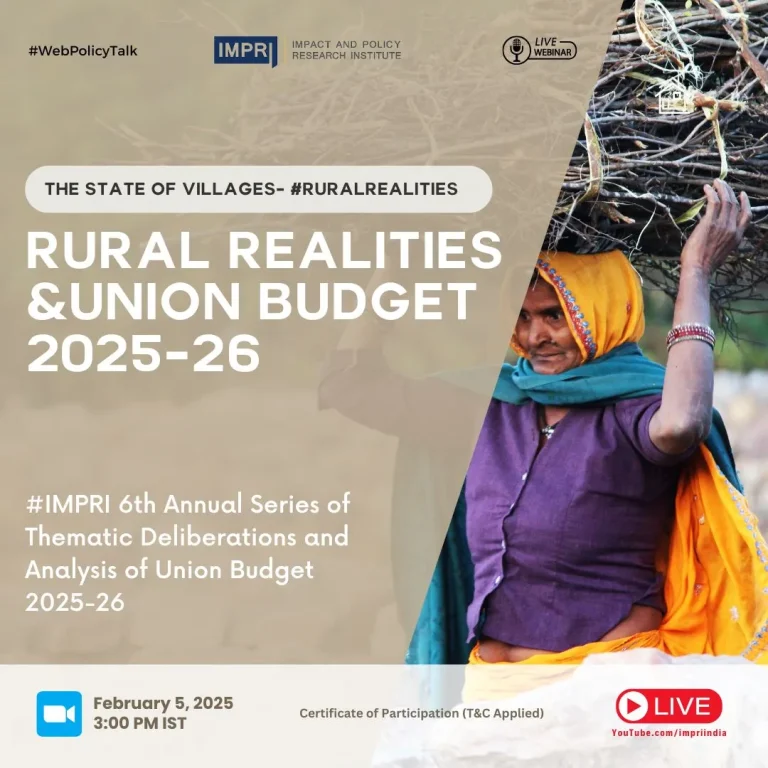
The IMPRI Center for Habitat, Urban, and Regional Studies (CHURS), New Delhi, hosted a panel discussion on February 5, 2025, as part of its 6th Annual Series on the Thematic Deliberations and Analysis of the Union Budget 2025-26. The session, titled Rural Realities and Union Budget 2025-26, focused on the challenges and opportunities facing rural India, particularly in the context of the government’s budgetary proposals and their potential impact on agriculture, rural employment, and development.
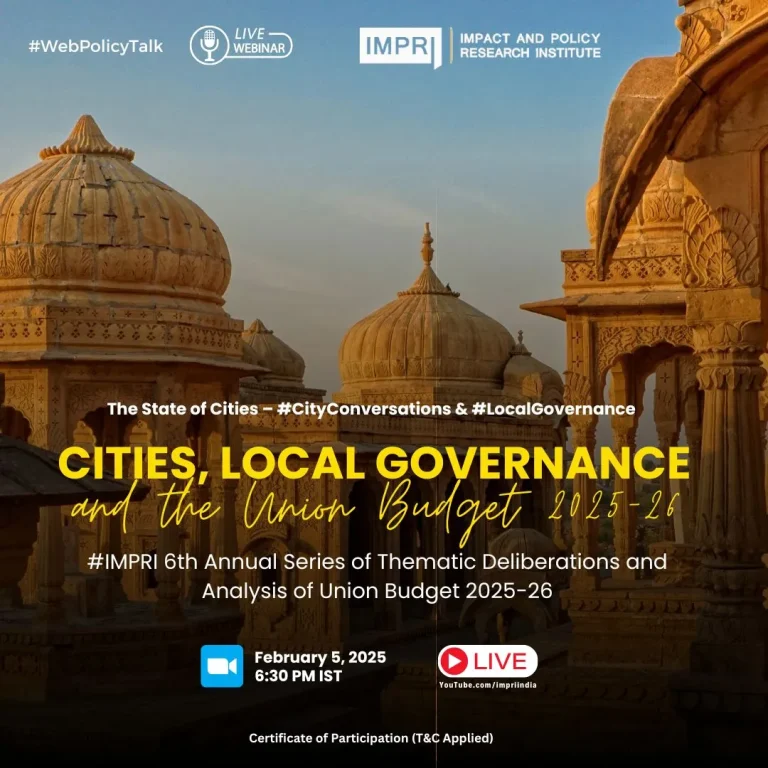
The panel discussion on IMPRI’s 6th Annual Series of Thematic Deliberations and Analysis of Budget 2025-2026 on Cities, Local Governance, and the Union Budget 2025-26. Organized by the Center for Habitat, Urban and Regional Studies (CHURS) at the IMPR, Impact and Policy Research Institute, New Delhi.
The IMPRI Center for Habitat, Urban and Regional Studies (CHURS), IMPRI Impact and Policy Research Institute, New Delhi, hosted an engaging panel discussion on “Cities, Local Governance, and Union Budget 2025–26” on February 5, 2025, at 6:30 p.m. IST, as part of IMPRI’s 6th Annual Series of Thematic Deliberations and Analysis of the Union Budget. This session brought together leading policymakers, urban experts, and academics to examine the implications of the Union Budget on urban development, governance, and sustainability in India, offering key insights and recommendations for future urban policy reforms.