Category Center for Human Dignity and Development

Responsibility for Combating Election Interference: Beyond the Election Commission’s Role

If the attacks on Opposition parties and leaders continue on the pretext of correcting economic wrongs, the fig leaf covering the truth of India’s democracy would wither and drop off.

The punitive actions by India’s tax authorities and the Enforcement Directorate against Opposition political parties and leaders, especially after the general elections have been notified, amount to election interference. The statutory body charged with holding free and fair elections is the Election Commission of India. It has powers to issue directives to the executive to act in a manner conducive to the conduct of free elections. Failure to check the intimidation of Opposition parties and leaders by agencies of the central government amounts to abdication of its responsibility by the Commission. If the Commission does not realise this and make amends, the Supreme Court should, suo motu, direct the Commission to act.

The Plight of Small Farmers in India: Income Disparity and the Need for Reform

Farmers’ unions in India are demanding higher wages and minimum price support, among other provisions. The Indian government’s approach to agriculture, including non-legally-binding minimum price support for crops and loan waivers have been met with mixed reactions from farmers and experts.

Action Research, Policy and Impact: A Bureaucrat’s Experience

The IMPRI Impact and Policy Research Institute, New Delhi is hosting a Four-Month Online Immersive Public Policy Qualitative Participatory Action Research Fieldwork Certificate Fellowship Cohort 2.0 from December 2023 to April 2024. On day 7 of the programme, the session today was spearheaded by Dr Purnima Chauhan, an IAS retired officer, former Secretary, Government of Himachal Pradesh, director of Himachal Pradesh Institute of Public Administration, and visiting Senior Fellow at Impri.

V.D. Savarkar’s Advocacy for a Society Beyond Caste Division

He believed that heredity could not determine a person's intellect or talent and that India's freeVinayak Damodar Savarkar, whose died 56 years ago on February 26, was a man who moved from the notion of social justice and embraced the ideals of social cohesion. Social cohesion is about connectedness, inter-dependence, accord and cultural assimilation among communities. It not only encompasses ideas of equality, fraternity and liberty, but marches towards social harmony. In the Indian sociological context, it can be better understood as “samajik samarasta”, which is a philosophical idea deeply embedded in the social fabric of this country and has a broader meaning than social justice. The word “samarasta” is an amalgamation of “sa” for “samata” (equity), “ma” for “mamata” (dignity), “ra” for “ramata” (sincerity), “sa” for “samanata” (equality) and “ta” for “tartamyata” (continuity). It is a continuous process of bringing about and achieving an equitable society by providing dignified ways and means to all strata. Despite being born and brought up in the orthodox and religious Chitpavan Brahmin community, Savarkar refused to accept the evil practices of Hinduism. He mocked the idea that eating a certain kind of food corrupts one’s religion. He said, “Religion rests in one’s heart and not in the stomach.”om wouldn't last without social reforms.

LPPYF 2.0 e1708498649107

Promoting Human Rights and Ending Gender-Based Violence

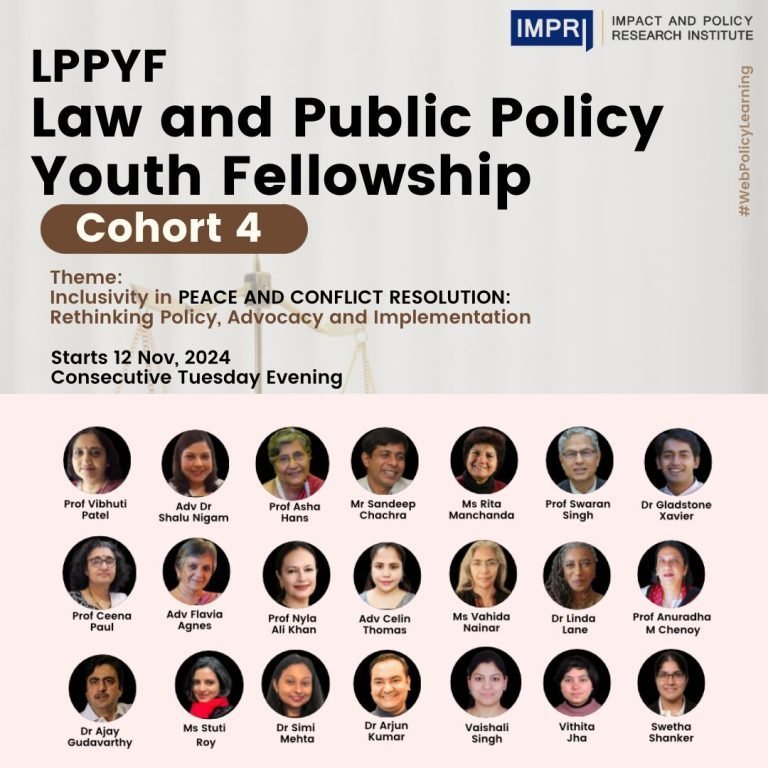
IMPRI Centre for Human Dignity and Development, IMPRI Impact and Policy Research Institute, New Delhi, conducted Law and Public Policy Youth Fellowship – Cohort 2.0 Winter’23 on the theme: Promoting Human Rights and Ending Gender-Based Violence. The session was held on the Occasion of Human Rights Day. December 10th, 2023 marks the 75th anniversary of one of the world’s most groundbreaking global pledges: the Universal Declaration of Human Rights (UDHR). 

Talk to Us