Category Thematic Areas

Copy of Copy of Policy Update 3

Transforming Digital Governance: A Policy Review of the Guidelines for Indian Government Websites (GIGW) 3.0

Government websites had always exhibited significant inconsistencies in terms of design, technology, content, and accessibility, resulting in challenges to the delivery of service and engagement of citizens using them. Hence, there was a clear need for stark changes in how the government planned to make Digital India a reality. The Guidelines for Indian Government Websites (GIGW) represent an integral initiative in India's e-governance landscape. Conceived in February 2009 by the National Informatics Centre (NIC), GIGW aims to standardize the fragmented digital presence of government entities across the nation. 
Swachh Bharat, Swachh Vidyalaya (2014): A Step Towards Clean and Inclusive Education

Swachh Bharat, Swachh Vidyalaya (2014): A Step Towards Clean and Inclusive Education

Swachh Bharat Swachh Vidyalaya (SBSV) is a national campaign driving ‘Clean India: Clean School’ launched by the Government of India on 25th September 2014, an initiative focused on improving sanitation and hygiene practices in Indian schools. It ensures that each school has well-maintained water, sanitation, and hygiene facilities.

India-Fiji Relations

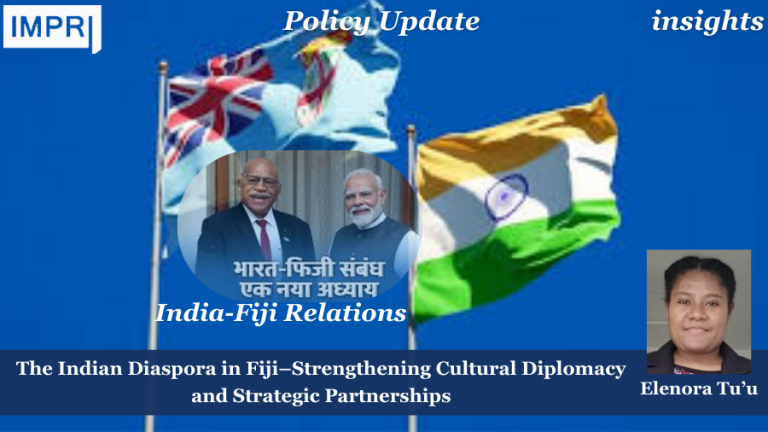
India-Fiji Relations: The Indian Diaspora in Fiji–Strengthening Cultural Diplomacy and Strategic Partnerships

India-Fiji relations are deeply rooted in a shared historical journey, tracing back to the ancestral legacy of indentured laborers who first migrated to Fiji under Bristish colonial rule.
Today, Indo-Fijians comprise nearly 37% of Fiji’s population, though their share has declined due to emigration to Australia, New Zealand, and other Pacific nations such as Papua New Guinea. Despite this, the community continues to preserve its traditions—language, cuisine, religion, and vibrant festivals—while adapting to local realities. This resilience underscores the enduring strength of diaspora communities. This migration not only created a resilient Indo-Fijian community but also laid the foundation for enduring cultural, social and diplomatic ties between both nations and the broader pacific.

Agriculture and Farmers Welfare

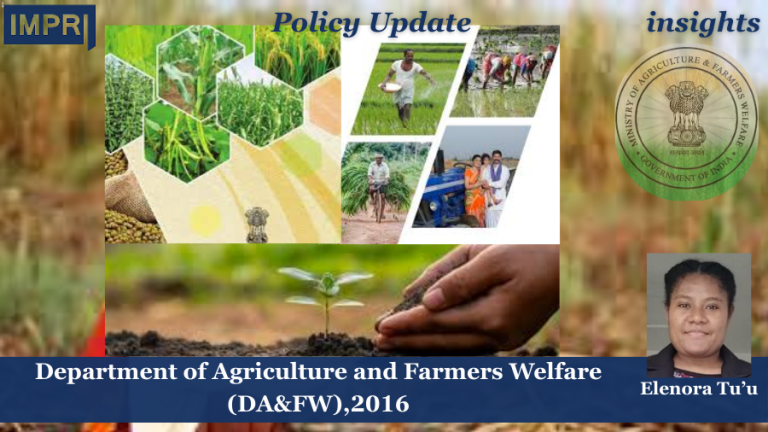
Department of Agriculture and Farmers Welfare (DA&FW),2016

The Department of Agriculture and Farmers Welfare (DA & FW) is one of two constituent departments under the Ministry of Agriculture and Farmers Welfare, the other being the Department of Agriculture, Research and Education (DARE).
DA&FW is primarily responsible for policy formulation, regulation and implementation of programs relating to agriculture and farmer welfare in India. Its functions span foodgrain production, farmer income support, crop insurance, market linkages, and agricultural sustainability.

Key institutional arms include the Commission for Agriculture Costs and Prices (CACP), which recommends Minimum Support Prices (MSPs); the Directorate of Economics and Statistics (DES); with multiple attached support subordinate offices. The Department has been a Centre of India’s Green Revolution, food security policies, and recent farmer-centric digital reforms.

Ministry of Jal Shakti 2019

Ministry of Jal Shakti 2019

The Department of Water Resources, River Development and Ganga Rejuvenation (DoWR, RD & GR) plays a primary role in laying down the policy guidelines and programmes in the field of development, conservation and management of water as a national resource. It also provides an overarching national view on water planning and coordination as regards various uses of water; water laws and legislations, how inter-state and trans-boundary problems regarding water could be localized, bilateral and multi-lateral co-operations, and broad policy guidelines and programmes to determine how the waters of the nation can be judged, developed and controlled.

Empowering Overseas Indian Students: An Analysis of the MEA's Students Registration Portal, 2015

Empowering Overseas Indian Students: An Analysis of the MEA’s Students Registration Portal, 2015

The number of Indian students pursuing higher education programs abroad is estimated to stand at nearly 10.9 lakhs as of July 2019 (Student Registration Portal, MEA). In order to collect data about the number of Indian students abroad and the courses they are pursuing, and to enable a more effective grievance redressal mechanism, the ministry launched in July 2015 a portal (madad.gov.in/appconsular/welcomelink) for voluntary registration of Indian students abroad.

Aatmanirbhar Bharat Rozgar Yojana (2020): An Analysis of Objectives and Impact

Aatmanirbhar Bharat Rozgar Yojana (2020): An Analysis of Objectives and Impact

The Atmanirbhar Bharat Rozghar Yojana is a government program designed to encourage employers to create new jobs, provide social security benefits, and compensate workers who lost their jobs during the COVID-19 pandemic. Launched under the Ministry of Labour and Employment, it came into effect on 1 October 2020 as a part of the Atmanirbhar Bharat package 3.0.

Talk to Us