Category Thematic Areas

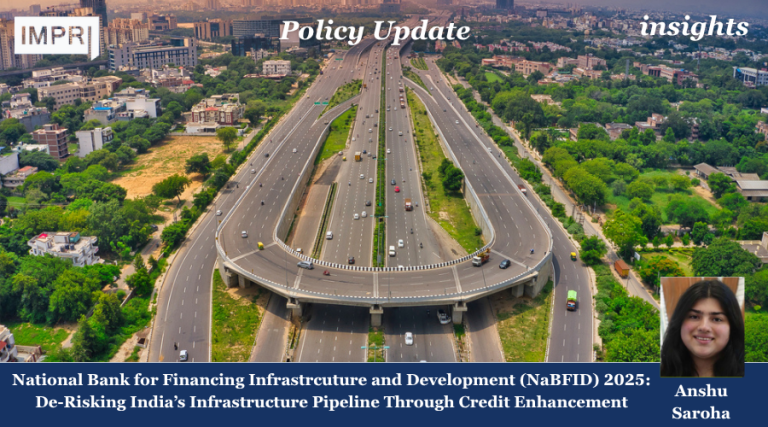
NaBFID 2025: De-Risking India’s Infrastructure Pipeline Through Credit Enhancement

NaBFID 2025: De-Risking India’s Infrastructure Pipeline Through Credit Enhancement

The National Bank for Financing Infrastructure and Development (NaBFID) was introduced in 2021 to promote and fund long-term infrastructure projects in India. It began its operation in December 2022 with the disbursement of its first loan. By March 2024, it had sanctioned ₹86,804 crore for projects in various infrastructure sub-sectors, including roads, renewable energy, water sanitation, among others
Evaluating Healthcare Access for Trans Women and Gender-Fluid AFAB Individuals within India’s Cisgender Policy Framework

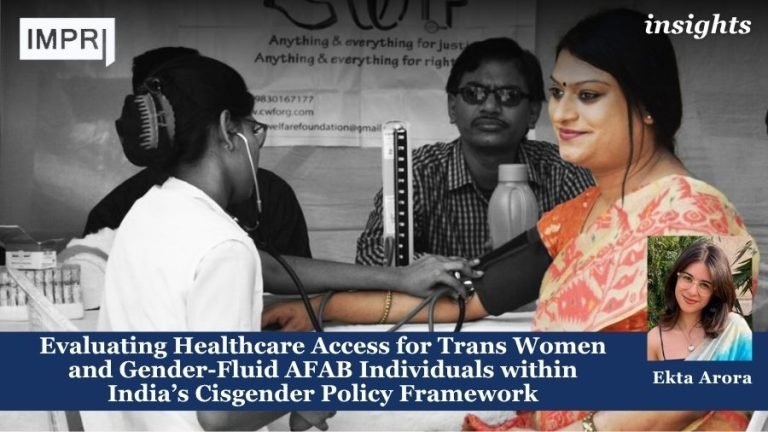
Evaluating Healthcare Access for Trans Women and Gender-Fluid AFAB Individuals within India’s Cisgender Policy Framework

The term “transgender” is used to describe individuals whose innate sense of one’s gender, expression, or behaviour is not in alignment with the sociocultural expectations emerging from the gender assigned to them at birth, legally and medically. [1] The term “AFAB” is an acronym meaning “Assigned Female at Birth"; it describes individuals who were assigned female at birth based on certain characteristics of their bodies at birth.

India’s Aviation Climate Agenda 2025: Status and Strategy

India’s Aviation Climate Agenda 2025: Status and Strategy

The aviation sector in India is surging; it is determined, sometimes unpredictable, and a dawning responsibility. The specter of carbon emissions shadows every triumphant data point on air connectivity, every new airport or new aircraft order.

India’s Eco-Tourism Policy 2024: A Step Towards Sustainable Tourism and Conservation

India’s Eco-Tourism Policy 2024: A Step Towards Sustainable Tourism and Conservation

n a nation celebrated for its sprawling forests, snow-laden peaks, winding rivers, and cultural diversity, the interaction between development and conservation remains complex. Tourism carries potential for both resource stewardship and resource depletion. In 2022-23, it contributed 5% to the national GDP.  India’s Eco-Tourism Policy, drafted in 2018 and implemented in 2024, focuses on promoting sustainable and responsible tourism in ecologically sensitive areas.

Transforming Indian Aviation Through the National Civil Aviation Policy (NCAP), 2016

Transforming Indian Aviation Through the National Civil Aviation Policy (NCAP), 2016

The National Civil Aviation Policy (NCAP) 2016, which the Union Cabinet approved on June 15, 2016, was India’s first-ever integrated aviation policy since Independence. At that time, the aviation sector was not performing to its full potential. It was only the tenth-largest market globally, despite India having several advantages.

Bhaskaracharya National Institute for Space Applications and Geo-Informatics BISAG-N: Powering Tech-Driven Governance

Bhaskaracharya National Institute for Space Applications and Geo-Informatics BISAG-N: Powering Tech-Driven Governance

The Bhaskaracharya National Institute for Space Applications and Geo-Informatics (BISAG-N) is a self-sufficient scientific society functioning under the Ministry of Electronics and Information Technology of the Government of India.

Talk to Us