Category Policy Update

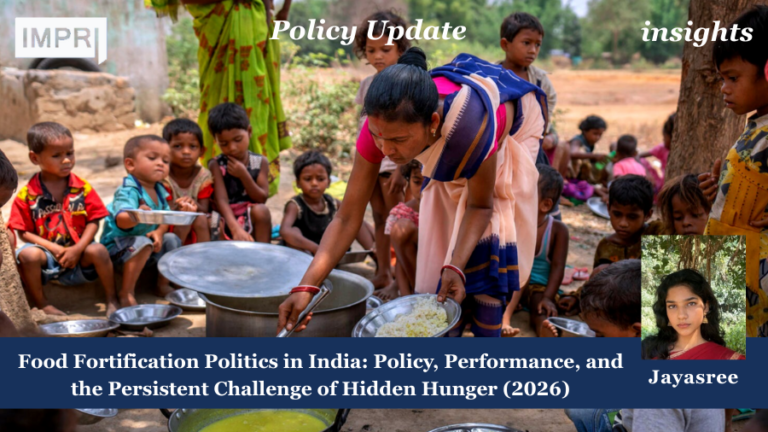
Food Fortification Politics in India: Policy, Performance, and the Persistent Challenge of Hidden Hunger (2026)

Food Fortification Politics in India: Policy, Performance, and the Persistent Challenge of Hidden Hunger (2026)

Food fortification is scientifically defined by the World Health Organisation (WHO) as the practice of deliberately increasing the content of one or more essential micronutrients (i.e. minerals and vitamins, including trace elements) in a food so as to improve the nutritional quality of the food supply and provide a public health benefit with minimal risk to health. From the purview of public policy in the Indian context, it deals with the state intervention or government efforts to combat malnutrition and other deficiencies via structured public policy schemes in the food sector.

India-Israel

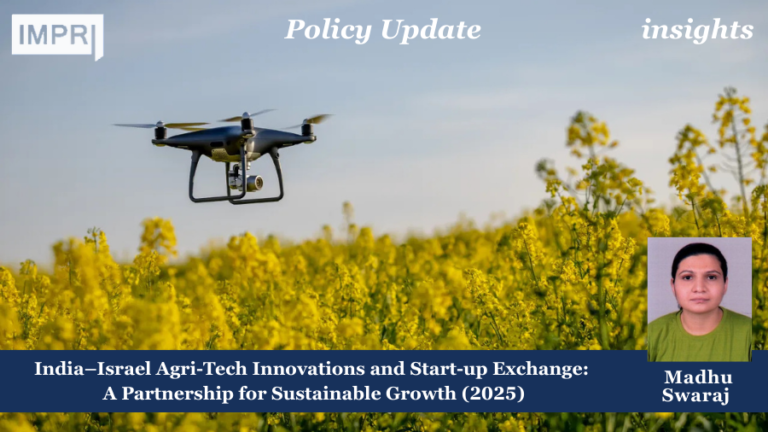
India–Israel Agri-Tech Innovations and Start-up Exchange: A Partnership for Sustainable Growth (2025)

The economic relationship between India and Israel has evolved strategically, moving beyond the traditional defence-centric ties to encompass high-technology sectors like cyber, water management, and most significantly, Agri-Tech. This partnership leverages Israel's cutting-edge agricultural innovation and India's massive scale, diverse market, and vast talent pool, creating a powerful synergy for sustainable and inclusive growth.

PU posting 2.0 2

India-France: Co-Producing Cinema for Global Audiences

While India and France have a deep cultural association, the film alliance between them has only clearly formed over the recent decades. What began as an occasional exchange of films between film societies in the 1950s culminated in a formal relationship when the two governments signed an audiovisual co-production agreement in 1985.

Copy of Insights 1

From Relief to Reform to Resilience: Assessing PM-SVANidhi’s Policy Trajectory

When we speak of successful government initiatives of the past decade, popular missions like the Swachh Bharat Mission (SBM) usually dominates the conversation. Yet, quietly, another programme has been impacting the lives of the millions of India’s urban street vendors, who sustain the everyday economy of Indian cities.

Copy of Insights

Interpreting the Rupee’s Decline: Trade Strategy and Export Incentives

The government's chief economic advisor, V Anantha Nageswaran, says he is not losing sleep over the falling rupee. We wish him long nights of peaceful rest and restoration. While the government and the RBl rest, the rupee will be hard at work, to give some respite to our exporters hit hard by Trumpian tariffs.

India–Brazil: Biofuels and Sustainable Aviation Fuel Cooperation

India–Brazil: Biofuels and Sustainable Aviation Fuel Cooperation

India and Brazil are natural partners in the low-carbon bioenergy transition. Brazil has decades of experience in large-scale biofuel deployment, most famously its sugarcane-based ethanol program and a mature flex-fuel vehicle market, while India has moved aggressively in recent years to scale ethanol blending and to develop policy frameworks for sustainable aviation fuel (SAF). The two countries formalized energy and biofuel cooperation through a series of memoranda and joint statements: New Delhi's Ministry of Petroleum and Natural Gas and its Brazilian counterparts highlighted SAF and biofuel collaboration in a joint statement on 21 September 2024, and broader bioenergy MOUs and bilateral instruments between India and Brazil date back several years and were reiterated during high-level exchanges in 2024–2025.

Tourism

India–Maldives: Sustainable Tourism Cooperation (2025)

The Republic of Maldives, located on the Indian subcontinent, consists of 1,190 coral islands grouped into 26 natural atolls. Following the Maldives' independence in 1965, India was one of the first countries to recognise and establish diplomatic relations with them. India and the Maldives have had long-standing ethnic, linguistic, cultural, religious, and economic links. Physical proximity, cultural links, and development collaboration have all contributed to the two countries' close, friendly, and diverse relationship.

In Small Island Developing States (SIDS) such as the Maldives, where tourism is the principal source of foreign exchange profits and government revenue, the business is growing.

Talk to Us