Category Livelihoods, Employment and Well-being

Co-Creating Care: India’s PCOS Discourse, Policy Neglect, and a Roadmap to Participatory Solutions

Polycystic Ovary Syndrome (PCOS) impacts countless women in India, yet our understanding often remains trapped in clinical jargon. This is more than just a medical condition; it is a socially constructed illness and lived experience deeply intertwined with our deep-rooted societal expectations, structural inequalities shaped by caste, class, and gender, and policy shortcomings. Despite its prevalence, existing research predominantly emphasizes biomedical and clinical dimensions, neglecting subjective narratives and sociocultural contexts.
Lending

Why Easy Lending Won’t Spark an Investment Revival

The RBI’s latest monetary policy and regulatory pronouncements are a strange mixture of caution and recklessness. The policy appreciates that with inflation depressed, not only because of well-behaved food prices but also because of deficient demand that has sent fast-moving consumer goods companies into depression, real interest rates in the economy are high.

Regulate Pre-Construction Deals to Secure Buyer Interests

Regulate Pre-Construction Deals to Secure Buyer Interests

Earlier this month, the Supreme Court ordered the government to set up a committee to evolve measures to help home buyers who find that the properties they have invested in are stuck in stalled construction, even as their builders go into insolvency.

Copy of Insights 4

Breathing Movement and Words: Rethinking Trauma-Informed SEL and CSE for Our Girls

In India’s secondary schools, discussions about mental health, violence, or sexuality are often minimal due to stigma, despite high need. Urban adolescent girls from low-income communities frequently encounter traumatic experiences – a national study by the Ministry of Women and Child Development found that 2 out of 3 children had faced physical abuse and half of all children had suffered sexual or emotional abuse

Copy of Insights 3

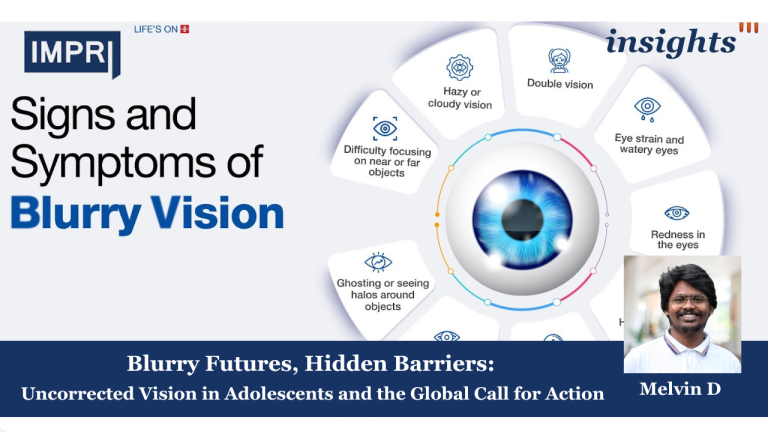
Blurry Futures, Hidden Barriers: Uncorrected Vision in Adolescents and the Global Call for Action 

Millions of adolescents across the globe suffer silently from uncorrected refractive errors (URE) such as myopia, hyperopia, and astigmatism. Despite being easily treated with corrective lenses, these vision problems remain one of the leading, yet under-addressed, public health challenges for young people. The ripple effects extend far beyond blurry sight, impacting education, psychosocial well-being, and future opportunities especially in low- and middle-income countries (LMICs).

Talk to Us