Category Public Policies, Programs and Schemes

Evaluating the National Geospatial Mission 2025: A New Era of Data-Driven Governance

The word geospatial simply means associating data with specific geographic locations. The process of rapid urbanization calls for actions to unlock the transformative potential that geospatial technology withhold. Traditional ways of keeping land records and planning urban development have proven to be inefficient, thereby leading to land disputes and delays in project executions. To address these challenges, the government initiated the National Geospatial Mission to operationalize the National Geospatial Policy (2022), to make land reforms and management more efficient and transparent.
Jal Jeevan Mission 2019 : Transforming Rural Water Access in India

The Jal Jeevan Mission, launched on 15th August, 2019, was to design a provision of functional household tap connections (FHTCs) to every rural household by 2024. This ambitious program addresses a crying need for potable water, which is estimated to cover around 19 crore rural families. Prior to JJM, more than 80% of rural households did not have piped water supply, thus exposing health hazards, economic burdens, and a greater share of responsibilities for women, with children joining in later to carry water for hours every day.

PM-SVANidhi 2020: Empowering Street Vendors for a Stronger Economy

Launched by the Ministry of Housing and Urban Affairs on June 1, 2020, as part of the “Atmanirbhar Bharat Abhiyan” Pradhan Mantri Street Vendor’s Atmanirbhar Nidhi (PM SVANidhi) aimed at empowering and improving the economic conditions of the street vendors that were adversely affected by the COVID-19 pandemic. The need for this scheme arises as India’s street vendor forms an integral part of the urban economy.

Tonnage Tax Schemes for Inland Vessels 2025

Tonnage tax schemes, a unique form of taxation primarily found in the maritime industry, provide shipowners and operators with an alternative to traditional corporate taxation. Instead of taxing profits, these schemes assess taxes based on a fixed rate per net ton of a vessel. This approach, unique to the maritime sector, aims to establish a more predictable and stable taxation structure, thereby promoting investment and competitiveness.

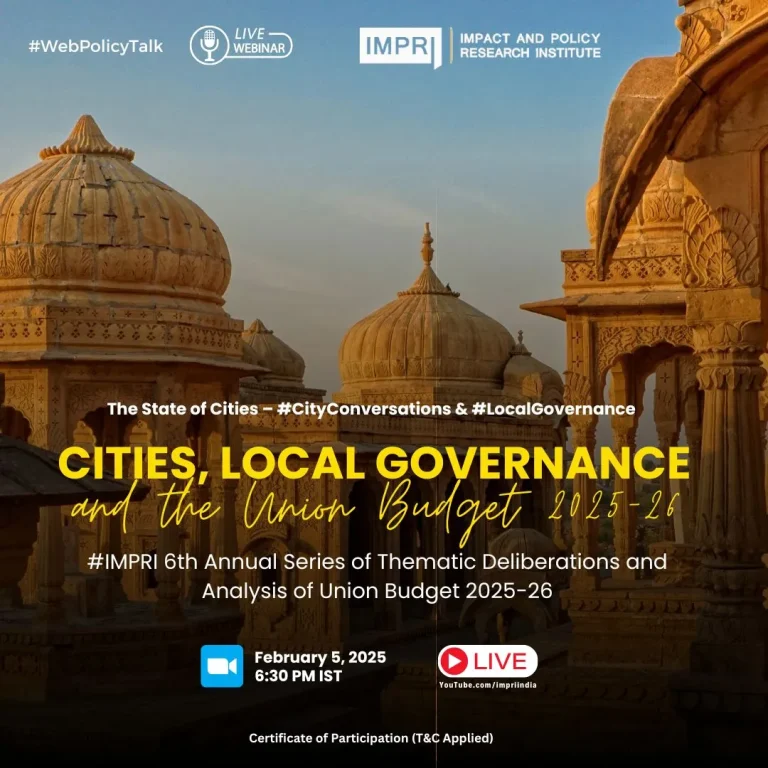
Cities, Local Governance and Union Budget 2025-26

Cities, Local Governance and the Union Budget 2025-26

The panel discussion on  IMPRI’s 6th Annual Series of Thematic Deliberations and Analysis of Budget 2025-2026 on Cities, Local Governance, and the Union Budget 2025-26. Organized by the Center for Habitat, Urban and Regional Studies (CHURS) at the IMPR, Impact and Policy Research Institute, New Delhi.

Enhancing Women’s Property Rights Through Financial Empowerment and Legal Reforms

Economic self-sufficiency is crucial for women’s emancipation because it fundamentally enables autonomy, freedom, and the empowerment necessary to make decisions. It also allows women to live beyond the limits imposed by patriarchal norms.

Equality in the workplace, along with the recognition and enforcement of women’s property rights, are vital instruments for ensuring women’s economic and financial independence.

Talk to Us