Category Center for ICT for Development

8

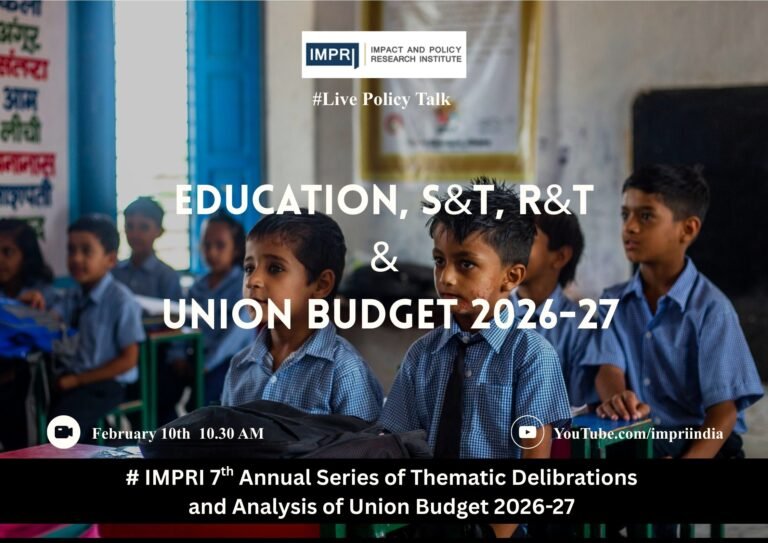
Education, Science & Technology, R&D and the Union Budget 2026–27

The IMPRI Centre for ICT for Development (CICTD), IMPRI Impact and Policy Research Institute, New Delhi, convened an online panel discussion on Education, Science & Technology, Research & Development and the Union Budget 2026–27 as part of IMPRI’s 7th Annual Series of Thematic Deliberations and Analysis of the Union Budget 2026–27, which was held on February 8 at 10:30 a.m IST.

Scaling Up Without Shoring Up: Education, S&T and India’s Budgetary Paradox

The IMPRI  Center for ICT for Development (CICTD), IMPRI Impact and Policy Research Institute, New Delhi, hosted an interactive panel discussion on “Education, S&T, R&D and Union Budget 2026-27” on February 8, 2026 (Sunday) at 10:30 a.m. IST under IMPRI’s 7th Annual Series of Thematic Deliberations and Analysis of Union Budget 2026-2027, as part of IMPRI.

E gram Swaraj

E-Gram Swaraj, 2020

eGramSwaraj is a flagship digital governance policy initiative of the Government of India launched under the e-Panchayat Mission Mode Project (MMP) on 24 April 2020. Developed by the National Informatics Centre (NIC) and spearheaded by the Ministry of Panchayati Raj (MoPR), the policy aims to strengthen Panchayati Raj Institutions (PRIs) by bringing planning, financial accounting, monitoring, audit and reporting onto a single digital platform.

Museums

India–Singapore Tech Museums and Cultural Start-ups

The India–Singapore relationship has transcended traditional bilateralism, entering a sophisticated era of Innovation Diplomacy. Since the 2015 Strategic Partnership, the focus has shifted toward the "Creative Economy." In 2025, the synergy between Singapore’s advanced digital infrastructure and India’s vast cultural repository has positioned tech-enabled museums and cultural start-ups as pivotal instruments of soft power.

Scholarship

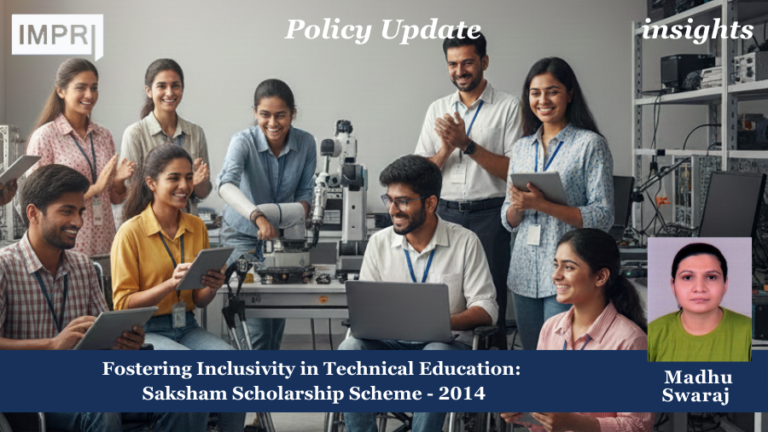
Fostering Inclusivity in Technical Education: Saksham Scholarship Scheme (2014)

The Saksham Scholarship Scheme is a significant initiative by the Government of India, aimed at providing financial support and encouragement to specially-abled students to pursue technical education. The scheme was officially launched in the academic year 2014-15. It was introduced under the then Ministry of Human Resource Development (MHRD), which has since been renamed the Ministry of Education. The All India Council for Technical Education (AICTE), the statutory body for technical education in the country, was tasked with implementing and managing the scheme.

Intel

What Intel’s Chip Agreement Means for India’s Semiconductor Ambitions

T.K. Arun China, facing US chip bans, doubled down on indigenous chipmaking—with success. If India leans on Intel instead of investing in homegrown R&D, it could miss its chance to replicate that model. Intel was one of the technology companies whose…

Talk to Us