Category Public Policies, Programs and Schemes

Beyond Binaries Social Media

Participants List & Details: Beyond Binaries: Understanding Sexual Identities and Queer Rights Issues in India

Beyond Binaries: Understanding Sexual Identities and Queer Rights Issues in India | An Online International Summer School Program | A Five-Day Immersive Online Certificate Training Course | June 2023 | IMPRI # Participants List & Details: Participants List and Details BEYOND BINARIES…

Why is PLI Scheme Suboptimal?

India’s Production Linked Incentive (PLI) scheme, launched in 2020 with high expectations, aimed to provide a subsidy of Rs 1.9 lakh crore over six years. However, as of March 2023, only Rs 3,400 crore in claims have been received and Rs 2,900 crore disbursed. The scheme had, therefore, experienced a significant shortfall.

Video: Inaugural Session LPPYF Law and Public Policy Youth Fellowship

LPPYF Law and Public Policy Youth Fellowship | An Online National Summer School Program | A Two- Month Online Immersive Legal Awareness & Action Research Certificate Training Course and Internship Program | June-August 2023 | IMPRI #WebPolicyLearning Inaugural Session: Chair: Prof Vibhuti…

Rise of Bangladesh Banner 2

Video: Rise of Bangladesh: Implications for India’s North-EastVideo:

Rise of Bangladesh: Implications for India’s North-East | Panel Discussion | #DiplomacyDialogue | IMPRI #WebPolicyTalk #IMPRI Center for International Relations and Strategic Studies (CIRSS), IMPRI Impact and Policy Research Institute, invites you to an IMPRI #WebPolicyTalk event, as a part of…

budget 23 urban development

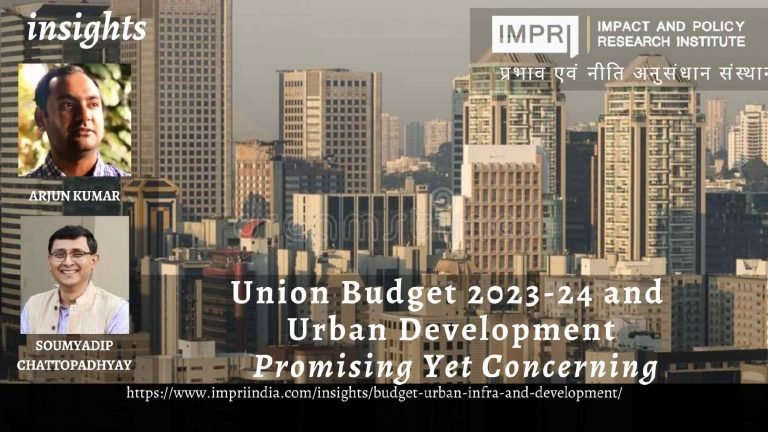
Union Budget 2023-24 and Urban Infrastructure and Development Financing: Promising Yet Concerning

Indian cities with their contribution of around two-thirds of the GDP are expected to play an instrumental role as the country’s ‘engines of economic growth'. The union budget 2023-24 has tried give a push to cities by way of capital expenditure.

Good and Services Tax (GST) Collection: India’s progress towards ‘One Nation, One Sales Tax’

The progress of India’s Goods and Services Tax (GST), based on taxing value-addition, introduced as a dual tax levied by both the centre and the states, in a short period since 2017 when it was introduced, has been commendable. The GST has helped India progress towards the vision of ‘one nation, one sales tax’; and has helped reduce transaction costs of businesses at all levels, while facilitating lower logistics costs toward greater global competitiveness.  To implement GST, a Constitutional amendment was needed as in the then-existing Constitution, there was no provision for levying sales tax on goods by the Union government, and the states could not levy sales tax on services.

Talk to Us