Category Public Policies, Programs and Schemes

Healthcare

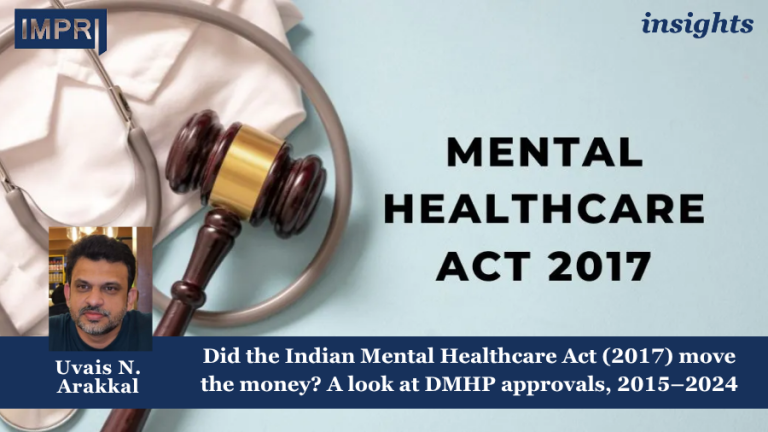
Did the Indian Mental Healthcare Act (2017) move the money? A look at DMHP approvals, 2015–2024

The enactment of India’s Mental Healthcare Act (2017) by the Indian Parliament on April 7, 2017, heralded a transformative, rights-based paradigm shift in the delivery of mental healthcare. The act unequivocally asserts that access to high-quality mental healthcare is an inherent right of individuals living with mental health conditions. Throughout the drafting process and subsequent to its enactment, the act encountered considerable opposition from various stakeholders, notably mental healthcare professionals.

Sustainable

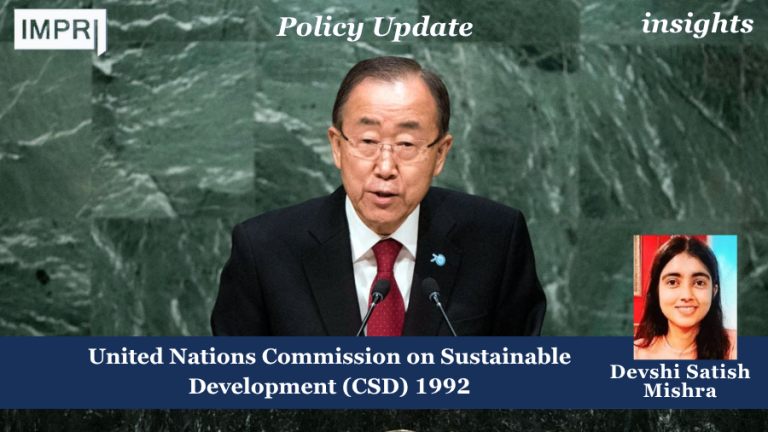
United Nations Commission on Sustainable Development (CSD) 1992

The Commission on Sustainable Development (CSD) was founded in December 1992 to follow up on the progress of Agenda 21 (an action plan for Sustainable Development) and other associated accords, including the Rio Declaration on Environment and Development, as well as the Johannesburg Plan of Implementation (JPOI) at the local, national, regional, and international levels.

Gaza

The Scars Remain: Gaza Beyond the Trump–Netanyahu Ceasefire

Two years and two days after the terrorist attack by Hamas fighters from the Gaza Strip that killed around 1,200 Israelis, and the beginning of Israel’s brutal retaliation, that leading genocide scholars and a UN Commission have labelled genocide, a ceasefire plan appears to be taking hold.

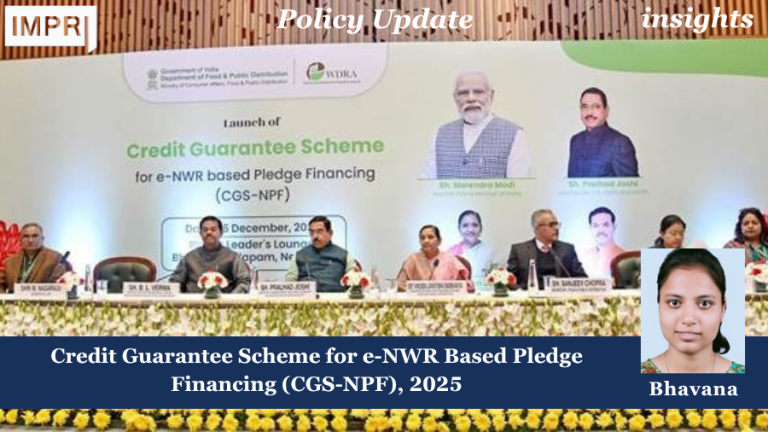
Credit Guarantee Scheme for e-NWR Based Pledge Financing (CGS-NPF), 2025

Credit Guarantee Scheme for e-NWR Based Pledge Financing (CGS-NPF), 2025

India’s agricultural sector is the backbone of the national economy. In FY 2023-24, it contributed 17.7% to the country’s Gross Value Added (GVA) and employed nearly half the nation’s working population.
Despite having such a large contribution to the economy, Indian farmers continue to struggle, particularly after the harvest season. Unpredictable monsoons, changing market prices, and limited access to institutional credit often leave them with little choice but to sell their produce quickly, even at low prices.
In order to overcome these challenges, the Government of India launched the Credit Guarantee Scheme for e-NWR Based Pledge Financing (CGS-NPF) on 16 December 2024. Budgeted at ₹1,000 crore, this Central Sector Scheme is managed by the Department of Food and Public Distribution (DFPD). It is set to operate from FY 2024-25 until the end of the 16th Finance Commission cycle in 2030-31.

Localisation in e-Governance: Enhancing Citizen-Government Connectivity

Localisation in e-Governance: Enhancing Citizen-Government Connectivity

India is a vast and diverse country, characterized by linguistic plurality and cultural richness. It recognizes 22 official languages and 12 different scripts reflecting its multilingual character. About 95% of India’s population uses Indian languages for communication. This makes it essential to provide government services and information in all constitutionally recognized local languages. Yet, many people, particularly in rural and semi-urban areas, face challenges accessing e-Governance services due to the digital divide and language barriers. This is where Localisation becomes vital. Adapting e-Governance services to local languages and cultural context ensures that more citizens can access, understand and benefit from digital government initiatives.

PU insights poster 6

Ishan Uday Special Scholarship Scheme for North East Region (2014): A Policy Analysis 

he Ishan Uday Scholarship Scheme was launched by the University Grants Commission (UGC) in collaboration with the Ministry of Education for the academic year 2014-15. The scheme was launched with an aim to provide equal opportunities for students from the Northeast Region to pursue higher education, consequently increasing the Gross Enrolment Ratio (GER) in the area Before 2014, the Gross Enrolment Ratio (GER) was significantly lower in the Northeastern States than the national average. A cumulation of various factors, including financial barriers, geographical isolation, and agriculture-dominated societies, prevented students from pursuing higher education. The scheme was launched to bridge the gap by encouraging students to pursue studies beyond the secondary level. 

Talk to Us